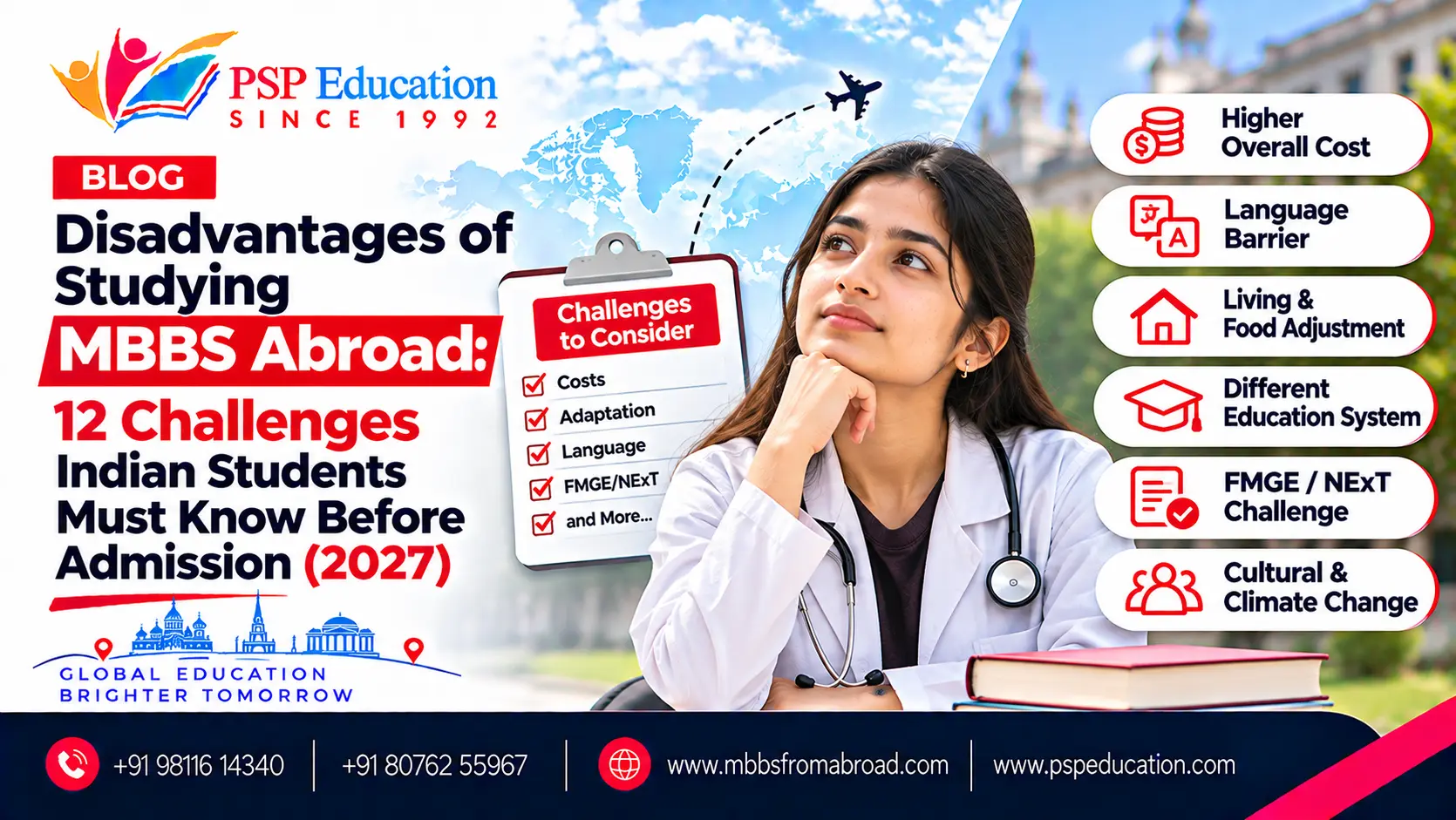
Disadvantages of Studying MBBS Abroad: Students Must Know Before Admission (2027)
Last updated: 14 November 2026 · Regulations, embassy pages and PSP articles checked on: 14 November 2026
A student clears NEET and gets two or three offer letters from foreign universities. The family has compared tuition fees, looked at hostel photographs and chosen a country. What often stays unexamined is everything that happens after the fee receipt: the ward where lectures stop and patient conversations begin, the first January away from home, the exchange rate on the third instalment, and the Indian licensing process at the end.
Short answer: The main disadvantages of studying MBBS abroad are language gaps in clinical training, uneven clinical exposure, distance from family, climate and food adjustment, unfamiliar daily systems, currency and travel costs, a different academic system, Indian licensing rules, university-level recognition risks, and the extra planning needed for FMGE and postgraduate study. Not every challenge applies to every country or university. Most can be managed if you check the exact university and programme before paying.
This guide is not an argument against MBBS abroad. It is a checklist of what can go wrong, where it is more likely, and what to ask before you commit.
Is Studying MBBS Abroad Really Worth It for Indian Students?
It can be worth it, but not for everyone. The answer depends on six things:
- the student's academic preparation and self-discipline
- the exact university, not just the country
- the family's total budget, including costs beyond tuition
- willingness to learn a local language for hospital work
- the quality and language of clinical training
- a clear plan for the Indian licensing exam and internship
A student who is independent, financially prepared and ready to prepare for FMGE from the first year may find these challenges manageable. A student who chose a university only because the fee looked low is more exposed. PSP Education is an admissions consultancy with a commercial interest in this subject, so every regulatory claim below links to its source. Please verify us too.
12 Disadvantages of Studying MBBS Abroad
1. Language Barrier in Hospitals, Even When Classes Are in English
"English-medium" usually describes lectures, textbooks and written exams. Patients in the wards speak the local language, and so do many nurses and senior doctors. The National Medical Commission (NMC) requires English as the medium of instruction under its FAQs on the FMGL Regulations, 2021. The FAQ we reviewed does not explain how patient conversation in a local language is treated.
The Embassy of India in Astana says Kazakh medical universities run English-medium departments for foreign students, but students should be prepared to learn Kazakh or Russian, which is needed during the internship. The Embassy of Georgia in India says Georgian MD programmes include a Georgian-language course for international students.
Check before admission: the language used in each year, in hospital rotations and with patients, in writing. Reduce the risk: start basic language classes in the first year, not the fourth. See our guides on English-medium MBBS and clinical training and whether Russian is mandatory for MBBS in Russia.
2. Uneven Clinical Exposure and Hands-On Training
Some universities give students supervised patient contact early and in small groups. Others have larger batches, shared hospital access or more observation than practice. We cannot say foreign universities provide poor clinical training; the evidence says it varies.
What we can point to: the NMC FAQ treats clinical training as part of the 54-month course, separate from the 12-month internship, and allows online classes for theory only. A press report on the NMC's April 2026 alert on Uzbekistan says the Embassy of India in Tashkent raised concerns about hands-on training where the medium of instruction was not English at certain institutions, and about admissions beyond intake capacity (Medical Dialogues). The Embassy called the alert precautionary, not a ban.
Check before admission: affiliated hospitals, departments, students per ward group, who supervises, and where the internship happens. Reduce the risk: ask current Indian students in the batch you would join, not only the admission office.
3. Distance From Family and Emotional Adjustment
Most first-year students are 17 or 18. Many have never managed laundry, a budget, a fever and an exam week together. Homesickness is common and usually fades, but it is harder when classmates are few, the city is small or a time-zone gap makes calls awkward.
This is a personal variable, not a fixed outcome. Some students settle within weeks. Others struggle through the first winter.
Check before admission: how many Indian students are in the batch, whether the hostel has a warden or student coordinator, and whether the university has counselling support. Reduce the risk: plan a weekly call routine, agree on an emergency contact in the city, and read what the first 30 days abroad usually look like.
4. Climate and Seasonal Adjustment
Cold is the best-known problem and it is real in some cities, not all. Climate data puts Astana's average January temperature near −14°C (Climates to Travel), while Almaty is milder, around −6°C in January (Climate-Data.org). Russian cities also differ sharply from one another. We did not find reliable comparable figures for every city covered here, so we do not rank countries by climate.
Short winter days, indoor heating and sudden temperature drops affect sleep, mood and attendance. Heated hostels reduce the problem indoors, not on the walk to the hospital.
Check before admission: the city, not just the country. Read our city-wise guide for MBBS in Russia. Reduce the risk: buy winter clothing after arrival where possible, and ask seniors which hostel buildings are warmest.
5. Food and Dietary Adjustment
Indian food is easier to find in some cities than others, and hostel kitchens vary. We found no reliable official country-level data on this, so treat any blanket promise of "Indian mess available" with caution. Ask what is served, how often, whether vegetarian meals are separate, and whether you can cook in the hostel.
Food also affects the budget. Cooking at home is usually cheaper than eating out, but it takes time during exam weeks.
Check before admission: mess arrangements, cooking facilities, and the nearest grocery stores. Reduce the risk: learn five simple dishes before leaving. For costs, use our hostel and living cost guide and the comparison of hostel and private accommodation in Russia.
6. Unfamiliar Healthcare, Banking and Daily Systems
Falling ill in a new country means finding a clinic, explaining symptoms in a second language and understanding what insurance covers. The same applies to opening a bank account, buying a local SIM, registering your address and renewing documents.
The Embassy of India in Astana issued an advisory on medical insurance for Indian students dated 25 August 2026. That is one example of how country-specific the rules are.
Check before admission: what the university arranges (insurance, registration, airport pickup) and what the student must do alone. Reduce the risk: read our guide to medical insurance for Indian MBBS students abroad before departure.
7. Currency Fluctuations and Financial Uncertainty
Tuition is often quoted in dollars, roubles or another foreign currency. If the rupee weakens during your course, later instalments cost more in rupees. Add bank transfer charges, forex margins and the possibility that a payment channel stops working or changes.
We are not giving cost figures here because fees are university-specific and change by year. Ask for a year-wise fee schedule in writing, whether tuition can be revised, and which currency each payment is in.
Check before admission: refund terms and the university's bank account name. Reduce the risk: keep a contingency fund. Detailed breakdowns are in our total cost guide and the Russia hidden costs article.
8. Distance and Travel Challenges
Flights home are longer and costlier than a train from your hometown. Connections, visa-validity rules at the time of travel and short holidays add friction. In a family emergency, a student may need to travel at short notice, and the best fares will not be available.
Course dates matter too. A student who leaves mid-session for a family reason may face attendance and re-entry issues, so read what happens if you take a gap year during MBBS abroad.
Check before admission: academic calendar, holiday dates and the university's leave policy. Reduce the risk: budget at least one return trip a year and keep documents and visa status current.
9. A Different Academic System and Assessment Style
Foreign universities may use frequent oral exams, continuous assessment, strict attendance rules and credit systems that Indian students find unfamiliar. A student who coasts in Class 12 and plans to "catch up before exams" often meets a system that checks progress every few weeks.
This is not a sign of poor quality. It is a different method. Failing a subject can mean a re-sit or a repeat year, which adds cost. Our guide explains what happens if an MBBS abroad student fails a university exam.
Check before admission: attendance rules, re-sit policy and the fee for repeating a year. Reduce the risk: study consistently from week one and ask seniors how internal assessments really work.
10. Indian Licensing Rules and Regulatory Compliance
This is the challenge with the largest consequences. A foreign MBBS does not automatically let you practise in India. For students admitted on or after 18 November 2021, the NMC's FMGL Regulations apply. Based on the NMC FAQ, the main conditions are:
- a course of at least 54 months
- a 12-month internship in the same foreign institution
- English as the medium of instruction
- a licence to practise in the country that awards the degree, on par with that country's own graduates
- passing the Indian screening exam, currently FMGE
- a further supervised internship in India
The FAQ is an explanatory note; the gazette notification governs. Check the NMC's page for students studying abroad for current notices.
Two live questions show why this needs checking, not assuming:
- Kazakhstan: the Embassy of India in Astana advised on 1 October 2026 that the standard medical course is seven years from 2026-27, and that the licence position of a six-year accelerated route is unconfirmed. We have not opened the original advisory; it is reported by Study Country and in PSP's myths-versus-facts guide. Please read the Embassy's own page.
- Georgia: the NMC told a grievance petitioner that "junior doctor" status satisfies Regulation 4(b) only if it legally permits practice at the required level (PTI via Careers360, 8 October 2026). Press reports since then describe conflicting NMC responses, and Georgian officials have given their own explanation. Treat it as unsettled and ask the NMC and the university in writing.
FMGE is hard. The June 2026 session overall pass rate was reported as 12.38% by Deccan Herald; check the official result on the NBEMS FMGE page. NExT has no confirmed start date. See FMGE vs NExT and the FMGE pass percentage guide.
11. Recognition, Accreditation and University-Specific Risks
Three things get mixed up: a directory listing, recognition in the host country, and eligibility for registration in India. The World Directory of Medical Schools says on its About page that a listing does not denote recognition or accreditation. A university can be legal in its own country and still not meet NMC conditions for your batch, campus or programme.
Branches matter. In July 2025 the NMC warned students about the Chirchik branch of Tashkent State Medical University, as reported by Careers360. The main university and its branch are separate questions.
Check before admission: exact legal name, campus, programme and intake year on the offer letter. Reduce the risk: use our university verification checklist and red-flags guide. If the worst happens, read what happens if a university closes or loses recognition.
12. Career and Postgraduate Planning
After the degree comes FMGE preparation, document collection, the foreign internship, the Indian internship and then, for many, NEET-PG. Each step has its own timeline. Students who treat FMGE as a final-year task often lose a year.
We do not claim that foreign graduates have worse career prospects. Many build successful careers. The point is that the path has more steps than a degree from India, and planning must begin before admission, not after graduation.
Check before admission: what the university offers for FMGE support, and what its past graduates did next. Reduce the risk: read FMGE preparation from first year, PG in India after MBBS abroad and career paths after MBBS abroad.
Are These Disadvantages the Same in Russia, Kazakhstan, Uzbekistan and Georgia?
No. Some challenges, such as distance and FMGE, apply everywhere. Others depend on country, city and university. The table lists only what we could support from official or press sources. Where we found nothing reliable, we say so.
| Challenge | Russia | Kazakhstan | Uzbekistan | Georgia |
|---|---|---|---|---|
| Clinical language environment | No country-wide official statement found; varies by university | English-medium departments for foreign students; Kazakh or Russian expected, at least for the internship (Embassy of India, Astana) | Embassy concerns reported at certain institutions where the medium was not English (press report) | Georgian-language course included for international students (Embassy of Georgia) |
| Climate adjustment | Varies widely by city; not quantified here | Astana among the coldest capitals; Almaty milder (climate data sources above) | Not verified in this research; check by city | Not verified in this research; check by city |
| Food and lifestyle adjustment | Varies by university and hostel; no reliable country-level data | Embassy has noted hostel shortages at some universities (2023 note); confirm current position | Varies by university and city | Varies by university and city |
| Student administrative requirements | Invitation-led student visa | C-9 student visa | Visa support via the Ministry of Foreign Affairs | D3 visa |
| Medical licensing considerations | Standard FMGL conditions; no NMC advisory naming a Russian university found by PSP, but verify | Seven-year standard course from 2026-27; accelerated route's licence status unconfirmed | NMC alert (1 April 2026) on named institutions and July 2025 advisory on a branch, as reported by the press | Regulation 4(b) question unsettled as of early November 2026 |
Visa details are from PSP's 2027 admission guide, which is not an official source; confirm with the university and embassy. For a direct comparison, see Russia vs Kazakhstan for MBBS.
How Can Indian Students Reduce the Challenges of Studying MBBS Abroad?
Use this checklist before paying any fee:
- [ ] University: confirm the exact legal name, campus and programme. Do not rely on a directory listing alone.
- [ ] NMC compliance: get written confirmation of how the programme meets the FMGL conditions, and read the NMC notices yourself.
- [ ] Clinical training: ask for hospital names, group sizes and the language used with patients.
- [ ] Language: plan local-language classes from year one.
- [ ] Money: get an itemised fee schedule, currency, refund terms and a contingency budget.
- [ ] Accommodation: confirm hostel availability and mess arrangements.
- [ ] Insurance: arrange cover before departure.
- [ ] Visa and registration: check the current rules with the university and the Indian embassy.
- [ ] Licensing path: map FMGE, the internship and PG plans before admission.
Our 15-point university selection framework and safety guide for Indian girls go deeper on selection and safety.
Should You Still Choose MBBS Abroad Despite These Disadvantages?
Only if the student and the university both pass the test. A student who is self-disciplined, comfortable with change, willing to learn a language and ready to start FMGE preparation early is more likely to adapt. A student who depends heavily on family support, struggles with self-study or is choosing purely on fees may find the same challenges overwhelming.
Parents should assess two things together: the university (compliance, hospitals, support) and the student (readiness, health, finances). Neither a low fee nor an agent's promise is enough. If your family has a realistic option in India, compare it honestly; our MBBS in Russia vs India guide and the NEET counselling vs MBBS abroad article can help.
Frequently Asked Questions
1. What are the biggest disadvantages of studying MBBS abroad?
Licensing compliance in India, the language gap in hospitals, uneven clinical exposure and the extra FMGE step are the biggest. Climate, food and homesickness matter, but they are usually more manageable.
2. Is studying MBBS abroad difficult for Indian students?
It can be, mainly because of independent living, a different assessment style and the need to prepare for an Indian exam while studying abroad. Difficulty varies by university and student.
3. Is clinical training a challenge in foreign medical universities?
It can be. Hospital access, group size and language differ by university. Ask for details in writing and speak to current students.
4. Do Indian students face language problems during MBBS abroad?
Often in the clinical years, even when lectures are in English. Embassy guidance for Kazakhstan and Georgia points to local-language needs.
5. Is MBBS abroad more expensive than expected?
It can be if you count only tuition. Hostel, food, insurance, visa, flights and exchange-rate movement add up. See the total cost guide.
6. Does studying MBBS abroad make it difficult to practise in India?
Not automatically, but you must meet the FMGL conditions, pass the Indian screening exam and complete an internship. Programmes that do not meet the conditions can leave a graduate ineligible.
7. Are the disadvantages of MBBS in Russia and Kazakhstan different?
Partly. Climate, language and licensing questions differ by city and university, and Kazakhstan has a recent Embassy advisory on course duration.
8. What should parents check before sending their child abroad?
The exact university and campus, NMC compliance, clinical hospitals, language, itemised costs, refund terms, insurance and the student's readiness.
9. Can students overcome the disadvantages of studying MBBS abroad?
Many can with early planning: language classes, a contingency budget, steady study habits and FMGE preparation from the first year.
10. Is MBBS abroad suitable for every NEET-qualified student?
No. It suits students who are prepared for independent living, can fund the full course and are willing to plan for Indian licensing.
Conclusion
The twelve challenges fall into four groups: language and clinical training, adjustment to life abroad, money and travel, and the regulatory path back to India. None of them is a reason to rule out MBBS abroad on its own. All of them are reasons to look closely at the exact university, programme, hospitals, finances and licensing route before you pay.
If you want help putting these questions to a university or reading its answers, you can speak to a PSP Education counsellor. PSP Education cannot guarantee admission, visa approval, degree recognition, Indian registration or exam results, and you should be cautious of anyone who does.
Key sources
- National Medical Commission: FAQs on the FMGL Regulations, 2021 and information for students studying abroad
- NBEMS: FMGE page
- Embassy of India, Astana: Education in Kazakhstan and medical insurance advisory, 25 August 2026
- Embassy of Georgia in India: Issues related to medical education in Georgia
- World Directory of Medical Schools: About
- Ministry of External Affairs: Indian students abroad
- Press reports (primary notices not opened): Careers360/PTI on Georgia, Medical Dialogues on Uzbekistan, Careers360 on the July 2025 advisory, Deccan Herald on FMGE June 2026
- Climate: Climates to Travel, Astana and Climate-Data.org, Kazakhstan in January