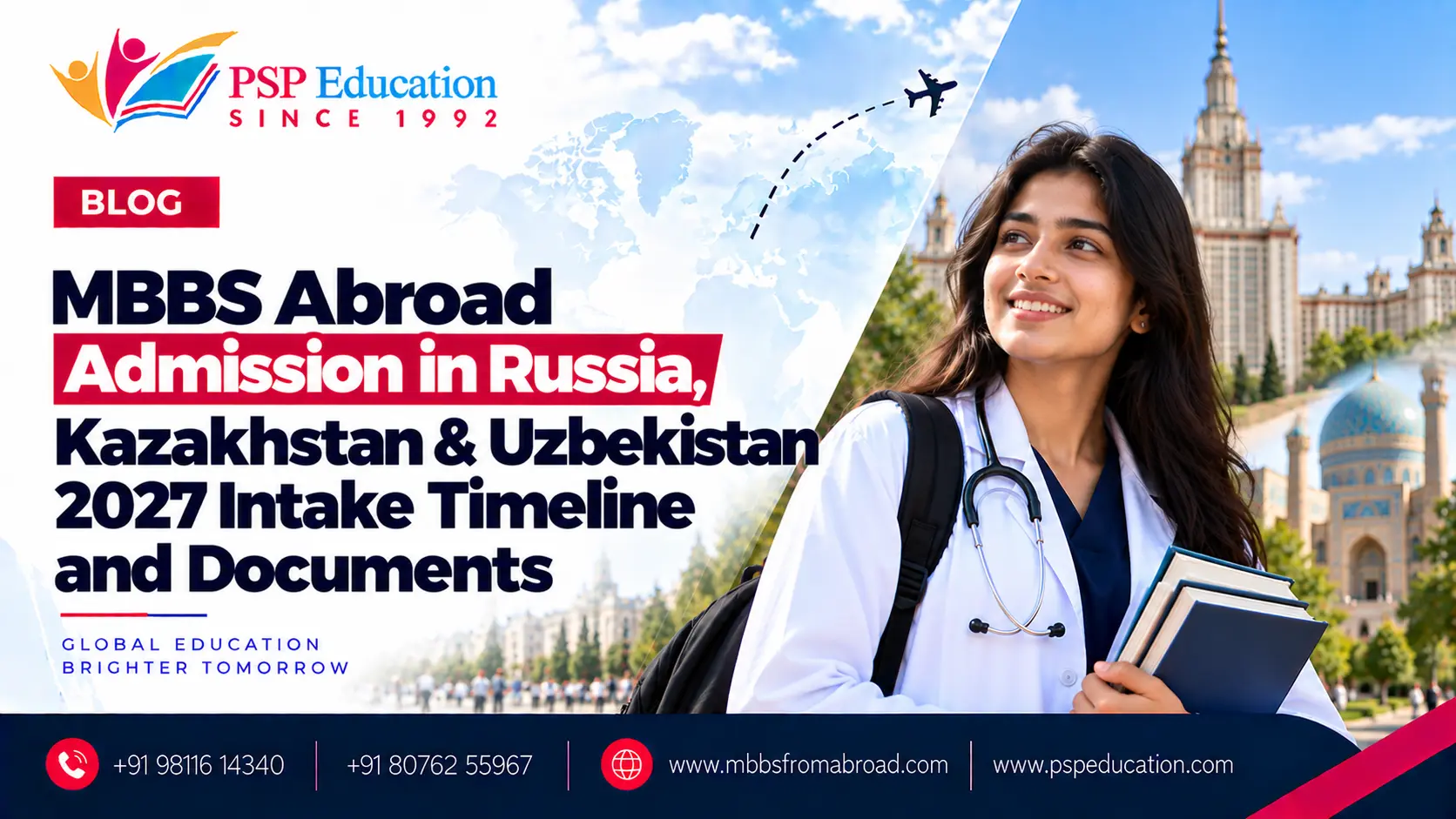
If you're planning MBBS admission in 2027 in Russia, Kazakhstan, Uzbekistan or Georgia, start with the uncomfortable fact: no official 2027 calendar exists yet. NTA hasn't announced the NEET UG 2027 date, and none of the university or embassy pages we reviewed publish 2027 application windows. What you can do today is collect the documents every country will ask for, understand where the four countries differ, and refuse to pay anyone on the strength of an "expected" date.
This guide gives you a staged planning timeline, a separate document section for each country, a comparison table, and a checklist for verifying offer letters and fee requests. Where we couldn't confirm something from an official source, we say so.
Quick answer: Use 2027 as a planning year, not a fixed calendar. Early preparation (passport, academic records, name and date-of-birth consistency) can start now. University applications for the September 2027 intake usually follow NEET results. Visa steps start only after a university issues an admission or enrolment order. Every date, fee and document list must be confirmed in writing with the specific university.
Planning MBBS Abroad Admission for 2027
What is confirmed and what isn't (as of 21 October 2026)
| Item | Status | What to do |
|---|---|---|
| NEET UG 2027 exam date | Not officially announced. Third-party sites quote early May 2027, but that's pattern-guessing. Live trackers from Careers360 still showed no NTA date when we checked. | Watch the official NTA NEET portal. |
| University application windows for 2027 | Not found published for the four countries. | Ask each university for its 2027 admission schedule in writing. |
| General admission season in Kazakhstan | The Embassy of India in Kazakhstan describes admissions as running roughly April to August, with the academic year starting in September. | Treat as a general pattern, not a deadline. |
| NMC rules for foreign medical qualifications | The FMGL Regulations, 2021 remain the governing framework for students admitted after 18 November 2021. | Re-check NMC notices before paying any fee. |
| Fresh 2026 regulatory signals | NMC issued an alert note on Uzbekistan dated 1 April 2026 and clarified a licensing point for Georgia on 7 October 2026 (both explained below). | Read the country sections before shortlisting. |
The 2026 cycle is a good reminder to stay flexible. NEET UG 2026 results were declared on 16 July 2026, later than a typical June result, and the Indian counselling rounds ran into October. A planning calendar that assumes everything lands on time is a fragile one.
Four different questions, four different decision-makers
Families often treat "eligible", "admitted" and "recognised in India" as one thing. They aren't.
| Question | What it means | Who decides |
|---|---|---|
| Can I apply? | Class 12 with Physics, Chemistry, Biology and the university's marks and age rules | The university |
| Do I meet NEET requirements? | NEET qualification needed if you want your foreign degree to count toward Indian registration | NMC (not the foreign university) |
| Will the university admit me? | An offer or admission letter for a named course, campus and intake | The university |
| Will my qualification be considered for Indian registration? | 54 months of study, a 12-month internship, one institution throughout, English medium, plus FMGE afterwards | NMC rules; see the NMC FMGL FAQs and this summary of the internship and English-medium conditions |
A university can say "no NEET needed" and still leave you unable to register in India. If you haven't yet checked your own starting position, read PSP's guide to MBBS abroad eligibility and the explainer on whether NEET is compulsory for MBBS abroad. The FMGL rules also differ by admission cohort: students admitted before 18 November 2021 fall under earlier regulations.
MBBS Admission Timeline for 2027: From Preparation to Departure
Direct answer: For a September 2027 start, plan in six stages: early preparation, application preparation, university application, offer and fee verification, visa and pre-departure, then final checks. The windows below are a planning framework, not an official calendar. Russia, Kazakhstan and Uzbekistan mostly run a September intake. Georgia's main intake is September or October, with a smaller February or March intake at some universities, according to PSP's Georgia guide.
| Stage | Indicative window | What to do | Confirm with |
|---|---|---|---|
| 1. Early preparation | Now to about January 2027 | Check eligibility and NEET status; shortlist universities; estimate the full six-year budget; check passport validity and name consistency | NMC, university |
| 2. Application preparation | About January to May 2027 | Collect Class 10 and 12 records, photographs, birth certificate; ask each shortlisted university which documents need apostille and translation, and where the translation must be done | University admissions office |
| 3. University application | After NEET UG 2027 results (date unannounced) through the summer | Apply through the university's real process; confirm receipt; answer document queries quickly | University |
| 4. Offer and fee verification | As soon as an offer arrives | Check course, campus, intake; get an itemised fee schedule; read refund terms; verify payment instructions | University directly |
| 5. Visa and pre-departure | After the enrolment order or invitation process begins | Follow the destination's visa route (differs sharply, see country sections); arrange insurance and accommodation | Embassy or consulate, university |
| 6. Final checks | Weeks before departure | Confirm reporting dates in writing; carry originals and copies; don't buy non-refundable tickets on an unverified date | University |
Some past-year examples show why a single national "deadline" doesn't exist. Kuban State Medical University's memo for foreign applicants gave a 2024 document window of 20 June to 19 July. Ivanovo State Medical University's admission page listed a contract-conclusion cut-off of 22 August in 2025. Those are two universities, two years, two different dates, and neither is a 2027 date.
Invitation lead times vary just as much. Russian universities report invitation processing of roughly three weeks (MIPT) to 30-40 days (Altai State University) and about 45 days (Orel State University). In Kazakhstan, Al-Farabi Kazakh National University says the invitation takes at least 10 working days after the enrolment order. Stage 5 is where late starters lose weeks.
Timelines can also change after you apply. A university may reopen or close a window, ask for extra documents, or change its fee schedule. Keep every message in writing, and re-check dates before you book anything.
Common Documents Indian Students May Need
Almost every university will want some version of the same core set. What changes is the authentication, translation and medical layer on top.
| Category | Typical items | Notes |
|---|---|---|
| Identity | Valid passport, photographs, birth certificate | Spelling and date of birth must match across every record |
| Academic | Class 10 and 12 marksheets and certificates, NEET scorecard | NEET is mainly an NMC requirement; universities may or may not ask for it |
| Application | Application form, university-specific forms, contract | University-specific |
| Medical | Fitness certificate, sometimes HIV report, sometimes local medical exam after arrival | Differs sharply by country and university |
| Visa and travel | Admission or invitation documents, visa form, insurance | Differs by country; don't reuse another country's checklist |
| Authentication | Apostille, notarised translation, sometimes recognition ("nostrification") | University and embassy specify the exact format |
For a general 20-item preparation list, PSP's MBBS abroad document checklist covers the basics. This article focuses on what's different across the four destinations.
On apostille. All four countries appear in the Hague Conference's Apostille Convention status table: Russia (in force 1992), Kazakhstan (2001), Georgia (2007) and Uzbekistan (2012). For Indian documents, the apostille is issued through the Ministry of External Affairs. Uzbekistan's accession is marked differently in the HCCH table, so ask the Uzbek university in writing whether it accepts your Indian apostilled documents before you pay for services. And an apostille doesn't replace a translation: that's a separate step with its own rules.
Don't pay a document agency until the university tells you exactly which documents need which treatment. Over-authenticating costs money. Under-authenticating costs weeks.
Documents Required for MBBS Admission in Russia
Russia is the most documented of the four, and the most university-specific.
Admission and academic documents. Universities we reviewed ask for the passport, the education certificate and a notarised Russian translation of each. Yaroslavl State Medical University says documents should be legalised or apostilled and translations must be notarised. North-Western State Medical University lists an application, passport, education document (with transcript and supplement) and a medical certificate on form 086/y, all with notarised translations where relevant. After documents are reviewed, the university prepares a contract; tuition is paid in roubles. Ivanovo State Medical University says educational documents must be confirmed by consular legalisation or apostille before you arrive in Russia.
Medical. Yaroslavl's page lists a health-status certificate and HIV test results among its mandatory documents. NWSMU lists form 086/y. Whether your university asks for the HIV report at admission, at the visa stage, or both, must be confirmed. Insurance is another item to check: HSE University states that medical insurance is required for its incoming students for the whole stay, and other universities set their own rules.
Visa. Studying in Russia requires a student visa, and that visa needs an official invitation from the university. Gnesin Academy's guide explains that the invitation is processed by the Russian Ministry of Internal Affairs and that a tourist visa can't be used for study. Sechenov University's migration guide lists a passport valid for at least 1.5 years after your planned entry date, the invitation, a visa form completed at visa.kdmid.ru, two 3.5 × 4.5 cm photographs, and a single-entry student visa valid for 90 days. MIPT quotes 18 months of passport validity, so the number isn't identical everywhere. The consular document list for your city sits on the Russian consular portal.
What's different from the other three: a mandatory government-issued electronic invitation, notarised Russian translations, and a medical form (086/y) that other countries don't use. For the step-by-step Russian process, see PSP's MBBS in Russia admission process and the MBBS in Russia country page.
Documents Required for MBBS Admission in Kazakhstan
Admission and academic documents. The pattern in Kazakhstan is apostille in India, translation into Russian or Kazakh, then often recognition of foreign education documents inside Kazakhstan. Al-Farabi Kazakh National University's foreign-student memo asks for the diploma or certificate with an apostille, plus two copies of notarised Russian or Kazakh translations of the diploma, transcript and passport. Another Al-Farabi page says translations must be done and notarised in Kazakhstan. Asfendiyarov Kazakh National Medical University's admission memo asks for notarised copies of the education document with a certified translation into Kazakh or Russian. (That memo is older, so confirm the current version.) The EAGI admission page states that translation, notarisation and recognition of foreign education documents are carried out in Kazakhstan after the applicant arrives. Ask each university where the translation must be done before you pay for it in India.
Medical. Several universities handle the medical examination after arrival. EAGI says medical documents must come from Kazakh institutions, and Al-Farabi's international students page says students undergo a medical examination under Kazakh migration rules. Asfendiyarov's preparatory department page lists form 086 and an HIV test for that programme. Don't assume a pre-departure HIV report is required (or not required) for your course.
Visa. Students (other than CIS citizens) need a C-9 student visa, per Al-Farabi's memo. The university obtains an invitation through Kazakhstan's migration authorities after the enrolment order. The Embassy of Kazakhstan in India has a C-9 page, though its last update date was 2020, so treat it as a starting point and confirm the current list with the embassy. After arrival, Al-Farabi's language department page tells students to notify the passport office within two days of entry.
Other official points. The Indian Embassy's student advisory tells students to confirm the institution and course are officially recognised, hold valid health insurance for the whole study period, and know that foreign students on student visas in Kazakhstan are, as of early 2026, prohibited from working, even part-time.
What's different from the others: translation and recognition often happen in Kazakhstan, the medical exam often happens on arrival, and the visa category is C-9. See PSP's MBBS in Kazakhstan page and the comparison in Russia vs Kazakhstan for MBBS.
Documents Required for MBBS Admission in Uzbekistan
This is the section with the thinnest official evidence, and the one that most needs careful, university-level confirmation.
What changed in 2026. NMC issued an alert note dated 1 April 2026 about admissions of Indian nationals in Uzbekistan. Medical Dialogues reported that it named Bukhara State Medical Institute, Samarkand State Medical University, Tashkent State Medical University and an offshore campus of its Termez branch in Bangalore. The Embassy of India in Tashkent described the alert as precautionary and not an admission ban. The practical meaning for you: verify the university's FMGL compliance in writing before paying. The Embassy's information page for students lists its current advisories, including an advisory on the Uzbek course structure (December 2022) saying Indian students were being enrolled in a six-year programme because a five-year MBBS programme wasn't part of Uzbekistan's classification. Ask the university how its programme meets the 54-month study plus 12-month internship conditions.
Admission and academic documents. We could not access full admission pages for Uzbek medical universities, so we reviewed other Uzbek university international-admission pages to see the general pattern. Andijan State University asks for the original education document with an approved Russian translation, and issues the enrolment order after a contract and payment of 50% of a year's fee. The University of Digital Economics and Agrotechnologies asks for notarised English or Russian translations. These are non-medical examples, so don't treat them as the medical-university rule. For medical courses, get the list from the university itself.
Visa. Entry requires a visa supported by the Uzbek Ministry of Foreign Affairs, arranged through the inviting university (Turin Polytechnic's explainer describes the process). The Embassy of Uzbekistan in New Delhi maintains its official site for current visa categories. A short-stay entry arrangement for tourists doesn't change the rule that a long study stay needs a proper student visa route, so confirm the category with the embassy. After arrival, universities quoted a short registration window, 72 hours at Turin and three working days at UDEA.
Medical and insurance. We found no reliable official source setting an Uzbekistan-wide medical or insurance document list. Mark both as "confirm with the university".
What's different from the others: the heaviest regulatory homework (NMC alert, university-level compliance, programme structure) and the lightest verified document detail. See PSP's MBBS in Uzbekistan page, and read the guide on how to verify an MBBS abroad university before you shortlist.
Documents Required for MBBS Admission in Georgia
Georgia sits on a different track from the other three: the admission process involves a Georgian recognition step, the visa is a D3, and 2026 brought two regulatory shifts families must understand.
What changed in 2026.
- State universities. According to PSP's Georgia guide, which cites OC Media, Georgia's government announced that state universities would stop admitting foreign students from the 2026-27 academic year. Private universities remain the route for new international applicants. If anyone offers you a state-university seat for a fresh admission, ask for the university's own written confirmation.
- Licensing. On 7 October 2026, NMC clarified that a foreign medical graduate must hold a licence to practise independently in the country of the degree, not merely "junior doctor" status, to be eligible for FMGE. PTI's report via ThePrint covers the clarification. PSP's guide says no published NMC notification yet settles, either way, whether a six-year Georgian MD alone makes a graduate FMGE-eligible. Get the university's position on this in writing before you pay.
Admission and academic documents. According to PSP's Georgia guide, typical items are the passport, Class 10 and 12 records, NEET scorecard, birth certificate, medical fitness certificate (with an HIV report where requested), photographs, proof of financial support, and apostille and translation as the university requires. English proficiency rules vary by university.
Recognition and enrolment. The guide describes the university applying to Georgia's National Center for Educational Quality Enhancement (NCEQE) to recognise the applicant's foreign education. At one university it cites, the enrolment order follows NCEQE's letter and a payment of at least half the annual tuition. Read the payment trigger carefully before you transfer money.
Visa. Indian students need a long-term D3 visa, applied for on the Georgian Ministry of Foreign Affairs' e-consular portal, with university-supplied reference and invitation letters. After arrival, the visa is converted to a study residence permit at the Public Service Hall, and universities advise applying at least 40 days before the visa expires. The Embassy of Georgia in India is the official contact.
What's different from the others: a recognition step by a Georgian authority, a D3 visa instead of an invitation-led student visa, and an open regulatory question about licensing. See PSP's MBBS in Georgia page.
Russia vs Kazakhstan vs Uzbekistan vs Georgia: Document Comparison
How to read the table. Verified means a university or official page we reviewed lists it. Some universities means only some of the reviewed pages list it. Confirm means it depends on the university or your case. Not verified means we found no reliable official source. Nothing here is a universal rule.
| Document or requirement | Russia | Kazakhstan | Uzbekistan | Georgia |
|---|---|---|---|---|
| NEET scorecard | NMC requirement; universities vary | NMC requirement; universities vary | NMC requirement; universities vary | NMC requirement; universities vary |
| Apostille on academic documents | Verified (Yaroslavl, Ivanovo) | Verified (Al-Farabi) | Confirm; not verified for medical universities | Confirm |
| Notarised translation | Verified, into Russian | Verified, into Russian or Kazakh; some universities require it be done in Kazakhstan | Some universities (Russian or English) | Confirm |
| Medical certificate | Verified (form 086/y at some; health certificate at others) | Verified, often done after arrival in Kazakhstan | Not verified | Confirm (fitness certificate where requested) |
| HIV report | Some universities (Yaroslavl); confirm at consulate | Some programmes; confirm | Not verified | Where requested |
| Government-linked invitation | Verified (Ministry of Internal Affairs, via university) | Verified (via university and migration authorities) | Verified (Ministry of Foreign Affairs visa support, via university) | University letters; D3 visa via e-consular portal |
| Visa type | Student visa; single-entry, 90 days first | C-9 student visa | Student visa; exact category to confirm | D3 long-term visa, then residence permit |
| Passport validity for visa | Sechenov: 1.5 years after entry; MIPT: 18 months | Not verified | Not verified | Confirm |
| Payment before enrolment order | Contract, then payment (NWSMU) | Not verified | 50% of annual fee at one university | At least half of annual tuition at one university (per PSP guide) |
| After-arrival registration | Migration registration; confirm with university | Notify passport office within 2 days (Al-Farabi) | 72 hours or 3 working days quoted | Residence permit; apply 40+ days before visa expiry |
| Regulatory flag worth reading | Verify university FMGL compliance | Verify recognition; check Embassy advisory | NMC alert note, 1 April 2026 | NMC clarification, 7 October 2026; state universities closed to new foreign students |
Where two universities in the same country disagree, treat the table as a map of questions to ask, not an answer key.
How to Verify Your Admission Letter, Fees and University Details
The Embassy of India in Kazakhstan's advisory gives sound guidance that applies to all four countries: apply directly to the institution wherever possible, get a written agreement or offer letter before making payments, read the refund policy, use authorised banking channels, avoid routing tuition through third-party agents, and avoid anyone promising guaranteed visas.
Put these questions to the university in writing:
- Identity. Is the university listed in the World Directory of Medical Schools? Does the Indian embassy for that country mention it in current advisories? (PSP's university verification guide and 12-point verification checklist walk through this.)
- Offer letter. Does it name the right university, course, campus, intake year and your exact passport name?
- Programme structure. Does the university confirm in writing how the programme meets the NMC's 54-month study and 12-month internship conditions in one institution?
- Fees. Can you get an itemised schedule: tuition, registration, hostel, insurance, medical, visa support?
- Refund. What happens if your visa is refused, or you withdraw before classes start? Is it written down?
- Payment. Is the account in the university's name? Can the university's international office confirm the payment instructions by an official email address?
- Agents. Is the intermediary officially authorised by the university? Who is responsible for visa help and accommodation, and does the agreement say so?
- Dates. What are the reporting date, orientation date and last date for fee payment, confirmed by the university rather than an agent?
Keep receipts, signed agreements and email trails. For warning signs, see PSP's list of 15 MBBS abroad university red flags.
Common Document and Timeline Mistakes to Avoid
Name or date-of-birth mismatch. Say a passport shows a middle name that your Class 10 certificate omits. A visa form built from one document and an invitation built from the other can disagree on the first line. Fix records before the university starts the invitation.
Authenticating the wrong way, or in the wrong place. If a Kazakh university says translations must be notarised in Kazakhstan, a stack of Indian-notarised translations is money spent twice.
Treating one country's checklist as universal. A Russia-style HIV report requirement or form 086/y says nothing about Georgia or Uzbekistan.
Missing the passport window. Russian universities quote around 18 months of validity from visa start. A passport with 14 months left can derail an otherwise complete file.
Assuming visa processing is fast. Invitation processing alone can take weeks (see the lead times above), and it starts only after the university acts.
Paying on an unverified instruction. A WhatsApp message with changed bank details isn't a university instruction. Confirm through the university's official channel.
Buying tickets early. Don't buy non-refundable travel until the reporting date is confirmed in writing. For related traps after NEET counselling, read PSP's guide to 10 admission mistakes students make.
Frequently Asked Questions
When should Indian students start preparing for MBBS admission in 2027?Now, for everything that doesn't depend on NEET results: passport, Class 10 and 12 records, birth certificate, photographs, and name consistency. University applications usually follow NEET results, and the NEET UG 2027 date hasn't been officially announced. Check the NTA portal for updates.
Which documents should students prepare before applying?A valid passport, academic marksheets and certificates, birth certificate, photographs and your NEET scorecard when available. Ask each university which items need an apostille and where the translation must be done. See the general document checklist for the core list.
Is NEET required for Indian students seeking MBBS abroad?Under NMC's rules, NEET qualification is needed for students who want their foreign qualification considered for Indian registration, even if a foreign university doesn't ask for it at admission. See the NMC FMGL FAQs and PSP's NEET explainer.
Are document requirements the same in Russia, Kazakhstan, Uzbekistan and Georgia?No. Core identity and academic records overlap, but medical documents, invitation routes, translation rules and visa categories differ by country, and often by university. Use the comparison table above as a list of questions.
Do foreign university applications require translated or authenticated documents?Often, yes, but the exact combination varies. Russian and Kazakh universities we reviewed ask for notarised translations into Russian or Kazakh, and several mention apostille or legalisation. Confirm the format, and the place of translation, before you pay for any service.
When should students apply for a visa?After the university issues the admission or enrolment document that supports the visa process. In Russia that is the electronic invitation; in Kazakhstan, the invitation after the enrolment order; in Uzbekistan, Ministry of Foreign Affairs visa support; in Georgia, the university letters used for the D3 application. Processing can take weeks, so start immediately once you have it.
Can the admission timeline change after an application is submitted?Yes. Universities can adjust windows, ask for more documents or change fee schedules, and the Indian exam cycle itself ran late in 2026. Keep confirming key dates in writing.
Final 2027 MBBS Admission Preparation Checklist
Now
- [ ] Check passport validity (aim well above the longest quoted requirement) and apply or renew early
- [ ] Compare name and date of birth across passport, Class 10, Class 12 and birth certificate
- [ ] Set a full six-year budget, not only first-year tuition
- [ ] Shortlist universities and verify each one (WDOMS, embassy advisories, NMC notices)
- [ ] Read the NMC conditions: NEET, 54 months, 12-month internship, one institution
Before applying
- [ ] Ask each university in writing: 2027 dates, document list, apostille, translation place, medical documents
- [ ] Scan all documents (PDF) and keep originals safe
- [ ] Get a written, itemised fee schedule and refund terms
After an offer
- [ ] Check course, campus, intake, spelling of your name and passport number
- [ ] Confirm payment instructions through the university's official email
- [ ] Start the visa route for your country (invitation, C-9, D3 or Uzbek visa support)
- [ ] Arrange insurance and accommodation
Before travel
- [ ] Confirm the reporting date in writing
- [ ] Carry originals, copies and the invitation or admission documents in hand luggage
- [ ] Note the registration deadline after arrival for your country
Conclusion
The honest summary of 2027 planning is simple. There's no official calendar yet, the four countries ask for different things, and 2026 brought two regulatory signals (Uzbekistan in April, Georgia in October) that families can't ignore. Start the identity and academic paperwork now. Verify the university, the programme structure and the fee terms before you pay. Treat any "guaranteed" promise as a reason to slow down.
If you'd like help understanding admission steps and university-specific requirements for your shortlist, you can talk to PSP Education's counsellors or read about the visa guidance service. PSP Education doesn't guarantee admission, visa approval, NMC recognition or exam outcomes, and no one honestly can.
Sources
Last checked on 21 October 2026. Rules, dates and fees change. Confirm with the university, the relevant embassy or consulate, and NMC before you act.
Regulatory (India)
- NMC: FMGL Regulations 2021 FAQs
- Careers360: NMC rules on 54 months, internship and English medium
- NTA NEET portal
- Ministry of External Affairs: apostille
- HCCH Apostille Convention status table
- Medical Dialogues: Uzbekistan NMC alert and Embassy clarification
- ThePrint (PTI): NMC clarification on Georgia
Embassies and consular
- Embassy of India in Kazakhstan: student advisory
- Embassy of India in Tashkent: information for students
- Embassy of India in Tashkent: advisory on the Uzbek medicine course (2022)
- Embassy of Kazakhstan in India: C-9 study visa page
- Embassy of Uzbekistan in India
- Embassy of Georgia in India
- Georgia e-consular portal
- Russian consular portal
Universities
- Sechenov University: migration support
- Gnesin Academy: invitations
- MIPT: visa information
- Altai State University: invitation documents
- Orel State University: invitation letter
- HSE University: starting your studies
- Yaroslavl State Medical University: foreign applicants
- North-Western State Medical University: documents and contract and payment
- Ivanovo State Medical University: admission
- Kuban State Medical University: memo for foreign applicants
- Al-Farabi Kazakh National University: foreign-student memo, language department and international students
- Asfendiyarov Kazakh National Medical University: admission memo and preparatory department
- EAGI: international applicants
- Andijan State University: foreign students
- UDEA: international students
- Turin Polytechnic University in Tashkent: visa support
Other