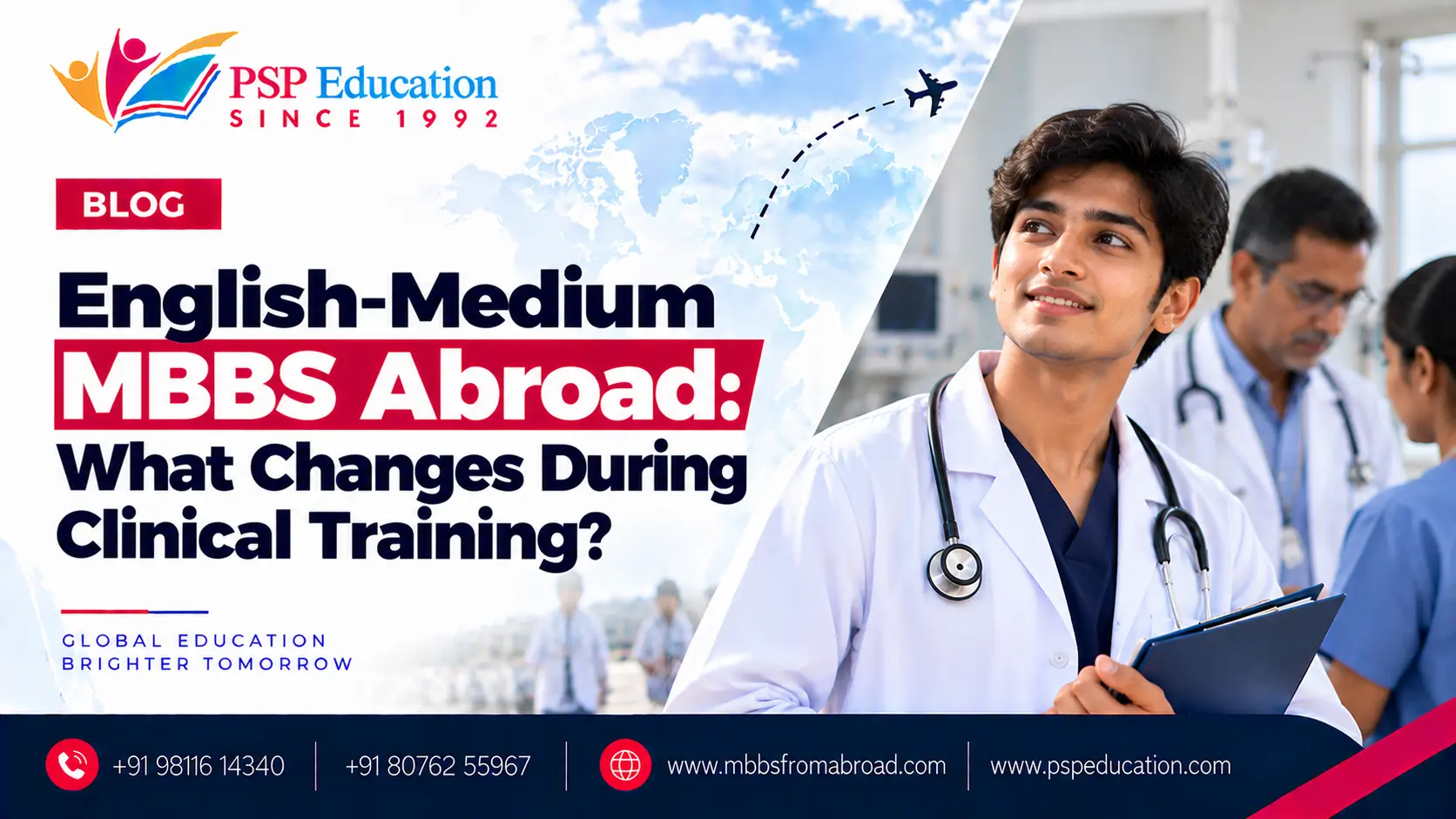
English-Medium MBBS Abroad: What Changes During Clinical Training?
Quick answer: An English-medium MBBS abroad usually means lectures, textbooks and written exams are in English. It does not automatically mean that every ward round, patient history and hospital conversation will also be in English. Once clinical training begins, you work in real hospitals where patients and staff may speak the local language (Russian, Kazakh, Uzbek, Georgian or another). How much English is used there depends on the specific university, programme and hospital, not on the country alone.
This guide explains what actually changes when you move from the classroom to the hospital, what official sources say for Russia, Kazakhstan, Uzbekistan and Georgia, and exactly what to ask a university in writing before you pay any fees.
What Does "English-Medium MBBS" Actually Mean?
"English-medium" is a marketing phrase, and it can cover very different arrangements. Before admission, it is worth separating five things:
- Lectures and presentations: the language the teacher uses in class.
- Textbooks and learning material: often English, but not always for every subject.
- Written examinations: the language of the question papers.
- Practical and simulation sessions: laboratory work, skills-lab practice, simulated patients.
- Hospital-based clinical learning: ward rounds, patient histories, case discussions, supervised examinations.
A university can truthfully say "our programme is in English" while one or more of these layers works partly in the local language. This is why the question "Is the programme in English?" is too broad. The useful question is: "In which language is each stage of the programme actually delivered?"
For Indian students, this matters beyond comfort. The National Medical Commission's FAQ on the Foreign Medical Graduate Licentiate (FMGL) Regulations, 2021 states that the medium of instruction must be English (Reg. 4(a)(iii)). The same FAQ notes that clinical posting and training during the course and the 12-month internship are separate phases of practical learning.
One honest caution: the NMC FAQ states the English requirement, but it does not spell out, in the extract we reviewed, how a conversation between a student and a local-language patient should be treated. Some consultants and websites read the rule very strictly; others read it loosely. Neither group is a substitute for the regulation itself. If this matters to you, ask the university for its clinical-teaching language arrangements in writing, and check the current NMC notices on nmc.org.in.
What Changes When MBBS Students Enter Clinical Training?
In the early years you learn mostly from lectures, books, labs and exams. In the clinical years, learning moves into hospitals and becomes patient-facing. The change is not only academic; it is also linguistic and practical.
In the classroom phase, you typically deal with:
- Lectures and slide presentations
- Textbooks and online resources
- Written and oral exams on theory
- Lab and simulation sessions
In the clinical phase, you typically deal with:
- Ward rounds, where a teacher and a group of students move from bed to bed discussing patients
- Patient histories, where you ask about symptoms in the patient's own words
- Communication with patients and families, including explaining what is happening in simple language
- Communication with doctors, nurses and other hospital staff
- Case discussions and presentations
- Supervised examinations and practical assessments
- Hospital documentation and case records, where the local language may be used
These activities do not all have to use the same language. A teacher may explain a case to the international group in English while the patient speaks only the local language. Hospital records may be kept in the local language. A practical exam may be conducted differently from a theory exam. This varies by university, programme, hospital and department, so no single statement about "Russia" or "Georgia" will be true everywhere.
Everything you do with patients happens under supervision and under the rules of your programme and the host country. Learning a local language does not make a student qualified to treat patients independently; it helps you learn safely and properly under supervision.
Why Can Language Become a Challenge During Clinical Years?
Not every student or every programme faces the same difficulty. Where a gap exists, it tends to show up in a few places:
- Taking a history. Patients describe symptoms in everyday speech ("a burning feeling after meals", "it comes and goes at night"), not in textbook terms. Understanding that speech accurately takes more than classroom vocabulary.
- Following ward rounds and case discussions. If staff switch to the local language, a student who understands little may follow only part of the discussion.
- Working with nurses and other staff. Day-to-day hospital routines run on short, fast, practical conversation.
- Understanding local terminology and documentation, where case sheets or forms may be in the local language.
- Asking the right follow-up questions. Learning from a patient means being able to respond to what they just said.
There is also a difference between general conversational ability (ordering food, asking directions) and clinical communication (asking about pain, onset, duration, medication, allergies, and understanding the answers). A student can be comfortable in the first and still need structured practice for the second.
Because of this, it is useful to treat local-language preparation as part of clinical readiness, not just as a "nice to have" for daily life. For a broader look at what daily life abroad involves, see PSP's guide to what your first 30 days abroad look like.
English-Medium MBBS Clinical Training in Russia
Russia has many medical universities, and they do not all work the same way. PSP's MBBS in Russia page lists the universities PSP works with, and arrangements differ from one to another.
What official sources show. Novosibirsk State University's own English-medium General Medicine page describes an intensive Russian-language course during the early years and states that from the 4th academic year the modules are organised so that they are taught in Russian, which lets students communicate with real patients and their supervisors. This is an example of a university that openly describes a shift in the language of teaching during the clinical years. It is one university, and it should not be taken as a description of every Russian university. Equally, it should not be ignored: it shows that "English-medium" can describe the early years more than the later ones.
How some Russian universities teach clinical Russian. Sechenov University publishes a Russian-for-medical-residents course aimed at beginners (A0–A1). It uses role-plays, standardised patients and real medical documents. This course is for residents, not for MBBS students, so it does not describe the undergraduate programme. It does illustrate what patient-focused language training looks like when a university takes it seriously.
What to confirm at your chosen university:
- Which years are in English, and whether any subjects or clinical departments move to Russian
- Whether Russian is taught as a formal subject, from which year, and with how many hours
- Which language is used with patients in the affiliated hospitals and in clinical exams
- How the university handles this under the NMC's English-medium requirement, in writing
PSP has an older article on whether Russian is mandatory for MBBS in Russia. This guide goes further by covering what changes stage by stage and how to verify it.
English-Medium MBBS Clinical Training in Kazakhstan
PSP's MBBS in Kazakhstan page lists the Kazakh universities PSP works with. Kazakhstan has a bilingual environment in which Kazakh and Russian are both widely used, so students may encounter either or both in hospitals, depending on city and region.
What official sources show. Semey Medical University describes itself as having added a foreign department alongside its traditional Russian and Kazakh-language instruction. The same university runs a Speaking Club for international students in Russian, described as preparation for communicating with patients and for internship training. The Embassy of India in Astana's education page advises students to be mentally prepared to learn Kazakh or Russian, which will be needed during the one-year internship.
These sources point in the same direction: international students in English-medium programmes in Kazakhstan are expected to build some Russian or Kazakh for clinical work. They do not tell you which language is used on which ward at which university, or how many hours of language teaching are provided. That is a university-specific answer.
What to confirm at your chosen university:
- Whether Russian, Kazakh or both are used with patients at its teaching hospitals
- Whether language teaching is part of the curriculum, from which year, and how it is assessed
- How the programme handles clinical teaching for international groups
- Whether the internship (a separate phase) has different language arrangements
For a comparison that includes clinical exposure, see PSP's guide to Russia vs Kazakhstan for MBBS.
English-Medium MBBS Clinical Training in Uzbekistan
PSP's MBBS in Uzbekistan page lists its Uzbek partner universities. Uzbekistan is where language and clinical training have drawn the most recent official attention, so it needs careful reading.
The NMC advisory, in context. According to reporting by Medbound Times, the NMC issued an advisory dated 1 April 2026 for Indian students seeking admission in Uzbekistan, following a communication from the Embassy of India in Tashkent. That communication raised concerns about:
- Students being admitted beyond approved intake capacity
- Difficulties with hands-on clinical training, including communication challenges where the medium of instruction was not English
- Complaints about possible violations of the FMGL Regulations involving the Tashkent State Medical University Termez Branch and an offshore-type arrangement
The advisory concerns Bukhara State Medical Institute, Samarkand State Medical University and Tashkent State Medical University, plus the other arrangements mentioned above. On 28 July 2026, the Haryana Medical Council and the Embassy of India in Tashkent clarified that the advisory is precautionary and should not be read as an admission ban. The report also notes that these were concerns communicated to the NMC, not conclusive findings on every allegation.
What this does and does not mean.
- It does not mean that every university or every English-medium programme in Uzbekistan has the same problem.
- It does not prove that all clinical teaching in Uzbekistan happens in a language Indian students cannot follow.
- It does show that regulators and the Embassy treat the link between language of instruction and hands-on training as a real issue worth checking, at the level of the individual institution.
- Separate notices exist for other institutions (for example, a warning on the Chirchiq branch of Tashkent State Medical University), so check each institution's current status rather than relying on a country-level impression.
Editorial note: we could not open the NMC's own PDF of the 1 April 2026 advisory in this research session, so the description above relies on press reports of it. Please check the notice itself on nmc.org.in before publishing.
Language arrangements at university level. We did not find an official university page that describes the language of patient communication or language training for Indian MBBS students in Uzbekistan. Consultant websites commonly say Uzbek or Russian is used with patients, but we could not verify that against official programme documents. Treat it as a question for the university.
What to confirm at your chosen university:
- The formal language of instruction in theory, practicals and clinical teaching, in writing
- The language of patient communication at each affiliated hospital
- The approved intake for your batch and the hospital capacity for clinical groups
- Whether Uzbek or Russian is taught, from which year, and how it is assessed
- The institution's current status on the NMC and Embassy of India pages
English-Medium MBBS Clinical Training in Georgia
PSP's MBBS in Georgia page lists its Georgian partner universities. Georgia is unusual in that official sources address the clinical-language question fairly directly.
What official sources show.
- A Q&A from the Georgian government's information for Indian students, published on the Embassy of Georgia in India's site, states that medical schools in Georgia provide the same clinical settings for all MD students regardless of nationality, and that MD programmes include a Georgian-language course for international students to help with patient communication.
- Georgian university and accreditation material, such as a Q&A reproduced by ALTE University, describes pre-clinical subjects and skills-centre training up to the 3rd year, with clinical rotations starting from the 4th year.
- Georgian accreditation reviews have discussed the language issue in clinical years. A 2018 expert report on Caucasus International University's English-language MD notes mandatory Georgian courses that help students communicate with patients and clinical teams. A 2021 report by Georgia's quality-assurance agency (NCEQE) on another English-language MD programme recommended focusing on Georgian teaching for international students before the clinical years so they can communicate with Georgian patients. That recommendation shows the issue is recognised, though it is a recommendation for one programme, not a description of all.
- English-medium MD programmes are offered, for example at Tbilisi Medical Academy, which describes a six-year English-language MD. We did not verify what that or any other university states about patient-communication language in its hospitals.
A separate point on licensing. Do not confuse the language question with the licensing question. In October 2026 the NMC clarified, in a reply reported by Careers360 (PTI), that "junior doctor" status in Georgia is sufficient for Indian FMGL purposes only if it legally permits practice at the required level, to be determined under Georgian law. This is not about language, but it is another reason to ask Georgian universities for programme-specific written answers.
What to confirm at your chosen university:
- Which hospitals host clinical rotations for international students and what language is used with patients there
- How many hours of Georgian are taught, in which years, and how they are assessed
- Whether the Georgian course is completed before clinical rotations begin
- How the university addresses the NMC's English-medium requirement and the licensing position, in writing
Comparison: What Is and Is Not Verified
The table below records only what we could support from official or primary-type sources. Where we could not, we say so rather than fill the cell with an assumption.
| Country | Verified classroom language | Verified clinical-training language | Local-language preparation | What students must confirm |
|---|---|---|---|---|
| Russia | English-medium programmes are offered (e.g. Novosibirsk State University's English-medium General Medicine). Other universities: Not verified; confirm with the university. | At Novosibirsk State University, the university states modules are taught in Russian from the 4th year. Other universities: Not verified; confirm with the university. | Novosibirsk State University describes an intensive Russian course in the early years. Others: Not verified. | Which years/subjects move to Russian; Russian teaching hours; how this squares with the NMC's English requirement, in writing |
| Kazakhstan | Not verified for any single university in this research; confirm with the university. | Not verified; official sources point to Russian or Kazakh being needed at least for internship. | Semey Medical University runs a Russian speaking club for international students to prepare for patient communication. Embassy of India in Astana advises preparing to learn Kazakh or Russian. | Language used at each teaching hospital; formal language courses; internship language arrangements |
| Uzbekistan | Not verified at programme level; the NMC advisory reports concerns where the medium was not English at certain institutions. | Not verified; the Embassy-communicated concern relates to communication difficulties affecting hands-on training at certain institutions. | Not verified; confirm with the university. | Written language-of-instruction policy; hospital language; intake and clinical capacity; the institution's current NMC/Embassy status |
| Georgia | English-language MD programmes exist (e.g. Tbilisi Medical Academy). | Official Georgian material says all MD programmes include a Georgian course to help communicate with patients; the language used in each hospital is not verified. | Georgian-language course is part of MD programmes for international students per Georgian official Q&A; hours and timing vary by university. | Georgian course hours and timing; hospital language; licensing position; written confirmation |
No ranking of countries by "language difficulty" is offered here, because we found no defensible evidence to support one.
Questions to Ask Before Choosing an English-Medium MBBS Programme
Send these to the university's international office and ask for the reply in writing, on university letterhead or official email. This list focuses on language and clinical communication; it does not repeat PSP's general checklists on recognition, fees and red flags (see links below).
- What is the formal medium of instruction for the entire programme, year by year?
- What language is used in theory classes and written examinations?
- What language is used in practical classes, oral examinations and clinical assessments?
- What language do patients generally use at the affiliated teaching hospitals?
- In which language are patient histories, ward rounds and case discussions conducted for international students?
- Is local-language teaching included in the curriculum?
- From which year does it begin, and how many hours does it include?
- How is language proficiency assessed, and does the assessment cover clinical communication?
- What language-support resources are available before clinical rotations (classes, role-play, supervised practice)?
- Can the university give its language-of-instruction policy in writing, including how it addresses the NMC's English-medium requirement?
Also speak to current senior students from India at that same university about how classes and hospital rotations actually run. Their experiences are useful, but remember that individual experiences differ by batch, department and hospital.
For the broader university checks, see PSP's guides on 12 things to verify before choosing a university, how to choose an MBBS abroad university after NEET 2026 and how to verify an MBBS abroad university before admission.
How to Prepare for Clinical Training Before It Begins
You do not need to be fluent. You need to be safe, polite and able to learn from patients under supervision. Start early.
- Start with useful phrases in year one. Greetings, "does it hurt?", "since when?", "show me where", "take a deep breath".
- Attend the university's language classes if they are offered, and treat them as part of your clinical preparation.
- Practise listening, not just speaking. Understanding the answer matters more than asking a perfect question.
- Learn common medical terms in the local language. Focus on symptoms, body parts, time, frequency and everyday instructions.
- Practise patient-history questions in role-play or supervised simulation, with a teacher or local classmate.
- Ask teachers for feedback on how clearly you communicate with patients.
- Use simulated-patient sessions where the university offers them.
- Say so when you do not understand. Ask for clarification or help from a supervisor. Never pretend to understand a patient's answer or a clinical instruction.
- Know your limits. Clinical activities happen under supervision and within your programme's rules. Basic language skills do not make you ready to act independently.
We have not listed a required language level or exam, because we found no university or official source that sets one for these programmes. Some blogs state specific levels (for example, a named Russian exam level); we could not confirm those against any official document. If a university gives you a required level, ask for it in writing.
Preparation also helps your later exams. PSP's guide to FMGE preparation from 1st year covers how clinical learning fits into exam planning.
Common Misunderstandings About English-Medium MBBS
"English-medium means I don't need any local language." It means the formal teaching language is English. Clinical settings can involve local-language conversation. Official material we found for Georgia, Kazakhstan and Russia points to local-language preparation being part of the plan for international students, and the Embassy of India in Astana says it should be expected for the internship.
"Every university in a country follows the same clinical language policy." They do not. Novosibirsk State University describes a move to Russian in the 4th year, and Georgian accreditation reports discuss Georgian teaching at specific programmes. The NMC's Uzbekistan advisory names specific institutions and arrangements. Check the university, not the country.
"A few everyday phrases guarantee effective clinical communication." Everyday phrases help with daily life. Clinical communication needs symptom vocabulary, listening skills and supervised practice. Sechenov University's residents' course is built around role-plays and simulated patients for a reason.
"A university's marketing statement is enough evidence." It is not. A brochure line like "taught in English" does not say what language is used on the ward. Ask for the policy in writing and compare it with what current students tell you. For warning signs about vague claims, see PSP's guide to MBBS abroad university red flags.
"An English-medium advertisement means my degree will meet licensing requirements." It does not. NMC eligibility depends on several conditions in the FMGL Regulations, 2021, and the NMC states that variations in duration, medium of instruction, syllabus or clinical training can lead to disqualification from registration in India. Verify these against the regulation itself.
Frequently Asked Questions
Is English-medium MBBS fully taught in English?
Often the lectures, textbooks and written exams are in English, but this varies. The formal medium of instruction, the language of practicals and the language of hospital communication can differ. Ask the university for a year-by-year written statement.
Do Indian students need to learn the local language during MBBS abroad?
The regulation we reviewed requires English as the medium of instruction, and it does not set a local-language requirement for students. In practice, official material for Georgia, Kazakhstan and Russia points to local-language preparation helping with patient communication and internship. Whether it is formally required depends on the university, so ask.
Does clinical training use a different language from classroom teaching?
It can. Patients and staff may speak the local language even where lectures are in English. Novosibirsk State University, for example, describes teaching modules in Russian from the 4th year. Other universities may arrange this differently.
Is Russian needed for clinical training in Russia?
At some universities, yes, at least for part of clinical teaching, as Novosibirsk State University describes. At others, arrangements may differ. Ask your university how much of the clinical phase runs in Russian and how Russian is taught.
Are Kazakh or Russian useful during clinical training in Kazakhstan?
Official sources, including the Embassy of India in Astana and Semey Medical University's language activities, point towards Russian or Kazakh being useful or expected, particularly for patient communication and the internship. Confirm the language used at your university's hospitals.
What languages may be used in clinical settings in Uzbekistan?
We could not verify this from official programme documents. Consultant websites mention Uzbek and Russian. The NMC advisory reported concerns about communication in hands-on training at certain institutions. Ask the university directly.
Do students in Georgia need to learn Georgian for patient communication?
Georgian official material says MD programmes include a Georgian course for international students to help with patient communication. How many hours it includes, when it starts and what language each hospital uses depends on the university.
How can students verify a university's language of instruction?
Ask the ten questions in this guide, get the answers in writing, speak to current Indian students at that university, and check the NMC site for current notices. Written confirmation should cover theory, practicals, clinical teaching and the internship.
Final Checklist for Students and Parents
Before paying admission fees, confirm:
- [ ] The formal medium of instruction for every year, in writing
- [ ] The language of theory teaching, written exams, practicals and clinical assessments
- [ ] The language patients use at the affiliated hospitals
- [ ] The language of ward rounds and case discussions for international students
- [ ] Local-language teaching: hours, start year and assessment method
- [ ] Language support before clinical rotations begin
- [ ] How the university addresses the NMC's English-medium requirement
- [ ] The institution's current status in NMC notices and Embassy of India advisories
- [ ] Reports from current Indian students at the same university
- [ ] All answers saved as emails or letters from the university
Conclusion
"English-medium" tells you about the classroom. It does not tell you the whole story of the hospital. Before you decide, look at two things together: the formal language of teaching and the real communication environment where you will learn from patients. The two can differ, and the difference varies from university to university, not simply from country to country.
Get university-specific answers in writing, ask current students what rotations really look like, and start preparing for clinical communication well before the clinical years begin. No programme can promise that it will meet every student's language needs or every licensing requirement, so verify the details yourself.
If you would like help preparing these questions, shortlisting universities in Russia, Kazakhstan, Uzbekistan or Georgia, or reading a university's reply, PSP Education's counsellors can help you plan the next step.
Sources
All sources were accessed on 24 October 2026. Where a source is a press report rather than the primary document, that is noted.
Regulatory
- National Medical Commission, FAQs on FMGL Regulations 2021 (NMC-hosted PDF): medium of instruction, internship, clinical training versus internship.
- Vikaspedia: FAQs on FMGL Regulations 2021: date of coming into force, 54-month duration, same-institution training (secondary reproduction of the FAQ).
- Careers360: NMC tells students to ensure FMGL conditions are fulfilled: NMC statement that variations may lead to disqualification (press report).
Uzbekistan (press reports of the NMC advisory; the NMC PDF itself could not be opened)
- Medbound Times: MBBS in Uzbekistan Not Banned: HMC and Indian Embassy Clarify
- Medical Dialogues: No admission ban on Uzbekistan medical universities
Georgia
- Embassy of Georgia in India: Q&A on medical education in Georgia
- ALTE University notice reproducing Georgian Q&A on clinical rotations
- Accreditation Expert Group Report, Caucasus International University MD (English), 2018
- NCEQE accreditation report, English-language MD programme, July 2021
- Tbilisi Medical Academy: Medicine in English
- Careers360 (PTI): NMC on junior doctor status in Georgia
Russia
- Novosibirsk State University: General Medicine in English
- Sechenov University: Russian as a Foreign Language for Medical Residents
Kazakhstan
- Semey Medical University: brief history
- Semey Medical University: Speaking Club for international students
- Embassy of India, Astana: Education in Kazakhstan
PSP Education pages referenced