MBBS in Russia vs India: What Actually Changes for Indian Students? Fees, Study & Career
Every year, once NEET results are out, thousands of Indian families sit at the kitchen table and ask the same question in different words: "Should we look at Russia, or should we wait it out in India?" It's rarely about tuition fees alone. It's about whether a 17- or 18-year-old is ready to live in a different country, whether the family can plan around six years abroad, and whether the degree will actually let their child come back and practise medicine in India.
This article isn't here to tell you Russia is the smarter choice, or that India is always safer. It's here to walk through what genuinely changes — admission, cost, teaching style, clinical exposure, language, lifestyle, and the licensing pathway back home — so you can decide with the full picture, not half of it.
Quick Answer: MBBS in Russia vs India — Which Is Better?
Neither option is universally "better." A government MBBS seat in India is usually the most affordable and administratively simplest route, but seats are extremely limited. Private MBBS in India is costly, often ₹60 lakh to over ₹1.2 crore for the full course. MBBS in Russia typically costs less overall (broadly ₹25–₹40 lakh across NMC-recognised universities) but adds living abroad, a different clinical environment, local-language interaction, and a licensing exam (currently FMGE) after returning to India. The right choice depends on your NEET outcome, budget, and comfort with studying abroad — not on which country sounds better in an advertisement.
MBBS in Russia vs India: The Biggest Difference
It helps to be direct about this upfront: choosing Russia over India doesn't just relocate your classroom. It changes the admission pathway, the language you'll hear in hospital wards, the climate you'll live in for six winters, the distance between you and your family, the cost structure of the entire degree, and — importantly — it adds a regulatory step that Indian-college graduates don't need: a licensing exam to practise in India after you return.
Consider two students with similar NEET scores. One gets a government MBBS seat in a state college. The other doesn't find an affordable seat within reach through counselling and starts looking at Russia. Their decision shouldn't be based on the headline tuition fee alone. The education environment, the experience of living abroad, the pattern of clinical exposure, and the India-return pathway are genuinely different journeys — not the same journey at a different price.
If you're still unsure whether you even meet the basic starting conditions for MBBS abroad, it's worth reading MBBS abroad eligibility requirements before going further into this comparison.
MBBS in Russia vs India — Complete Comparison Table
| Factor | MBBS in India | MBBS in Russia | What It Means for Indian Students |
|---|---|---|---|
| Admission | Through NEET-UG and centralised/state counselling | Through NEET-UG qualification + direct university application | India uses seat allotment; Russia uses university-level admission after NEET eligibility is confirmed |
| NEET | Mandatory, rank-based seat allotment | Mandatory for India-return eligibility; only a qualifying score is needed by the university | Russia doesn't need a competitive rank, but NEET qualification is still non-negotiable |
| Counselling | MCC (AIQ/central institutes) + state counselling rounds | No Indian counselling process; direct university admission | Russia skips India's seat-allotment competition entirely |
| Seat Availability | Government seats are extremely limited; private seats are costly but more available | Seats are comparatively easier to secure at NMC-recognised universities | Russia is often considered after India's government-seat competition doesn't work out |
| Tuition Fees | Government: roughly ₹5,000–₹2.5 lakh/year; Private: roughly ₹10–₹25 lakh+/year | Roughly ₹3–₹13 lakh/year, varies by university and city | Private India and Russia can be in a broadly comparable band; government India is far cheaper if you can get the seat |
| Total Cost (6 yrs) | Government: often well under ₹10 lakh total; Private: roughly ₹60 lakh–₹1.2 crore+ | Roughly ₹25–₹40 lakh total (tuition + hostel), varies by university | Fees vary by university and academic year — always confirm current, official figures |
| Hostel | Depends on college; government colleges usually have hostels | University hostels common, often with Indian mess facilities | Compare actual facilities, not just marketing photos |
| Living Expenses | Varies widely by city | Roughly ₹12,000–₹18,000/month, depending on city | Add this to tuition — tuition alone is never the full cost |
| Course Duration | 4.5 years academic + 1 year internship (5.5 years total) | 5 years academic + 1 year internship (6 years total), as most universities structure it | An extra academic year is common, plus post-return licensing steps for Russia-returned students |
| Medium of Instruction | English | English, with compulsory Russian-language training for clinical interaction | Russia adds a genuine local-language learning requirement |
| Teaching Environment | Large batch sizes, high-volume clinical rotations in India's hospitals | Structured curriculum, simulation labs, government teaching hospitals | Teaching style and hospital exposure differ meaningfully — verify per university, don't generalise |
| Clinical Exposure | Very high patient volume in most government hospitals | Varies significantly by university and affiliated hospital | Don't assume every Russian university offers identical exposure — check specifics |
| Patient Interaction | Directly in Hindi/regional languages/English | Requires basic Russian for ward-level patient communication | A real adjustment for Indian students used to communicating in Hindi or English |
| Language | English/Hindi/regional language | English (academics) + Russian (clinical years) | Academic English is not the same as functional Russian for patient care |
| Lifestyle | Familiar food, culture, and family proximity | New culture, food adjustment, Indian student communities in most cities | Independence builds faster abroad, but so does homesickness for some students |
| Climate | Varies by state, generally familiar | Cold winters in most regions, some cities more extreme than others | A genuine adjustment for students from warm parts of India |
| Distance from India | Domestic travel | International travel, limited visits home during the course | Emotionally and financially relevant for the whole family |
| FMGE/NExT | Not applicable — Indian MBBS graduates don't sit FMGE | Currently, Russia-returned graduates must qualify FMGE (NExT for foreign graduates remains deferred as of 2026) before practising in India | This is a genuine extra step Indian-college graduates skip entirely |
| India Return Pathway | Direct — graduate, intern, register, practise | Requires clearing FMGE (or NExT once implemented) and completing internship requirements before Indian registration | Not automatic — depends on meeting NMC's FMGL conditions from day one of admission |
| Career | Direct entry into Indian practice/PG pathway | Same long-term options, but only after clearing the licensing exam | Career destination can be similar; the road to it is longer for Russia-returned graduates |
Fees, living costs and pass-rate figures vary by university and academic year. Always verify current numbers directly with the specific university and with NMC before making a financial decision.
MBBS Fees in Russia vs India: What Does the Total Cost Actually Look Like?
"MBBS in India" is not one category — it changes completely depending on whether you're looking at a government seat or a private one. Comparing Russia only to government colleges (which almost no one can guarantee) or only to the most expensive private deemed universities gives a distorted picture either way. Here's a more complete breakdown.
Government MBBS in India
Government medical colleges are heavily subsidised. Tuition at institutions like AIIMS can be startlingly low — often just a few thousand rupees a year — while other government colleges typically charge somewhere between ₹5,000 and ₹2.5 lakh per year depending on the state and institution. Add hostel and mess charges (usually modest, often ₹4,000–₹8,000 a month), and the entire 5.5-year course at a government college frequently costs less than ₹10 lakh in total — sometimes far less. The catch is availability: seats are limited, and only a small fraction of NEET-qualified students secure one.
Private MBBS in India
Private and deemed medical colleges operate on a completely different scale. Annual tuition commonly runs ₹10–₹25 lakh, and some private/deemed institutions charge considerably more — the total cost for the full course can range from roughly ₹60 lakh to well over ₹1.2 crore, occasionally higher at the priciest deemed universities. This is the comparison point that matters most for students weighing Russia against India, because most students who don't get a government seat are realistically choosing between a private Indian college and a foreign option — not between Russia and AIIMS.
MBBS in Russia
Across NMC-recognised Russian universities commonly chosen by Indian students, annual tuition tends to fall in the range of roughly ₹3–₹13 lakh, with the total 6-year cost (tuition plus hostel) generally landing between approximately ₹25 lakh and ₹40 lakh. Monthly living expenses — food, transport, incidentals — typically add another ₹12,000–₹18,000. Fees vary by university and academic year, and can shift with currency movements, so treat any single number as an estimate to be confirmed directly with the university, not a fixed promise.
A practical formula for either country:
Total MBBS Cost =
Tuition
+ Hostel
+ Food
+ Living Expenses
+ Travel
+ Visa/Documentation (for Russia)
+ Insurance/Other Charges
+ Licensing-Exam Preparation Costs (for Russia-returned students)
Tuition is never the whole story. A university that advertises a low annual fee but requires expensive private accommodation, or a private Indian college with hidden development charges, can end up costing more than the headline number suggests.
Admission After NEET: India vs Russia
Both pathways start at the same place — NEET-UG — but diverge immediately after.
In India: NEET → MCC counselling (for AIQ/central institutes) and state-level counselling → seat allotment based on rank, category, and choices filled → reporting and admission.
In Russia: NEET qualification confirmed → university shortlisting based on budget, city, and course structure → direct application to the university → document submission → admission/invitation letter → student visa → travel → enrolment.
Russia does not remove the NEET requirement — it changes how your NEET result is used. In India, your rank determines which seat you can realistically get. For Russia, most universities only need proof that you qualified NEET at all; a middling score that limits your India options usually won't limit a Russian university's willingness to admit you. This is precisely why some students who are NEET-qualified but couldn't clear India's competitive cutoffs start looking abroad. If you want the detailed, step-by-step version of this process, our MBBS in Russia admission process guide walks through it stage by stage.
Seat Availability: Why Students Consider Russia
Russia usually enters the conversation after — not instead of — India's counselling process. The typical situation looks like this: a student qualifies NEET, participates in AIQ and state counselling rounds, and still doesn't get a seat that's both affordable and realistic for their rank. That student remains NEET-qualified; they simply didn't get through India's seat competition. From that position, comparing Russia against a private Indian college (not a government one) is the honest comparison.
This is a different situation from a student who never qualified NEET at all — that scenario carries much bigger regulatory risk, and we've covered it in detail separately in MBBS abroad without NEET requirements. Skipping Indian counselling altogether without first understanding your actual options in India is not something to do based on urgency or an advertisement's promise. If your NEET score is qualifying but on the lower side, our dedicated guide on low NEET score MBBS abroad options breaks this specific situation down by budget and country.
Course Duration and Academic Structure
In India, MBBS runs 4.5 years of academic study followed by a 1-year compulsory internship — 5.5 years total, after which graduates can register and begin practising (subject to internship completion).
In Russia, most universities structure the programme as 5 years of academic study plus 1 year of integrated internship, for a 6-year total. But course length on paper isn't the full timeline for a Russia-returned student. After finishing the Russian programme, an Indian student must additionally clear the applicable licensing exam (currently FMGE) and satisfy internship-related conditions under NMC's Foreign Medical Graduate Licentiate (FMGL) Regulations, 2021, before they can register to practise in India. So while both numbers look close on paper, the complete pathway — including licensing — takes meaningfully longer for the Russia route.
Teaching and Study Environment
Indian medical colleges, particularly government ones, are known for very high patient volumes — students often get hands-on exposure to a large and diverse caseload simply because Indian government hospitals see enormous numbers of patients daily. Class sizes can be large, and competition for close faculty attention is real.
Russian universities generally offer a more structured, smaller-cohort teaching style for international students, often supported by simulation labs and digital learning tools. Clinical rotations begin in the middle academic years at most universities. But — and this matters — clinical exposure varies significantly from one Russian university and affiliated hospital to another. It is not accurate to describe "Russian clinical training" as a single, uniform experience; some universities have consistently stronger FMGE outcomes than others, which is one indirect signal of how well their clinical training translates into readiness for Indian licensing.
Clinical Exposure: Russia vs India
This is one area where blanket claims do students a disservice. Indian government hospitals typically expose students to extremely high patient inflow, which many doctors describe as a strength of Indian medical training. Russian universities offer structured rotations through affiliated hospitals, but patient volume and hands-on involvement can differ sharply by city and institution — a university in a major hospital hub is not the same experience as one in a smaller regional teaching hospital. Before choosing a specific Russian university, it's worth asking directly about affiliated hospital size, rotation structure, and how much direct patient contact is built into the clinical years — not just relying on a brochure description. Official FMGE performance data published by NBEMS is one useful, university-neutral way to cross-check how graduates of a specific institution have historically performed, rather than relying on a consultant's claim alone. Our broader university selection framework covers more factors beyond fees worth checking before shortlisting a university.
Language and Patient Interaction
Academic instruction at most Russian universities chosen by Indian students is in English. What often surprises students is the second language requirement: Russian universities generally build in compulsory Russian-language training specifically for clinical years, because meaningful patient interaction in a Russian hospital requires at least conversational Russian. English alone is not enough once clinical rotations begin — this is a genuine adjustment, not a formality, and students should not assume that an "English-medium" label means the entire six years happen in English.
In India, this issue doesn't arise in the same way — students typically interact with patients in Hindi, English, or the regional language they already know.
Hostel, Food and Living Costs
Most Russian universities provide on-campus hostels, particularly for first-year students, often with Indian mess facilities offering vegetarian and non-vegetarian options. Estimated monthly living costs — accommodation, food, transport, internet, and incidentals — generally fall between ₹12,000 and ₹18,000, though Moscow and Saint Petersburg tend to run higher than regional cities.
In India, hostel quality and cost depend heavily on the specific college — government college hostels are usually inexpensive, while private college accommodation costs vary widely and are sometimes bundled into overall fee structures. In both countries, always ask for an itemised breakdown rather than assuming "hostel included" covers everything.
For a closer look at how living costs and lifestyle differ across specific Russian cities, see MBBS in Russia cities, climate and student life.
Student Life: Russia vs India
Studying MBBS in India means staying within a familiar cultural and linguistic environment, with regular access to family and known support systems. It also means competing and studying within India's academic and hospital culture from day one.
Studying in Russia means genuine independence — managing life in a new country, adjusting to different food, building a social circle from scratch, and typically relying on established Indian student communities for support in the early months. Most major student cities have an active Indian student presence, which eases the transition, but it doesn't remove it entirely. Some students find this independence genuinely valuable for personal growth; others find the distance from family harder than expected. Neither reaction is wrong — it's worth being honest with yourself about which type of environment suits you before committing to six years abroad.
Climate and Adjustment for Indian Students
Russia has long, cold winters across most regions, with some Siberian and northern cities experiencing significantly harsher conditions than others. Students from warmer parts of India — Kerala, Tamil Nadu, coastal Maharashtra — often need real time to adjust, though heated hostels and proper winter clothing make it manageable for most. This is a legitimate factor to weigh, not a minor detail: six winters is a long commitment for someone who has never experienced sustained cold.
Safety and Distance From Family
Safety for Indian students in Russia depends heavily on the specific city, university, type of accommodation, and individual behaviour — it is not something that can be generalised into a single blanket statement for the entire country. Major student cities with large, established Indian communities and university-managed hostel security tend to be more reassuring for families, but standard precautions that apply to any international study destination still apply here. Before departure, families should check current official travel advisories and the specific university's safety and support arrangements, rather than relying solely on informal reassurances.
Distance from family is a separate, non-negotiable reality of studying abroad: fewer visits home, time-zone differences for calls, and being physically unavailable during family emergencies. In India, this simply isn't a factor in the same way, regardless of which state the college is in.
FMGE/NExT and Returning to India
This is the section that deserves the most careful reading, because it's where "MBBS in Russia" and "MBBS in India" diverge most sharply after graduation.
Indian MBBS graduates complete their degree, finish their internship, and register with a State Medical Council — there's no separate licensing exam standing between the degree and the right to practise.
Graduates of foreign medical universities — including Russia — are treated differently under NMC's regulatory framework. As of 2026, the Foreign Medical Graduate Examination (FMGE) remains the operative screening test that Indian citizens and OCI cardholders with a foreign MBBS must clear before they can register with the NMC or a State Medical Council. The National Exit Test (NExT) has been proposed to eventually serve as a common licensing exam for both Indian and foreign graduates, but its rollout for foreign medical graduates has been repeatedly deferred, and no confirmed implementation date for FMGs exists as of this writing. NMC's own 2026 draft amendments continue to retain FMGE as the qualifying route until NExT is actually notified into force. Students should verify the latest applicable requirement directly with the National Medical Commission rather than relying on any fixed timeline — this is a genuinely moving regulatory picture, and treating it as settled would be inaccurate.
None of this means Russia-returned students can't eventually practise in India. It means there's an additional, real exam standing between the degree and Indian registration — one that Indian-college graduates never have to sit. FMGE pass rates for Russia-returned students have varied considerably by university in recent years, which is a useful reminder that "graduating from Russia" doesn't guarantee a uniform outcome; the specific university's clinical training quality appears to correlate with how well-prepared its graduates are for this exam.
For a broader look at where a medical career can actually go after a foreign degree — including what depends on licensing and what doesn't — see career paths after MBBS abroad.
Career After MBBS: Russia vs India
| Career Factor | MBBS in India | MBBS in Russia + India Return | What Students Should Know |
|---|---|---|---|
| Practising in India | Direct, after internship and registration | Requires clearing FMGE (or NExT, once implemented) plus internship-related conditions | An extra regulatory step, not a guarantee either way |
| Postgraduate studies (MD/MS) in India | Through NEET-PG after MBBS | Same NEET-PG pathway, but only after FMGE/NExT clearance and registration | Timeline to PG eligibility is typically longer for Russia-returned graduates |
| Practising outside India | Depends on the destination country's own licensing exam (USMLE, PLAB, etc.) | Same — depends on the destination country's exam, regardless of where the MBBS was completed | Neither Indian nor Russian MBBS automatically grants practice rights abroad |
| Research/academic roles | Available with relevant postgraduate qualifications | Same, subject to meeting the destination institution's own requirements | Not materially different between the two paths at this stage |
No consultant, university, or article can guarantee outcomes for FMGE/NExT, admission to a specific PG seat, or a specific job. What can be planned for is the process itself — and understanding it clearly before committing years and money to either path.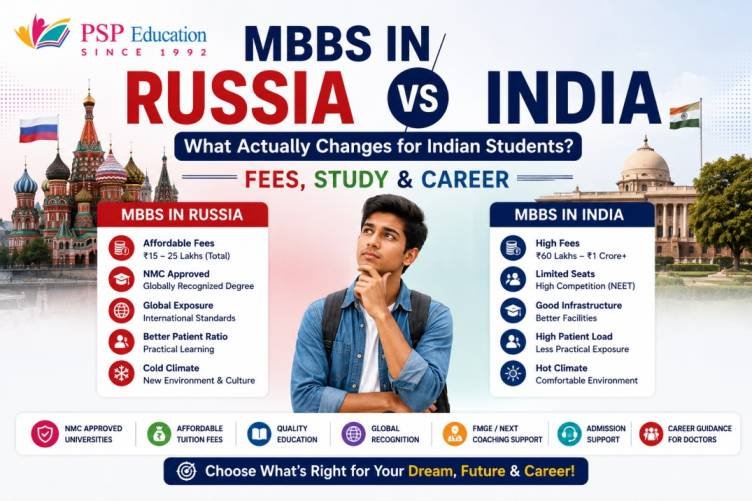
Advantages of Studying MBBS in India
- No additional licensing exam after graduation — a smoother, more direct route to practice
- Familiar language, food, and cultural environment throughout the course
- Very high patient volume and clinical exposure in most government hospitals
- Physical proximity to family for support and emergencies
- No visa, international travel, or currency-related planning required
Challenges of Studying MBBS in India
- Government seats are extremely limited relative to the number of NEET-qualified applicants
- Private and deemed college fees can be very high — often ₹60 lakh to over ₹1.2 crore for the full course
- High competition even for private seats in reputed colleges
- Large batch sizes in some colleges can mean less individual faculty attention
Advantages of Studying MBBS in Russia
- Generally lower total cost than most private Indian colleges, particularly at NMC-recognised regional universities
- No donation or capitation-style charges at most government-run Russian universities
- Structured, English-medium academic curriculum with modern labs and simulation facilities
- Genuine exposure to an international academic and cultural environment
- Established Indian student communities in most major university cities
Challenges of Studying MBBS in Russia
- FMGE (or NExT, once applicable) remains a required step before Indian registration — not optional and not guaranteed
- Compulsory Russian-language learning for clinical-year patient interaction
- Cold climate adjustment, especially for students from warmer Indian states
- Distance from family for extended periods, with limited visits home
- Clinical exposure and FMGE outcomes vary meaningfully by university — careful research is essential before choosing one
Who Should Consider MBBS in Russia?
MBBS in Russia may be worth evaluating for students who:
- Have qualified NEET-UG and understand this is a firm regulatory requirement, not a formality
- Have already gone through India's counselling process and genuinely could not secure a suitable, affordable seat
- Are comfortable with the idea of living independently in another country for six years
- Can reasonably adapt to a colder climate and a different cultural environment
- Are willing to put in real effort learning conversational Russian for clinical years
- Understand — and accept — that FMGE (or NExT, eventually) stands between graduation and Indian practice
- Are prepared to research specific universities carefully rather than choosing based on the lowest advertised fee
Who May Be Better Off Choosing India?
MBBS in India may suit students who:
- Have secured, or have a realistic chance of securing, an affordable government seat
- Have a private college option that is genuinely manageable within their family's financial plan, without straining into unsustainable debt
- Strongly prefer to remain close to family throughout their medical education
- Want to train directly within the Indian clinical and hospital system they'll eventually practise in
- Prefer to avoid an additional licensing exam and the uncertainty around its evolving regulatory timeline
Russia or India? 10 Questions to Ask Yourself
- What is my actual NEET-UG result, and what does it realistically qualify me for in India's counselling?
- What type of MBBS seat — government or private — can I realistically obtain in India this year?
- What is my genuine total budget, including hostel, food, and incidental costs, not just tuition?
- Am I comparing Russia against Indian government colleges or private colleges? (The comparison changes completely depending on which.)
- Am I comfortable living independently abroad for six years, away from daily family contact?
- Can I realistically adapt to Russian winters and a different cultural environment?
- Am I willing to put in consistent effort learning Russian for clinical-year patient interaction?
- Have I researched this specific university's clinical training and hospital affiliations — not just its brochure?
- Do I clearly understand that FMGE (or NExT, once implemented) is a required step before I can register in India?
- Have I verified every claim — fees, recognition, admission process — directly with official sources rather than taking a consultant's word alone?
Final Verdict: Russia vs India for MBBS in 2026
There isn't a single right answer here — only a right answer for your specific situation.
If you have secured an affordable government MBBS seat in India and are comfortable with that option, studying in India is likely to be the more straightforward pathway: no additional licensing exam, no language adjustment, and family close by throughout.
If you have qualified NEET but cannot secure a suitable or affordable seat in India — whether government or private — Russia may be worth evaluating carefully, provided you go in with complete awareness of the additional requirements: living abroad, adapting to a different clinical and cultural environment, learning Russian for patient interaction, and clearing FMGE (or NExT, once it applies) before you can register to practise in India.
If your primary constraint is that private Indian colleges are financially out of reach but you're not entirely comfortable with the idea of studying abroad, this is worth sitting with rather than rushing — the decision should follow from your comfort with the complete picture, not from tuition fee comparison alone.
Russia or India? A Quick Reference
| If Your Situation Is... | Consider |
|---|---|
| You have an affordable government MBBS seat in India | India may be the simpler, more direct pathway |
| No suitable, affordable seat is available in India | Compare Russia carefully against your realistic private-college alternative |
| Private India options are financially unmanageable for your family | Russia may be worth evaluating on total cost and university quality |
| You strongly prefer to stay near family throughout your studies | India |
| You're genuinely comfortable studying and living independently abroad | Russia can be considered, with careful university research |
| You haven't yet researched FMGE/NExT and the licensing pathway | Do this research first, before choosing Russia |
| You want the lowest possible upfront cost | Compare the complete cost — tuition, hostel, living, and licensing prep — not tuition alone |
How PSP Education Helps Students Compare Their Options
When a student comes to PSP Education specifically to compare MBBS in Russia against staying in India, the goal isn't to steer them toward whichever option is easier to sell — it's to lay out what's actually verifiable so the family can decide with real information.
That includes helping with:
- An honest discussion of NEET status, realistic India counselling outcomes, and what that means for the Russia comparison
- University shortlisting in Russia based on budget, city, and course structure — not just headline fees
- Sharing verifiable, university-sourced fee structures rather than a single blanket number
- Explaining the admission process, documentation, and visa steps clearly
- Hostel and pre-departure information so families know what to expect on arrival
- Ongoing parent communication throughout the decision and admission process
- A direct, upfront explanation of what FMGE/NExT and India-return registration actually involve
PSP Education does not guarantee admission, visa approval, NMC recognition, or FMGE/NExT results — no consultant is in a position to guarantee outcomes that depend on documentation, individual preparation, and regulatory decisions outside anyone's control. What we can offer is accurate, current information and consistent support, so the Russia-vs-India decision is made on facts rather than assumptions. If you'd like to talk through your specific NEET result, budget, and options in both India and Russia, you can reach out to PSP Education for a direct conversation rather than relying on an advertisement.
For students who have already decided Russia is worth exploring further, the complete MBBS in Russia guide covers universities, fees, and eligibility in more depth than this comparison article.
FAQs
Is MBBS in Russia better than India?
Neither is universally better. India offers a more direct pathway to Indian practice without an additional licensing exam, while Russia is often more affordable than private Indian colleges but adds living abroad, language adjustment, and the FMGE/NExT requirement before Indian registration. The right choice depends on your NEET outcome, budget, and comfort with studying abroad.
Is MBBS in Russia cheaper than private MBBS in India?
Generally, yes. Total MBBS cost in Russia is commonly estimated at ₹25–₹40 lakh, while private Indian colleges often range from ₹60 lakh to over ₹1.2 crore for the full course. Fees vary by university and academic year, so always confirm current figures directly.
Is MBBS in Russia cheaper than government MBBS in India?
No. Government MBBS in India, especially at institutions like AIIMS, is dramatically cheaper than any option abroad — often under ₹10 lakh for the entire course, sometimes far less. Government seats are simply very limited and highly competitive.
What is the total cost of MBBS in Russia vs India?
Russia typically totals ₹25–₹40 lakh including tuition and hostel. Indian government colleges often total under ₹10 lakh. Private Indian colleges typically range from ₹60 lakh to over ₹1.2 crore. These are broad estimates — verify current, university-specific figures before deciding.
Is NEET required for MBBS in Russia?
Yes. NEET-UG qualification is mandatory for Indian students who want their Russian MBBS degree to count toward future FMGE/NExT eligibility and Indian medical registration, regardless of what a specific university's own admission policy requires.
Is MBBS in Russia recognised in India?
MBBS degrees from NMC-recognised Russian universities listed in the WHO World Directory of Medical Schools can lead to Indian registration, but only after the graduate clears the applicable licensing exam (currently FMGE) and meets other FMGL 2021 conditions. Recognition of the university is not the same as automatic registration of the individual graduate.
Can I practise in India after MBBS in Russia?
Yes, this is possible, but not automatic. You must clear FMGE (or NExT, once it applies to foreign graduates), complete any required internship conditions, and register with the NMC or a State Medical Council. Simply completing the degree does not by itself grant the right to practise in India.
Is FMGE/NExT required after MBBS in Russia?
Yes. As of 2026, FMGE remains the operative screening exam for foreign medical graduates, including those from Russia. NExT is intended to eventually replace it for this purpose, but its implementation for foreign graduates has been repeatedly deferred, with no confirmed date. Verify the current status with the NMC before assuming either exam's timeline.
Which is better for Indian students: Russia or India?
It depends on individual circumstances — NEET outcome, budget, family preferences, and comfort with living abroad. Students with an affordable Indian seat often find India simpler; students without a suitable Indian option sometimes find Russia worth evaluating, provided they understand the additional requirements involved.
Who should choose MBBS in Russia?
Students who are NEET-qualified, have genuinely explored India's counselling options first, are comfortable living abroad for six years, can adapt to a different climate and language, and understand the FMGE/NExT requirement are generally better positioned to consider Russia.
How does admission in Russia differ from India?
India uses NEET rank-based counselling through MCC and state bodies to allot seats. Russia uses NEET qualification as an eligibility filter, followed by direct application to a specific university, without a centralised Indian-style counselling process.
Is clinical exposure good in Russian medical universities? I
t varies significantly by university and affiliated hospital. Some Russian universities have consistently stronger clinical training track records (reflected partly in FMGE pass rates) than others. It is inaccurate to generalise all Russian universities as offering identical clinical exposure — research the specific institution.
Do Indian students need to learn Russian?
Yes, at a functional level. While academic instruction is in English, most Russian universities require compulsory Russian-language training because clinical-year patient interaction generally cannot happen in English alone.
What is student life like for Indians in Russia?
Most major university cities have established Indian student communities, Indian mess facilities, and university-managed hostel support. Adjustment to climate, food, and cultural differences is real but generally manageable with preparation and community support.
Is Russia safe for Indian MBBS students?
Safety depends on the specific city, university, accommodation, and individual precautions — it cannot be generalised into one blanket statement. Families should check current official travel advisories and the university's specific safety arrangements before departure, rather than relying only on informal assurances.
Should I choose Russia if I have a government MBBS seat in India?
Generally, if you have secured an affordable government seat in India and are comfortable with it, there is little practical reason to choose Russia instead, given the additional licensing exam and living-abroad adjustments Russia requires.
This article reflects information available and verified at the time of publishing (August 2026). NEET, NMC, FMGE/NExT, and university-specific fee structures can change. Students and parents should verify the latest applicable rules directly with the National Medical Commission and the National Testing Agency, and confirm current fee and admission details with the specific university, before making any admission or payment decision.