

Choosing an MBBS Abroad University Check 12 Things Indian Students Must Verify
A university looking good in a brochure, being recommended by three different consultants, or showing up on the first page of Google does not tell you whether it is the right medical program for you. It tells you that the university has good marketing. Verification is a separate job — and it is yours, not your agent's.
Every year, thousands of Indian families shortlist a foreign medical university based on fee comparisons, agent recommendations, or a friend's experience. Some of these choices work out well. Others create problems years later — a course structure that does not meet Indian regulatory requirements, an internship that was never clearly defined, or a fee structure that grew after admission. Almost all of these problems are avoidable, and almost all of them are avoidable at the same stage: before you pay any money.
This article is not a university list. It is a working checklist — the 12 things you should personally verify, or ask a counsellor to verify in writing, before you commit to any foreign medical university. For each point, you'll find what to check, why it matters, how to actually check it, and the red flags that suggest something is being glossed over.
MBBS Abroad University Verification Checklist: Quick Answer
| What to Verify | Why It Matters | Where to Check |
|---|---|---|
| Compliance with applicable NMC requirements | Determines whether your qualification can be considered for licensing in India | NMC official website, FMGL Regulations 2021 |
| Exact course duration | Under-duration programs can create eligibility problems later | Official university curriculum document |
| Actual medium of instruction | Marketing claims of "100% English" can be incomplete | University prospectus, current students |
| Internship structure | Must be part of the program and properly documented | University academic calendar, internship policy |
| Real clinical exposure | Infrastructure photos don't show patient contact hours | Teaching hospital details, rotation schedule |
| Local registration/licence eligibility | Confirms the qualification is valid in the country of study itself | Country's health/education ministry |
| Official university status | Confirms the institution genuinely exists and operates legally | Government registry, World Directory of Medical Schools |
| Complete fee structure | Avoids mid-course cost surprises | Written fee schedule from the university |
| Hostel and living conditions | Affects daily life and safety for years, not months | Photos/video calls with current students, hostel policy |
| FMGE/NExT and licensing outcomes | Determines your path to practising in India | NBEMS official data, NMC notifications |
| Student safety and on-ground support | Matters during emergencies, not just admission season | University's international student office |
| Admission letter, payment and refund terms | Protects your money and your paperwork | Written contract, bank verification |
Each of these is explained in detail below.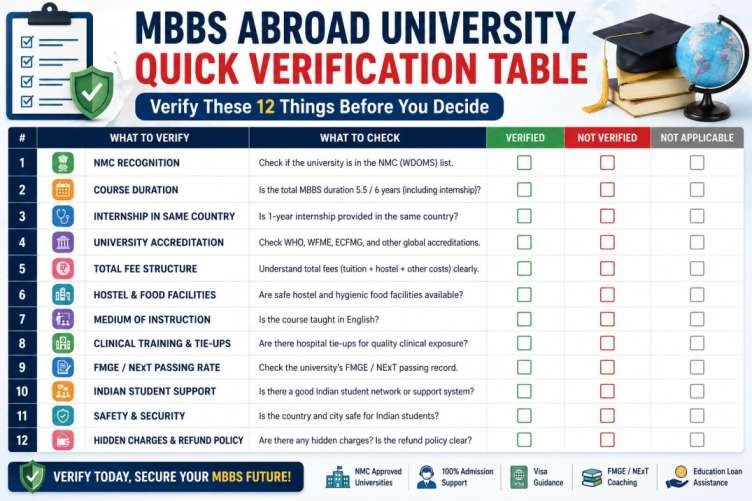
1. Does the Medical Program Meet Applicable NMC Requirements?
What to check: Whether the specific MBBS program you are considering — its duration, internship structure, and medium of instruction — satisfies the conditions set out under the NMC's Foreign Medical Graduate Licentiate (FMGL) Regulations, 2021. This is different from asking "is this an NMC-approved university," because the NMC does not issue a general "approved university" certification. What it regulates are the conditions a foreign medical qualification must meet.
Why it matters: If the program does not meet these conditions, your degree may not qualify you to appear for the licensing exam in India, regardless of how good the university's infrastructure or reputation is.
How to verify: Read the FMGL Regulations 2021 directly on the NMC official website, along with the official FAQs published under the same regulation. Ask the university (in writing, not through an agent) to confirm your program's duration, internship placement, and language of instruction in a way that matches these conditions.
Red flags: Anyone describing a university simply as "NMC approved" without explaining which specific requirement they mean. There is no official, NMC-issued list titled "Approved Foreign Medical Universities" — treat that phrase with caution whenever you see it in marketing material.
2. Verify the Exact Course Duration
What to check: The total length of the program in months — not years rounded off in marketing language — broken down into academic instruction and internship.
Why it matters: Under the FMGL Regulations 2021, the academic component of the medical course must run for a minimum period before internship. A program that is shorter on paper, even if marketed as "MBBS," can create eligibility problems when you apply to sit for India's licensing exam later.
How to verify: Ask the university for its official academic calendar or curriculum document, not a promotional brochure. Cross-check the total duration (in months) against what your consultant tells you verbally.
Red flags: Verbal claims of a "fast-track" or "shortened" MBBS program, or vague answers when you ask for the exact month-by-month breakdown.
3. Confirm the Actual Medium of Instruction
What to check: Whether classroom teaching, textbooks, and examinations are genuinely conducted in English throughout the program — and separately, what language is used during clinical postings and patient interaction in later years.
Why it matters: Many universities teach pre-clinical years fully in English but shift toward the local language once students begin working with real patients in hospital wards. This is not necessarily a problem, but it is something you need to know in advance rather than discover in year three.
How to verify: Ask directly: "In which language do senior students interact with patients during clinical rotations?" Speak to a current student in the program, not just the admissions team.
Red flags: A blanket claim of "100% English medium, no local language required at any stage." Clinical medicine almost always involves some local-language exposure once you start treating patients — a university that denies this entirely may be simplifying the truth to close an admission.
4. Verify How and Where the Internship Is Completed
What to check: Whether the internship is a formal, documented part of the qualification, its duration, and where it physically takes place — the same institution, an affiliated hospital, or somewhere unspecified.
Why it matters: The FMGL Regulations require a defined internship period as part of the qualification. If your internship location or structure is unclear, it can complicate your registration and licensing process after you return.
How to verify: Request the university's written internship policy. Confirm whether the hospital used for internship is formally affiliated with the university (not just "nearby").
Red flags: Universities that treat internship as an afterthought, or agents who say "internship details will be shared closer to the time."
5. Check Clinical Exposure, Not Just Campus Photos
What to check: The teaching hospitals attached to the university, approximate patient volumes, the departments students rotate through, and how much direct, supervised patient contact students actually get during clinical years.
Why it matters: A large campus, a modern simulation lab, or a well-produced promotional video says very little about whether you'll get to examine real patients under supervision — which is the core of clinical medical training.
How to verify: Ask for the names of the teaching hospitals used (not just "our university hospital") and search for them independently. Ask current senior students how many patients they see per week during clinical postings.
Red flags: Vague answers about "state-of-the-art facilities" when you ask specifically about hospital names, patient volume, or rotation schedules.
6. Verify Eligibility for Medical Registration in the Country of Study
What to check: Whether graduates of the specific program are themselves eligible to register and practise medicine in the country where the university is located.
Why it matters: This is one of the underlying principles behind Indian regulatory requirements — a foreign medical qualification is expected to be one that would actually permit practice in that country. A program that does not lead to local registration eligibility raises a fundamental question about its recognition.
How to verify: Check with the relevant health or education ministry of the country in question. This varies significantly by country, so avoid treating advice for one country as automatically applicable to another.
Red flags: A university or agent unable or unwilling to explain the local licensing pathway for its own graduates.
7. Verify the University's Official Status
What to check: Whether the university is a genuine, legally operating institution recognised by the appropriate government authority in its own country, and whether it is listed in the World Directory of Medical Schools (WDOMS).
Why it matters: This confirms the institution actually exists and is authorised to run medical education programs. However — and this is important — a WDOMS listing by itself confirms that a medical school exists; it does not denote recognition, accreditation, or endorsement by the World Directory, WFME, FAIMER or any sponsoring organisation unless expressly stated. In other words, WDOMS tells you the school is real. It does not, by itself, tell you that your degree from that school will meet India's licensing requirements.
How to verify: Search the university by its exact name at wdoms.org. Separately, check the university's status with the education/health ministry of its home country. Do not treat these two checks as interchangeable.
Red flags: Marketing that presents a WDOMS listing as equivalent to "NMC approval" or a guarantee of Indian licensing eligibility. It is neither.
8. Ask for the Complete Fee Structure — Not Just First-Year Tuition
What to check: Tuition for the full course (not just year one), hostel charges, mandatory university fees, medical insurance, documentation and visa-related charges, and any other recurring costs. Ask which of these are fixed for the full course and which can increase.
Why it matters: A quoted "starting" fee is often only tuition. Hostel, insurance, and administrative charges can add a meaningful amount every year, and fees quoted in a foreign currency can shift with exchange rates.
How to verify: Insist on a written, itemised fee schedule directly from the university, ideally covering the entire course duration. If you're comparing overall costs across destinations, PSP Education's MBBS in Russia Budget Guide breaks down what different budget ranges actually cover.
Red flags: A total cost that seems significantly lower than every other university you're comparing, with no clear explanation of what is or isn't included.
9. Verify Hostel, Food and Living Conditions
What to check: Hostel availability for international students, distance from the campus and teaching hospitals, room-sharing arrangements, heating (important in Russia, Kazakhstan, Kyrgyzstan winters), security arrangements, kitchen access, availability of Indian food, internet access, and local transport.
Why it matters: These conditions affect daily life for five to six years. They can also vary significantly between hostels at the same university, so a generic country-level claim ("hostels in Russia are good") is not specific enough to rely on.
How to verify: Ask for recent photos or a video call showing the actual hostel, not stock images. Speak to a current student living there if possible.
Red flags: Only seeing polished promotional photos with no willingness to arrange a live video walkthrough or a conversation with a current resident.
10. Understand FMGE/NExT and Licensing Outcomes
What to check: The current, applicable licensing exam pathway for foreign medical graduates, and how the university's own students have historically performed — using official data, not the university's self-reported numbers.
Why it matters: As of 2026, the Foreign Medical Graduate Examination (FMGE), conducted by the National Board of Examinations in Medical Sciences (NBEMS), remains the operative licensing screening exam for foreign medical graduates. The National Medical Commission has officially deferred the National Exit Test (NExT); for the 2026 cohort, FMGE remains the mandatory gateway to practising medicine in India for foreign medical graduates. NExT has been proposed as a future replacement and mock/pilot rounds are underway, but it has not replaced FMGE for currently graduating students. Do not treat "NExT has replaced FMGE" as settled fact — check the NMC and NBEMS websites for the latest position before making decisions based on this.
How to verify: Check NBEMS's official FMGE result data (nbe.edu.in), which publishes pass percentages by exam session, rather than accepting a university's or agent's claimed "pass rate."
Red flags: Claims like "100% FMGE guaranteed" or "our university has zero students who ever failed." Historically, FMGE pass percentages across foreign medical graduates as a whole have remained well below 50%, so any guarantee of universal success should be treated with scepticism. A university's teaching quality is one factor in FMGE outcomes; a student's own preparation is another, and no one can promise the exam outcome in advance.
11. Check Student Safety and On-Ground Support
What to check: Whether there is a genuine international student support office at the university, how emergencies are handled (medical, documentation, personal), how airport arrival and initial registration is managed, and how the university or your consultant communicates with parents in India.
Why it matters: Problems that arise mid-course — a lost passport, a medical emergency, a delayed registration — are far easier to handle when there is a clear, responsive support structure already in place, rather than being figured out for the first time during a crisis.
How to verify: Ask specific questions: "Who do I contact at 2 a.m. if there's a medical emergency?" "How is airport pickup arranged?" Ask for the name and contact details of the international student coordinator at the university, not just your consultant's number.
Red flags: Support that is described only in general terms ("we take care of everything") with no specific names, processes, or contact points.
12. Verify the Admission Letter, Payment Process and Refund Terms
This is the most actionable check on this list, and the one most often skipped under time pressure.
What to check:
- That the official admission/offer letter carries the university's letterhead, correct spelling of the university's name, your correct personal details, and the exact program name.
- The bank account details for payment — confirm this is the university's own institutional account, not a personal or third-party account.
- Written refund and cancellation terms, before you pay anything.
- A receipt for every payment made.
Why it matters: This is where genuine financial risk sits. A university's academic reputation does not protect you from a payment made to the wrong account or a fee paid with no refund clause.
How to verify: Ask the university directly (by email, in writing) to confirm the bank account details independently of whatever your consultant provides. Read the refund policy before paying, not after a problem arises.
Red flags: Pressure to transfer money within 24–48 hours "before the seat is lost," requests to pay into a personal bank account, admission letters sent only as a WhatsApp photo with no official letterhead, and any refusal to put refund terms in writing.
10 Red Flags You Should Not Ignore Before MBBS Abroad Admission
- "Guaranteed licence to practise in India" — no one can guarantee an exam outcome or a future regulatory decision.
- "No licensing exam required after this course" — every foreign medical graduate currently needs to clear FMGE (or its eventual successor) to practise in India.
- A university described only as "NMC approved" with no explanation of which specific requirement is being referred to.
- Refusal to share a complete, itemised fee structure in writing.
- A total cost noticeably lower than every comparable university, without a clear explanation of what's excluded.
- No independent, official source confirming the university's existence beyond the consultant's own materials.
- Vague or shifting answers about where and how the internship is completed.
- Requests to pay fees into a personal bank account rather than the university's institutional account.
- No written refund or cancellation policy provided before payment.
- Pressure to pay immediately, with the seat described as being at imminent risk of being lost.
How to Compare Two MBBS Abroad Universities
Use this blank scorecard for any two universities you're deciding between. Fill it in only with information you've verified directly, not with an agent's summary.
| Factor | University A | University B | What You Should Verify |
|---|---|---|---|
| NMC-related requirements | Duration, internship, and instruction language against FMGL 2021 | ||
| Course duration | Exact months, from official curriculum document | ||
| Medium of instruction | Pre-clinical vs clinical years, confirmed by current students | ||
| Internship | Location, affiliated hospital, duration | ||
| Clinical exposure | Named teaching hospitals, patient volume | ||
| Total cost | Full-course, itemised, written fee schedule | ||
| Hostel | Live video walkthrough, distance from campus | ||
| Student support | Named contact for international student office | ||
| Licensing pathway | Official FMGE/NExT status from NBEMS/NMC |
Does This Checklist Change for Russia, Kazakhstan or Other Countries?
The verification principles above apply regardless of destination. What changes from country to country — and sometimes from university to university within the same country — are the specific regulations, curriculum structure, fee levels, language exposure, internship arrangements, and local licensing conditions. A checklist point that's straightforward to verify in one country may require a different process in another.
For destination-specific detail, see PSP Education's dedicated guides: MBBS in Russia and MBBS in Kazakhstan. This article is meant to be used alongside those pages, not instead of them — use the country pages to shortlist, and this checklist to verify before you pay.
15 Questions to Ask Before Paying an MBBS Abroad Admission Fee
- What is the exact, official name of the program (as it appears on the degree certificate)?
- What is the total course duration, in months, including internship?
- Where exactly is the internship completed, and is it formally affiliated with the university?
- Can I see the full, itemised tuition and fee schedule for all years, in writing?
- Which costs (hostel, insurance, documentation) are included, and which are separate?
- In which currency is tuition fixed, and can it change during the course?
- What is the university's refund and cancellation policy?
- Who is the recipient of my payment, and can I verify this account independently?
- Which teaching hospitals are used for clinical rotations?
- What language is used for patient interaction during clinical years?
- Is the university listed in the World Directory of Medical Schools under its exact name?
- What is the university's recent FMGE performance, according to official NBEMS data?
- Who is my point of contact at the university for emergencies?
- Can I speak to a current Indian student studying there right now?
- Can I get all of the above confirmed in writing, directly from the university?
Frequently Asked Questions
How do I choose a good MBBS abroad university?
Compare shortlisted universities against verified facts, not marketing claims: confirmed course duration, documented internship structure, real clinical exposure, complete written fees, and current FMGE outcomes from official NBEMS data. Popularity or a low fee alone are not selection criteria.
How do I verify a foreign medical university?
Check its official government recognition in its home country, confirm its listing in the World Directory of Medical Schools by exact name, request its official curriculum and internship documents, and speak to current Indian students already enrolled there.
How can I check whether an MBBS abroad university meets NMC requirements?
Compare the program's actual duration, internship structure, and medium of instruction against the conditions set out in the NMC's FMGL Regulations 2021, available on the official NMC website. There is no single "approved university" list to check against instead.
Is WDOMS listing enough for Indian students?
No. A WDOMS listing confirms the medical school exists and is recognised as operational — it does not, by itself, denote accreditation or guarantee that a specific program meets India's licensing requirements. Treat it as one verification step among several, not a final answer.
Is an "NMC approved university" list reliable?
Treat such lists with caution unless the source clearly explains what specific requirement each university satisfies. The NMC regulates conditions for foreign medical qualifications rather than issuing a general "approved university" certificate, so a consultant-created list should not be your only source of verification.
Does MBBS abroad need to be taught in English?
Most programs for international students are taught in English, particularly in the pre-clinical years. However, clinical years often involve some local-language use during patient interaction. Confirm this specifically for your shortlisted university rather than assuming.
How important is clinical exposure?
It is central to medical training. Classroom knowledge without adequate, supervised patient contact leaves a gap that affects both your licensing exam preparation and your practical readiness as a doctor. Verify named teaching hospitals and rotation structures directly.
Should I choose a university based on FMGE pass rate?
FMGE performance is one useful data point, but it should come from official NBEMS records, not a university's self-reported claim, and should never be read as a guarantee for any individual student. Preparation quality also depends on the student's own effort.
What documents should I verify before paying?
The official admission/offer letter on proper letterhead, a complete written fee schedule, the university's bank account details, and a written refund and cancellation policy.
How do I check whether an MBBS abroad admission letter is genuine?
Confirm it carries the university's official letterhead and your correct details, and independently email or contact the university (using contact information you find yourself, not just what the consultant provides) to confirm the letter was actually issued by them.
How PSP Education Helps Students Verify MBBS Abroad Universities
Once you have a shortlist, working through 12 detailed checks on your own — across regulatory documents, university communications, and government registries — takes time most families don't have during an admission cycle. This is where an experienced consultant can help: not by telling you a university is "approved," but by helping you get the documentation, translations, and direct confirmations you need to verify it yourself.
PSP Education, which has worked in overseas medical education counselling since 1992, supports Indian students through: student profile and eligibility assessment, explanation of applicable NMC-related requirements, country and university shortlisting based on your budget and goals, assistance verifying official university documents, transparent explanation of the complete fee structure, application and admission coordination, visa guidance, hostel and travel arrangements, pre-departure preparation, and continued support once students are on campus.
Even when working with PSP Education or any other consultant, we encourage you to independently verify important information — university recognition status, fee structures, and regulatory requirements — through the official sources named throughout this article. A consultant should make verification easier, not replace it.
If you've already shortlisted a university, PSP Education's counsellors can walk through this exact 12-point checklist with you against the specific program you're considering, and help you get the required confirmations in writing before you pay any fee. Get in touch for a free consultation, or explore verified Russia and Kazakhstan university options to begin your shortlist.