MBBS in Russia Admission Process 2026 Complete Guide
If you've just finished NEET 2026 and Russia is on your shortlist, the question you actually have is rarely "why Russia" — it's "what do I do now, in what order, and what can go wrong." This guide answers that question the way an experienced counsellor would, sitting across the table from you and your parents.
Quick answer: The MBBS in Russia admission process for Indian students generally starts after confirming eligibility and NEET-related requirements, followed by university selection, document submission, application and admission confirmation, applicable fee and payment steps, the invitation and student visa process, and finally travel and university joining. The exact sequence, documents and deadlines vary by university, so every step below should be reconfirmed with your chosen institution before you commit money or travel plans.
This article focuses specifically on the admission journey — not a full country overview. For fees, city comparisons, the complete university list and broader country information, see the complete MBBS in Russia guide.
MBBS in Russia Admission Process 2026 at a Glance
| Step | What Student Does | Typical Documents/Action | What to Verify | Who Usually Handles It |
|---|---|---|---|---|
| 1. Eligibility check | Confirm NEET, PCB and age criteria | NEET scorecard, Class 12 marksheet | Category-wise PCB percentage, NMC/FMGL compliance | Student, parents, counsellor |
| 2. University shortlisting | Compare universities on fee, city, recognition | Shortlist based on budget and preference | Current NMC status, WHO/WDOMS listing | Student with counsellor |
| 3. University verification | Check official claims before applying | University website, official communication | Admission letter authenticity, course duration | Student, parents |
| 4. Document preparation | Collect and prepare required documents | 10th/12th certificates, NEET scorecard, passport | University-specific document list | Student |
| 5. Application submission | Submit application to chosen university | Application form, scanned documents | Application deadline, intake cycle | Student, university admission office |
| 6. Admission/offer confirmation | Receive admission or offer letter | Official admission letter | Course name, duration, fee structure in writing | University |
| 7. Fee/payment formalities | Complete applicable payment steps | Fee receipt, payment confirmation | Payment recipient account, official receipt | Student/parents, university accounts office |
| 8. Invitation and visa | Apply for invitation letter and student visa | Invitation letter, visa application, HIV test, medical certificate | Name/passport match, visa validity | University (invitation), Russian consulate (visa) |
| 9. Travel preparation | Book tickets, arrange forex, pack | Air ticket, forex, insurance | Travel dates against visa validity | Student, parents |
| 10. Arrival in Russia | Reach city, get picked up if arranged | Passport, visa, admission documents | Airport transfer arrangement | Student, university/local coordinator |
| 11. University reporting | Complete registration and document checks | Original documents, migration card | Migration registration within required timeframe | Student, university international office |
| 12. Hostel, orientation, classes | Settle into hostel, attend orientation | Hostel allotment, ID card | Hostel rules, roommate arrangement | University |
The exact order and requirements can vary by university, so treat this as a roadmap, not a fixed script.
Who Can Apply for MBBS in Russia After NEET?
In broad terms, an Indian student who has qualified NEET-UG, completed Class 12 with Physics, Chemistry and Biology meeting the applicable percentage for their category, and meets the minimum age requirement can begin exploring MBBS in Russia. But "can apply" and "should apply to this specific university" are different questions, and this is where a lot of confusion starts.
Admission Eligibility vs University Admission Process
These two things get mixed up constantly, and separating them clearly will save you time and money.
Eligibility answers: "Can I apply?" It depends on your NEET status, Class 12 marks, category, and age — largely governed by Indian rules under the National Medical Commission (NMC).
Admission process answers: "How do I actually apply and join?" It depends on the specific Russian university's own procedure — its application form, document checklist, deadline, admission letter process, fee schedule and joining formalities.
A student can be eligible on paper and still get the admission process wrong — missing a deadline, submitting incomplete documents, or paying before verifying the university. We've written about the eligibility side in detail separately in MBBS Abroad Eligibility 2026: What Indian Students Need Before Applying After NEET — read that first if you're still unsure whether you qualify at all. This article picks up from there and walks through the actual admission mechanics.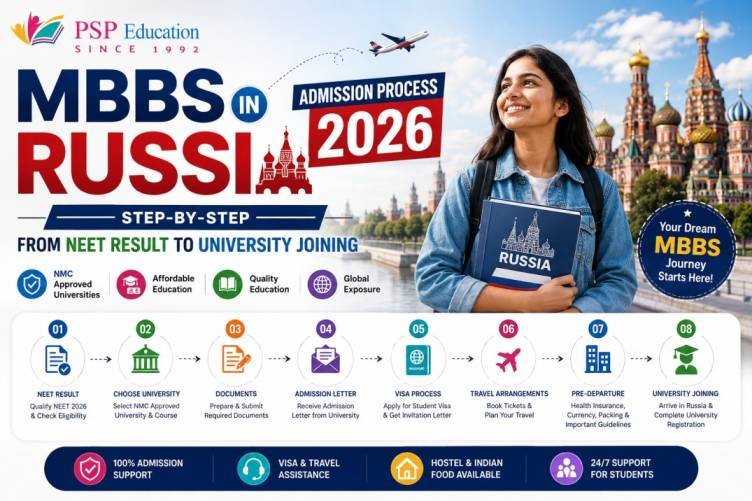
Step 1: Check Your NEET and Academic Eligibility
Before you shortlist a single university, confirm the basics.
NEET
NEET-UG, conducted by the National Testing Agency (NTA), is currently required for Indian citizens and OCI students before joining an MBBS programme abroad, as per National Medical Commission guidelines. Qualifying NEET is a starting condition — it doesn't by itself guarantee admission to any particular university.
Class 12
You need 10+2 with Physics, Chemistry, Biology (or Biotechnology) and English from a recognised board.
PCB
Minimum PCB aggregate is generally 50% for General/EWS category and 40% for SC/ST/OBC category, as per current NEET eligibility norms. This is calculated only from your Physics, Chemistry and Biology marks — not your overall Class 12 percentage.
Age
Minimum age is 17 years by 31 December of the admission year, under current NEET norms. There is currently no upper age limit for NEET-UG, though individual universities may apply their own internal policies.
Other applicable requirements
A valid passport (or one in process) and basic medical fitness are commonly expected further down the process, though these are usually confirmed closer to the visa stage rather than at this first step.
Requirements can be updated by NMC or NTA at any time — always cross-check the latest official notification on nmc.org.in before finalising a decision. If your NEET score is on the lower side and you're unsure what that means for MBBS abroad, our breakdown of MBBS abroad options by NEET score looks at this in more depth.
Step 2: Shortlist Russian Medical Universities
Once eligibility is confirmed, the next step is narrowing down from Russia's 40+ state medical universities to a realistic shortlist of three to five.
What Indian Students Should Compare
- NMC/WHO status — is the university currently recognised, and listed in the WHO World Directory of Medical Schools?
- Fee structure — annual tuition, hostel charges, and total 6-year cost
- City and climate — a Siberian winter is a different experience from a southern Russian city; our guide on MBBS in Russia cities for Indian students compares cost, climate and student life across popular cities
- Course structure and clinical training — how early clinical exposure begins, and where hospital rotations happen
- Language of instruction — confirm the MBBS programme itself is taught in English, with Russian offered separately for clinical communication
- Duration — should meet or exceed NMC's minimum course and internship requirements
- Hostel and safety — separate hostels, security, Indian food availability
- Student support — presence of an international office, Indian student community, and grievance handling
- Long-term career fit — how the university's FMGE/NExT track record and course structure align with your future plans
If you want a structured way to weigh these factors against each other rather than picking by name recognition alone, our 15-point university selection framework walks through this decision step by step. Universities such as Altai State Medical University, Kirov State Medical University, Ulyanovsk State University, Yaroslavl State Medical University and Chita State Medical Academy are among those Indian students commonly evaluate, but the right fit depends entirely on your own budget, academic profile and preferences — not on any single "best university" list.
Step 3: Verify the University Before Applying
This step is easy to skip when you're excited about an offer, and it's exactly where problems tend to start.
What to Check on Official Sources
- The university's current status directly on its official website, not only through a brochure or agent
- Whether the university appears in the WHO World Directory of Medical Schools
- The official fee structure, in writing, from the university itself
What Indian Students Should Verify Before Paying
- That the admission communication is coming from the university's own domain or verified representative, not an unofficial WhatsApp number
- That the course duration and internship structure meet NMC's FMGL requirements — a minimum 54-month course plus a 12-month internship completed in the same foreign institution
- That fee instructions point to an official university account, not a personal or third-party account
For a fuller list of warning signs at this stage, see MBBS abroad university red flags to check before paying — it covers 15 specific things worth checking before any payment leaves your account.
Step 4: Prepare Your MBBS in Russia Documents
Once you've verified the university, document preparation can begin. Requirements can vary by university and by the visa process, so treat the list below as commonly requested, not universal.
Academic Documents
- Class 10 certificate and marksheet
- Class 12 certificate and marksheet
Identity Documents
- Valid passport (commonly recommended to have at least 18 months of validity remaining at the time of visa processing)
- Passport-size photographs, as per university/visa specifications
- Birth certificate or other age proof, where required
NEET Documents
- NEET-UG scorecard/result (mandatory)
Medical/Other Documents
- Basic medical fitness certificate, where required
- HIV test report, typically required later at the visa stage, valid within a specific window (commonly one to three months) before the application
- Transfer or migration certificate, where applicable
- Any additional university-specific forms
Commonly requested vs university-specific: treat the academic, NEET and passport documents above as commonly requested by most universities, while medical certificates, HIV reports, and additional affidavits are more likely to be university- or visa-specific. Always request a written, itemised checklist from your chosen university rather than working from a generic list.
Russia MBBS Admission Verification Checklist
- Passport
- Class 10 certificate
- Class 12 certificate
- NEET scorecard/result
- Passport photographs
- Medical documents where required
- Birth/age proof where required
- Other university-specific documents
- Visa-related documents
- Original/certified documents where required
Requirements can vary by university and visa process — confirm the current list directly with your chosen institution before submission.
Step 5: Submit the University Application
With documents ready, scanned copies are submitted to the shortlisted university, either directly or through your counsellor, along with the completed application form.
What Happens After Application?
The university's admission office reviews your documents against its own criteria. This can take anywhere from a few days to a couple of weeks depending on the university and the volume of applications during that intake period — there's no single fixed timeline that applies to every institution, so ask your chosen university what to expect for their current cycle.
Step 6: Receive Admission / Offer Confirmation
If your documents meet the university's requirements, you'll receive an official admission or offer letter.
What Students Should Check Before Confirming
- That the course name matches "MBBS" or its Russian equivalent (often referred to locally as a specialist physician programme) and is what you actually applied for
- The exact course duration stated on the letter
- The complete fee structure attached to the offer, including tuition, hostel and any other charges
- That the letter is issued on the university's official letterhead, with verifiable contact details
Do not treat a verbal or WhatsApp confirmation as equivalent to a written admission letter directly from the university.
Step 7: Understand Fees and Payment Requirements
This section covers only what you need to know about fees at the admission stage — for full tuition breakdowns and cost comparisons across universities, see our MBBS in Russia fees guide.
Tuition
Most Russian government medical universities charge a fixed annual tuition fee, generally without donation or capitation charges. The exact figure varies significantly by university and city.
Other Charges
Hostel fees, medical insurance and sometimes a one-time registration charge may be billed separately from tuition. Ask for an itemised breakdown rather than a single lump-sum figure.
Payment Proof
Once you pay, insist on an official receipt from the university, not just a bank transfer confirmation. Keep this for your records and for any future loan or visa documentation.
Step 8: Complete the Invitation and Student Visa Process
Admission and the visa process are two separate things, and they don't always move at the same pace.
What Happens After Admission?
Once your admission is confirmed, the university typically initiates an official invitation letter through Russia's migration authorities (commonly referenced as GUVM, under the Ministry of Internal Affairs). This invitation letter — not just the admission letter — is generally the document Indian students need before applying for a Russian student visa at the consulate or visa application centre.
Alongside the invitation letter, the visa application generally requires a completed visa form, a medical fitness certificate, an HIV-negative test report (valid within a specific recent window), proof of sufficient funds, and travel insurance. Indian students are generally not required to attend a personal interview for this visa, though requirements can change, so check current guidance from the Russian consulate or your university's international office.
Processing time can vary depending on the university, documentation, immigration process and individual circumstances — published estimates for Russian student visas commonly range from around two to four weeks, but this is not guaranteed for every applicant. Build in a buffer rather than planning travel around a best-case timeline.
The initial visa issued is commonly a single-entry visa valid around 90 days; it is then typically extended by the university once you arrive and register in Russia, for the duration of your academic year, renewable annually. This extension process, and the exact documentation it requires, should be confirmed with your specific university's international office.
Step 9: Prepare for Travel to Russia
Once the visa is issued, it's time for practical departure preparation.
Documents
Carry originals and multiple photocopies of your passport, visa, admission letter, invitation letter, academic certificates and NEET scorecard — both in hand luggage and backed up digitally.
Money
Arrange forex for initial expenses and keep a mix of cash and card access. Confirm with the university how and where the first tuition instalment, if still pending, should be paid.
Clothing
If heading to a colder region, pack layered winter clothing; many universities advise buying heavier winter gear locally once you arrive, since it's suited to local conditions.
Medicines
Carry a basic personal medical kit and any prescription medication, along with the prescription itself, in case customs questions arise.
Communication
Set up an international roaming plan or research local SIM options in advance so you're reachable during transit and on arrival.
Emergency Contacts
Save the university's international office number, the nearest Indian embassy/consulate contact, and your family's emergency contacts before you fly.
Step 10: Arrive in Russia
Airport to University
Some universities arrange airport pickup for new international students; others expect you to arrange your own transfer. Confirm this in advance so you're not stranded on arrival.
University Reporting
On reaching the university or hostel, you'll typically report to the international student office with your original documents for verification.
Document Verification
Expect your passport, visa, admission letter and academic certificates to be checked against the copies submitted earlier. Keep everything organised and easily accessible for this step.
Step 11: Hostel and University Registration
Hostel
Most universities require first-year international students to stay in university-provided hostels, primarily for safety and ease of settling in.
Registration
A mandatory step for all international students in Russia is migration registration with local authorities, generally required within a set number of working days of arrival (commonly around seven). Universities typically handle this on behalf of students, but you should confirm it has been completed — it is a legal requirement, not an optional formality.
Orientation
Universities usually run an orientation covering campus facilities, academic calendar, local rules, and introductions to faculty and senior students.
Step 12: Start Your MBBS Classes
Academic Routine
Classes typically begin with foundational subjects — anatomy, physiology, biochemistry — before progressing into pathology, pharmacology and clinical subjects in later years.
Attendance
Russian medical universities generally maintain structured attendance requirements; missing classes without valid documentation can affect your standing.
Language
While the MBBS programme is taught in English, most universities include compulsory Russian language classes early on, since clinical years require basic communication with patients.
Clinical Education
Hands-on clinical exposure typically begins in the middle years of the course, through rotations at affiliated teaching hospitals.
MBBS in Russia Admission Timeline 2026
| Stage | What Happens | Approximate Timing | What Can Affect Timing |
|---|---|---|---|
| Eligibility check + university shortlisting | Student reviews NEET status, compares universities | Days to a few weeks | How quickly documents and decisions are ready |
| Application submission | Documents submitted to chosen university | Varies by university | Document completeness |
| Admission review | University verifies documents | Days to a couple of weeks | University's application volume during intake |
| Fee payment | Student pays applicable fees | As per university instructions | Bank transfer processing, currency conversion |
| Invitation letter | University initiates invitation via migration authorities | Varies by university | Documentation accuracy, university processing speed |
| Visa application | Student applies at consulate/visa centre | Commonly a few weeks, varies by embassy | Completeness of documents, embassy workload, season |
| Travel | Student departs for Russia | After visa issuance | Flight availability, academic calendar |
| Arrival & joining | Registration, hostel, orientation, classes begin | Within days of arrival | University's onboarding schedule |
Primary intake for most Russian medical universities is commonly in September, with a smaller intake at some universities in February. Exact intake dates, and how much lead time each stage needs, differ by university — always confirm the current year's calendar with your chosen institution rather than assuming a fixed date.
Is It Too Late to Apply for MBBS in Russia After NEET Counselling?
This depends entirely on the specific university, remaining seat availability, the academic calendar and how quickly your documents and visa process can move — there is no single answer that applies to every student. Some universities continue accepting international applications after India's NEET counselling rounds conclude, since their own intake calendar doesn't run on the same schedule as Indian counselling. Others may have limited seats remaining by that point. If you're weighing this question specifically after NEET counselling, our dedicated guide on MBBS in Russia after NEET counselling looks at what's realistically involved in applying at this stage. The only reliable way to know your options is to check directly with universities or your counsellor about current seat availability and deadlines for the specific intake you're targeting.
What Can Delay Your Russia MBBS Admission?
- Incomplete or incorrectly attested documents
- Mismatched spelling or details between passport and invitation letter
- Delayed HIV test or medical certificate submission
- Payment sent to an unverified account, requiring correction and resubmission
- High application volume at the university during peak intake
- Visa appointment availability at the consulate
- Slow response in submitting requested documents
10 Mistakes Students Make During MBBS in Russia Admission
- Applying before actually checking their own eligibility
- Choosing a university only because it has the lowest fees
- Not verifying the university's current recognition status independently
- Ignoring the exact course name and structure on the offer letter
- Not asking where and how clinical training will actually happen
- Skimming past the fee terms instead of getting them in writing
- Paying into an account that isn't clearly the university's own
- Waiting until the last moment to prepare documents and apply for a passport
- Assuming every Russian university follows an identical process and timeline
- Overlooking how the course's structure connects to future medical registration requirements in India
Before Paying Any Russia MBBS Admission Fee: 10 Checks
Suppose a student receives their NEET result and wants to move quickly on Russia. The first step should not be transferring an admission fee the same week — it should be confirming these ten things first:
- University identity — confirm you're dealing with the actual university, not an intermediary claiming to represent it
- Official admission confirmation — a written letter on the university's letterhead, not a verbal promise
- Course name — matches MBBS or its recognised local equivalent
- Fee structure — a complete, itemised breakdown, not a round number
- Payment recipient/account — matches the university's own official account details
- Official receipt — issued after payment, not just a transaction screenshot
- Refund terms where applicable — understand what happens if a visa is refused
- Hostel details — confirmed in writing, not assumed
- Clinical training information — where and how it will actually be conducted
- Regulatory requirements — course duration and internship structure checked against NMC's FMGL norms
Strongly avoid paying based solely on WhatsApp promises, verbal guarantees, artificial urgency ("seats closing tonight"), unofficial bank details, unclear documents, or unverified screenshots. A genuine university admission process does not require you to skip verification steps.
What Parents Should Verify Before Confirming Admission
- The university's identity and current status
- The exact course and its duration
- The complete fee structure, including hidden costs
- Hostel arrangements and safety measures
- The city the student will actually be living in
- How and where clinical training will happen
- The full document checklist and its deadlines
- Visa requirements and realistic processing time
- Refund or cancellation terms, in writing
- How this specific course fits the student's long-term plan to eventually register and practise as a doctor
How PSP Education Helps Students With the MBBS in Russia Admission Process
Trying to manage NEET-status checks, university verification, documentation, invitation letters and visa timelines entirely on your own — often while still finishing school or waiting on results — is where a lot of avoidable delays and mistakes happen.
PSP Education has been guiding Indian students through MBBS abroad admissions since 1992. At this stage, our role is to make the process clearer and more predictable, not to promise outcomes we can't control. That includes:
- Reviewing your NEET score and academic background against current eligibility requirements
- Shortlisting NMC-compliant universities that genuinely fit your budget and preferences
- Explaining university-specific admission criteria and documentation in writing
- Coordinating document submission with the university's admission office
- Explaining the fee structure clearly, so there are no surprises later
- Guiding you through the invitation letter and student visa process
- Helping with pre-departure preparation and travel planning
- Supporting hostel confirmation and arrival coordination
- Staying available to parents throughout, not just to the student
We do not guarantee admission, visa approval, NMC recognition, or future FMGE/NExT results — these depend on your documents, the university's own review, regulatory decisions and your personal preparation. What we can offer is accurate, step-by-step guidance so you're making decisions with real information rather than assumptions.
If you're planning MBBS in Russia after NEET 2026 and are unsure about the right university, documents or admission steps, PSP Education can help you understand the process and evaluate your options before you make an admission decision. Get free counselling or speak with our team directly.
FAQs
What is the admission process for MBBS in Russia?
It generally involves checking NEET and academic eligibility, shortlisting and verifying a university, submitting documents, receiving admission confirmation, completing fee payment, applying for the invitation letter and student visa, then travelling, reporting to the university and starting classes. Exact steps and order can vary by university.
How can Indian students apply for MBBS in Russia after NEET?
After confirming NEET qualification and academic eligibility, students shortlist and verify a university, submit required documents through the university's application process, and proceed through admission confirmation, fee payment and visa formalities once accepted.
What are the steps to get admission in MBBS in Russia?
Broadly: eligibility check, university shortlisting, university verification, document preparation, application submission, admission confirmation, fee payment, invitation and visa processing, travel, arrival, and university registration. See the step-by-step table above for details.
Is NEET required for MBBS in Russia for Indian students?
Yes. Qualifying NEET-UG is currently a requirement under NMC guidelines for Indian citizens and OCI students pursuing an undergraduate medical course abroad, including in Russia.
What documents are required for MBBS in Russia?
Commonly requested documents include a valid passport, Class 10 and 12 certificates, NEET scorecard, passport photographs, and medical/HIV documentation closer to the visa stage. Exact requirements vary by university and should be confirmed directly.
When should I apply for MBBS in Russia after NEET?
As soon as your NEET result and eligibility are confirmed, since document preparation, university verification and visa processing all take time. Exact deadlines differ by university and intake, so check with your shortlisted institutions directly.
How long does MBBS Russia admission take?
There's no single fixed duration — it depends on how quickly documents are ready, how the university processes applications, and how long visa processing takes for your specific case. Build in several weeks of buffer rather than assuming a fixed number.
What happens after getting admission to a Russian medical university?
After admission, the university typically initiates your official invitation letter, after which you apply for a student visa, prepare for travel, and then complete arrival formalities including registration and hostel allotment.
How does the Russia MBBS visa process work?
Broadly, the university arranges an official invitation letter through Russian migration authorities, which you then use to apply for a student visa at the consulate or visa centre, along with a visa form, medical/HIV documentation and proof of funds. Processing time and exact requirements vary and should be confirmed with the current consulate guidance.
What happens after arriving in Russia for MBBS?
Students typically go through airport-to-university transfer (where arranged), report to the international office with original documents, complete migration registration, get hostel allotment, and attend orientation before classes begin.
How do I join the university after reaching Russia?
By reporting to the university's international student office with your original documents, completing document verification and any required registration, and then attending orientation before your academic year officially starts.
Can I apply for MBBS in Russia after NEET counselling?
It's possible in many cases, since Russian universities generally don't run on India's exact counselling calendar, but it depends on the specific university's remaining seats and deadlines for that intake. Always verify current availability directly.
Is it possible to apply late for MBBS in Russia?
Sometimes, depending on the university and how many seats remain for that intake cycle — but this should never be assumed. Confirm current deadlines and seat status with your shortlisted universities before planning around a late application.
How should I verify a Russian medical university before paying?
Check the university's official website directly, confirm its recognition status independently, request a written admission letter and fee structure, and avoid paying into any account that isn't clearly the university's own.
Does admission to a Russian university guarantee medical registration in India?
No. Admission to a university only confirms you can join that course. Future eligibility to register and practise medicine in India depends separately on the course meeting NMC's FMGL requirements and on clearing the applicable licensing exam after graduation.
This article provides general guidance based on information available at the time of publishing. NEET, NMC and Russian admission/visa requirements can be updated at any time — always verify current rules directly with the National Medical Commission, the National Testing Agency, and your chosen university before making any admission or payment decision.