

MBBS Abroad Without NEET? What Indian Students Can and Cannot Do Guide
Every year, right after NEET results are declared, a familiar pattern repeats. A student doesn't get the score they hoped for. A parent starts searching late at night. And somewhere in that search, an advertisement or a consultant's message shows up saying "MBBS Abroad Without NEET — 100% Admission Guaranteed."
It sounds like a way out. But it's also the point where a lot of Indian families make decisions based on half the picture.
This article is written to give you the full picture — not a sales pitch, and not a scare story either. As a counsellor, the most useful thing we can do here is separate two questions that keep getting merged into one: can a foreign university admit you without NEET, and can you, as an Indian citizen, actually use that MBBS degree afterward. Those are not the same question, and 2026's rules make the difference matter more than ever.
Quick Answer: Can Indians Study MBBS Abroad Without NEET?
A foreign university may admit international students under its own criteria, and some do not ask for NEET at the point of admission. But for an Indian citizen or OCI cardholder, qualifying NEET-UG before joining that foreign course is currently a requirement under National Medical Commission (NMC) regulations if you ever want to appear for the FMGE/NExT screening test or register to practise medicine in India. A university's admission decision and India's regulatory eligibility are governed by two entirely different authorities.
What Does "MBBS Abroad Without NEET" Actually Mean?
This phrase gets used loosely, and that's exactly where the confusion starts. It can mean at least three different things, and each has a different answer:
- "Can a foreign university let me join without asking for NEET?" — Possibly yes, depending on the university and country. This is an admission-office decision.
- "Can I, as an Indian student, skip NEET and still have my degree count in India later?" — No, not under current NMC rules, if you were admitted after the applicable cut-off dates discussed below.
- "Does not qualifying NEET mean I have zero options?" — Not necessarily either — it depends on what your actual goal is (see the sections on low score vs non-qualification further below).
University Admission vs Indian Eligibility
Think of these as two separate gates, run by two separate authorities, that happen to sit on the same road:
- Gate 1 — University Admission: Set by the individual foreign university. It decides who it will teach, based on its own academic policy, seat availability and documentation requirements.
- Gate 2 — Indian Regulatory Eligibility: Set by the NMC, under the Foreign Medical Graduate Licentiate (FMGL) Regulations, 2021, and related NEET-UG rules. It decides whether your foreign degree can later lead to registration and practice in India.
Passing through Gate 1 says nothing about Gate 2. A student can be admitted by a university abroad and still be completely unable to register as a doctor in India. That single sentence is the core of everything else in this article.
If you haven't yet worked through the basic academic and NEET-related conditions that apply before applying anywhere, our detailed breakdown in MBBS Abroad Eligibility 2026: What Indian Students Need Before Applying After NEET is a useful starting point before you go further into this article.
Is NEET Required for Indian Students Who Want to Study Medicine Abroad?
Yes — for Indian citizens and OCI cardholders who want their foreign MBBS to eventually count toward practising medicine in India. Under NMC guidance, since admissions on or after May 2018 (with the current framework formalised through the FMGL Regulations, 2021, notified 18 November 2021), Indian students must qualify NEET-UG before taking admission in a foreign medical institution. The NEET-UG result itself now also serves as the "Eligibility Certificate" for this purpose — a separate certificate is not needed for students in this category. This isn't a PSP Education interpretation; it reflects the NMC's own published guidance for students planning to study abroad, and it was upheld by the Supreme Court of India when a group of students challenged the requirement and sought a one-time exemption.
There is one detail students often misunderstand: you don't need a high score, you need a qualifying one. The NMC does not prescribe a separate cut-off for studying abroad — you need to meet the qualifying percentile for your category in the same NEET-UG exam Indian MBBS aspirants take, as declared by the National Testing Agency (NTA) each year. A university abroad is very unlikely to ask what your score was — it typically only wants to see that you have a valid, qualifying NEET-UG result.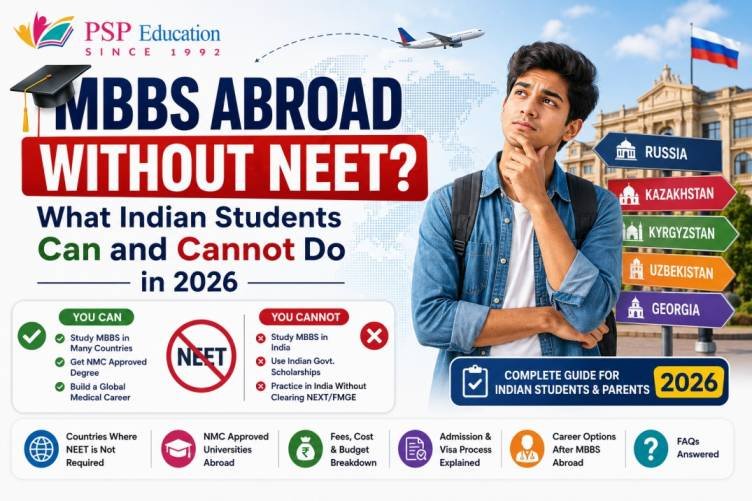
Why Foreign University Admission and Indian Medical Eligibility Are Different
Here's a hypothetical example — not describing any real university or applicant, just illustrating the mechanism.
Suppose a university in Country X advertises: "No NEET required for international admission." A student who did not qualify NEET applies, submits Class 12 marksheets and a passport, and receives an admission letter within a week.
What has actually happened here? The university has confirmed that, by its own internal policy, it is willing to teach this student. It has not confirmed, and cannot confirm, whether Indian regulations will later allow that same student to sit the licensing exam or register with an Indian State Medical Council. A foreign university's admission office has no authority over the NMC's rules — and typically has no obligation to explain them to you either, since NEET compliance is your responsibility as an Indian applicant, not theirs.
This is why a claim like "no NEET required" is not necessarily false — it may accurately describe that specific university's admission process. What it leaves out is everything that happens after your five or six years abroad are complete.
What Can You Do If You Did Not Qualify NEET in 2026?
This is the honest, non-sensational answer:
- You can reappear for NEET. NEET-UG is conducted annually, and there is currently no cap on the number of attempts under NMC/NTA rules. Many students who narrowly miss the qualifying percentile in one year qualify comfortably the next.
- You can explore non-medical academic paths if your longer-term goal is a science, allied-health, or healthcare-adjacent career that doesn't require NMC registration as a doctor.
- You can still study medicine at a foreign university without NEET, in the narrow sense that some universities will admit you — but you should go in with complete awareness that this route, under current rules, is very unlikely to lead to registration and independent practice as a doctor in India.
- You cannot assume that a foreign admission letter retroactively solves the NEET requirement. It doesn't, because the two are decided by different bodies for different purposes.
If your real question is about a low score rather than a missed qualification altogether, that's addressed separately below — the two situations are not the same, and the confusion between them causes a lot of avoidable stress.
What You Cannot Assume If a University Accepts You Without NEET
Getting an offer letter feels like validation. It is validation — of your eligibility for that university's programme. It is not validation of anything related to Indian medical registration. Specifically, an admission offer without NEET does not mean:
- That the National Medical Commission will recognise your eventual degree for registration purposes.
- That you will be allowed to appear for FMGE or the upcoming National Exit Test (NExT).
- That your internship, wherever completed, will count toward Indian registration requirements.
- That a consultant's verbal assurance of "NMC approved" is the same as an official NMC listing (the NMC does not maintain a list of "approved" foreign universities — it publishes rules that universities and courses must meet, and verification is the student's own responsibility).
- That visa approval by the destination country's embassy has anything to do with Indian medical eligibility. A visa confirms you're allowed to enter and study in that country — nothing about India.
MBBS Abroad Without NEET: Country-Wise Reality
No two MBBS-abroad destinations run identical admission systems, and painting them all with the same brush does students a disservice. What is consistent across every country below is this: the NEET-UG requirement is an Indian regulation, not a foreign one. It applies to you as an Indian applicant regardless of which country or university you choose. What varies is how strictly individual universities check for it at the admission stage, and how the course structure aligns with NMC's other requirements (course duration, English medium, clinical training, single-institution internship).
Russia
Russia remains one of the largest destinations for Indian MBBS aspirants, with dozens of state medical universities offering English-medium programmes. Admission processes and document checklists differ by university, but Indian applicants are consistently expected to hold a qualifying NEET-UG result as part of their eligibility profile, in line with NMC requirements. For a full breakdown of universities, cities, costs and the detailed admission journey, see the complete MBBS in Russia guide and our step-by-step MBBS in Russia admission process for 2026.
Kazakhstan
Kazakhstan hosts several government medical universities with English-medium MBBS tracks for international students. As with Russia, university-level admission requirements are set by each institution, but Indian students still need to independently satisfy NEET and other NMC-linked conditions if they want the degree to hold value for Indian registration later. Explore MBBS university options in Kazakhstan for institution-specific detail.
Kyrgyzstan
Kyrgyzstan is a popular lower-cost option among Indian applicants, with several medical academies offering English-medium instruction. University admission criteria are set locally, but the same Indian-side NEET and NMC compliance questions apply exactly as they do for every other country on this list. See MBBS study options in Kyrgyzstan for university-wise information.
Uzbekistan
Uzbekistan has grown as an MBBS destination in recent years, with a handful of state medical universities and institutes offering international programmes. Admission is university-driven, but again, an Indian applicant's future ability to register in India rests on NEET qualification and NMC compliance, not on the university's own entry bar. Details are available on our MBBS in Uzbekistan page.
Georgia
Georgia is home to a smaller number of medical universities that actively court international students, often with relatively compact intake sizes. As with the other countries above, university admission and Indian regulatory eligibility remain two separate tracks that a student must satisfy independently. See MBBS in Georgia for the universities we cover.
China
China's medical universities operate under a structured, government-regulated admission process for international students, and several offer MBBS (Bachelor of Medicine and Bachelor of Surgery) programmes in English. Chinese universities set their own entry requirements; separately, Indian applicants must still meet NEET-UG and other NMC-linked conditions to keep the India-return route open. Programme structure and duration should be checked carefully here, since some Chinese MBBS courses run on a different academic calendar than the NMC's expected minimum. See our MBBS in China overview for university-specific detail.
Nepal
Nepal is a geographically and culturally closer option for many Indian families, with several private medical colleges offering MBBS seats, including a portion reserved under bilateral arrangements for Indian students. University-level entry norms (which can include entrance tests specific to Nepal) exist alongside — not instead of — the Indian-side NEET requirement for students who want their degree to count for NMC registration later. See MBBS in Nepal for what we currently cover on this destination.
A note on scope: this list reflects the countries our own destination pages currently cover in detail. Other countries occasionally advertise "MBBS without NEET" programmes to Indian students; where we don't have verified, current information on a specific country's university-admission landscape, we'd rather say so than guess. If a destination isn't listed here, that is not an endorsement or a rejection of it — it simply means you should ask us or verify independently before proceeding.
Country-Wise Comparison Table
| Country | University Admission Requirement | NEET Position for Indian Students | Important India-Return Consideration | What to Verify |
|---|---|---|---|---|
| Russia | Set independently by each state medical university (documents, application, fee schedule) | NEET-UG qualification required under NMC rules for future India-registration eligibility, regardless of university's own admission checklist | Course duration, English medium and single-institution internship must meet NMC's FMGL norms | Current recognition status, course structure, official fee account, WHO World Directory listing |
| Kazakhstan | Set independently by each university | Same as above — NEET applies to the Indian student, not the Kazakh university | Same FMGL compliance checks apply before assuming India-return value | University's official communication, course duration, clinical training location |
| Kyrgyzstan | Set independently by each medical academy | Same as above | Same FMGL compliance checks apply | Recognition status, English-medium confirmation, fee structure in writing |
| Uzbekistan | Set independently by each university/institute | Same as above | Same FMGL compliance checks apply | University's official documentation, course duration and internship location |
| Georgia | Set independently by each university | Same as above | Same FMGL compliance checks apply | Official admission letter, intake size, recognition status |
| China | Set by China's international-admission framework and each university | Same as above | Programme duration/structure should be checked against NMC's minimum course expectations | Ministry-recognised university status, English-medium confirmation, internship arrangement |
| Nepal | Set by Nepal's private medical colleges, sometimes via bilateral quota | Same as above | Physical proximity does not change NMC's regulatory requirements | Recognition status, bilateral-quota terms if applicable, fee structure |
University-level admission criteria may differ from country to country and even university to university, but Indian students must separately, and independently, satisfy applicable Indian medical-education requirements no matter where they enrol. Students should verify the latest applicable requirement with the NMC and the concerned university before admission.
Does a Foreign University Requiring No NEET Mean an Indian Student Can Study MBBS Without NEET?
Short answer: no, not in the sense that matters for your future in India.
A university's decision not to ask for NEET at the admission stage tells you about that university's internal policy. It does not, and cannot, override an Indian regulatory requirement, because the university has no jurisdiction over Indian medical registration rules. This is worth repeating in plain language because it's the single most common misunderstanding behind "MBBS abroad without NEET" advertising: university admission policy is not the same as Indian regulatory eligibility.
The Main Decision Framework
Use this as a starting checklist, not a substitute for professional verification.
Did you qualify NEET-UG (met the qualifying percentile for your category)?

    │
    ├── YES
    │     → You can explore MBBS abroad options.
    │     → Still verify: university recognition, course duration,
    │        English medium, clinical training location, fee structure.
    │
    └── NO / DID NOT QUALIFY
          → Do NOT assume a foreign university's admission offer
             solves the Indian eligibility question.
          → Before deciding anything, check:
                1. Current NMC requirements for foreign medical study
                2. The specific university's own eligibility criteria
                3. Country-specific admission and course-structure rules
                4. What India-return / registration would realistically involve
          → Consider whether reappearing for NEET is a more direct path
             if your goal is to register and practise in India.

Either way → make the decision only after independent verification,
             not on the basis of an advertisement or a single consultant's claim.
Can You Study MBBS Abroad Without NEET and Later Practise Medicine in India?
Under the current NMC framework, if you were admitted to a foreign medical course without a qualifying NEET-UG result (for admissions falling under the post-2018/FMGL 2021 framework), you would not be eligible to appear for the FMGE/NExT screening examination or seek registration with the NMC or a State Medical Council. This isn't a minor procedural gap — it is described by the NMC's regulations as a threshold requirement, not something that gets reconsidered case-by-case after the fact. The Supreme Court's 2025 ruling on this point specifically declined to grant exemptions, noting that the regulation does not stop anyone from practising medicine outside India, but it does control eligibility to practise within India.
If your intention is to build a medical career in India, NEET is not a formality to work around — it is the condition that keeps that path open at all. If your plans genuinely involve practising outside India permanently, the calculation is different, but that is a decision to make with full information, not as a fallback explanation after enrolling somewhere.
For students thinking further ahead about what a career actually looks like after finishing MBBS abroad, our detailed piece on career paths after MBBS abroad walks through the realistic routes available, including what depends on NEET compliance and what doesn't.
What NMC Rules Should Indian Students Check Before Admission?
At minimum, verify these directly against current NMC and university sources before paying anything:
- Whether you currently hold a valid, qualifying NEET-UG result, and its validity window (commonly understood as roughly three years for the purpose of taking foreign admission, though students should confirm current guidance).
- Whether the specific course runs for at least the minimum duration NMC expects (54 months of academic study plus a 12-month internship, completed at the same institution).
- Whether the entire programme, including clinical postings, is genuinely conducted in English.
- Whether the internship must be completed in the same country/institution as your academic years — under FMGL 2021, it generally cannot be shifted to India.
- Whether the university's medium of instruction, teaching hospital access, and clinical exposure meet NMC's expectations for a genuine, hands-on medical education.
The NMC does not maintain or publish a list of "approved" foreign universities; it publishes the applicable rules and leaves verification to the student. Where we cannot independently verify a specific claim, we say so rather than assert it — and you should expect the same standard from anyone advising you.
What Happens If You Ignore the NEET/NMC Requirements?
The consequences aren't limited to "a bit of extra paperwork later." Based on the NMC's own published position, ignoring these requirements can mean:
- You will not be permitted to sit the FMGE or, later, NExT.
- You cannot obtain permanent registration with any State Medical Council or the NMC.
- You cannot legally practise medicine, prescribe, or hold a clinical position in India.
- The years and money invested in the foreign degree will not translate into an Indian medical career, regardless of how strong the clinical training itself was.
- There is currently no described appeal or exception mechanism for non-compliance discovered after the fact — verification has to happen before admission, not after.
This is exactly why this decision deserves the same seriousness as any major financial and academic commitment — because in this specific case, a mistake made at 18 is very difficult to reverse at 24.
Low NEET Score vs Not Qualifying NEET: What's the Difference?
These two situations get treated as identical online, and they are not.
- Qualifying NEET means you met the minimum percentile set for your category by the NTA. This is a pass/fail line, unrelated to how competitive your score is for a government MBBS seat in India.
- A low NEET score means you qualified, but your rank isn't strong enough for the government or affordable private seats you were hoping for through India's counselling process. You are still NEET-qualified in the eyes of the NMC.
- Not qualifying NEET means you did not cross the minimum percentile at all, and currently do not hold a valid, qualifying result.
These lead to very different sets of options. A student with a low but qualifying score can generally still pursue MBBS abroad while remaining NMC-compliant, since the qualification itself — not the score — is what matters for India-return eligibility. A student who did not qualify at all faces the harder conversation covered throughout this article. We've written a dedicated piece specifically for the low-score situation — Low NEET Score in 2026? MBBS Abroad Options by Score, Budget & Country — which goes deeper into budget and country choices once qualification itself isn't in question.
A related situation: qualifying NEET but not getting a seat through counselling
There's a third scenario worth naming clearly, because it's often confused with "not qualifying." A student can:
- Qualify NEET,
- Participate in India's counselling rounds, and
- Still not receive an MBBS seat in India, purely because of limited seats and high competition.
This student remains NEET-qualified. Choosing MBBS abroad from this position is a completely different situation, regulation-wise, from a student who never crossed the qualifying line and is hoping a foreign admission offer will substitute for it. If this describes your situation, most of the "without NEET" conversation in this article doesn't actually apply to you — your NEET status is already valid.
MBBS Abroad After NEET Qualification vs Without NEET
| Aspect | NEET-Qualified Student Going Abroad | Student Without a Qualifying NEET Result |
|---|---|---|
| University admission | Generally possible, subject to that university's own criteria | May still be possible at some universities |
| FMGE/NExT eligibility later | Preserved, subject to meeting other NMC/FMGL conditions (course duration, English medium, internship location) | Not available under current NMC rules |
| NMC/State Medical Council registration | Remains a realistic future path if all other FMGL conditions are met | Not available under current NMC rules |
| Practising medicine in India | Possible after clearing the applicable screening exam and internship requirements | Not currently possible under NMC's framework |
| Recommended next step | Verify university and course-structure compliance carefully | Reconsider reappearing for NEET if an Indian medical career is the goal |
What Indian Students CAN Do
- Check your current NEET-UG status and its validity window.
- Verify current NMC requirements directly, not through a consultant's paraphrase.
- Research each shortlisted university's admission requirements independently.
- Compare countries on cost, course structure, clinical training and safety — not marketing claims.
- Confirm the course duration and internship structure against NMC's minimum expectations.
- Ask for the university's credentials and current recognition status in writing.
- Review the complete, itemised cost of the programme, not just the headline tuition figure.
- Request written documentation for every claim a consultant makes.
- Consult official sources — NMC, NTA, the university's own website — before deciding anything.
- Get professional counselling from someone willing to explain limitations, not just possibilities.
- Make your final decision only after weighing both the foreign admission process and the Indian regulatory picture together.
What Indian Students CANNOT Assume
- "The university accepted me, so everything is legal for my future in India." Admission and Indian regulatory eligibility are decided separately, by separate authorities.
- "NEET doesn't matter because I'm studying abroad." NEET is an Indian requirement tied to your citizenship and future registration goals, not to where you study.
- "Any foreign medical degree is automatically accepted in India." It is not automatic — it depends on NEET compliance, course structure and clearing the applicable licensing exam.
- "The consultant says NMC approved, so it must be true." The NMC does not publish an "approved list" of foreign universities — verify independently on official sources.
- "I can definitely practise in India after graduation." This depends on multiple conditions being met from day one of admission, not just on completing the degree.
- "FMGE/NExT will definitely be easy." These are genuine licensing exams, and outcomes depend on your own preparation and the quality of your foreign education.
- "Visa approval means medical eligibility." A student visa confirms your right to study and reside in that country — it has no bearing on Indian medical registration.
- "Low fees mean a better option." A lower headline fee can sometimes reflect a university or programme that doesn't meet NMC's structural requirements — cost and compliance are separate questions.
MBBS Abroad Without NEET: 10 Red Flags in Advertisements and Consultant Claims
- "100% guaranteed admission without NEET" — no one can guarantee outcomes that depend on documentation, university review and regulatory compliance.
- "NMC approval guaranteed" — the NMC does not pre-approve individual student applications.
- "No NEET needed for Indian registration" — this contradicts the NMC's own published position.
- "You can definitely practise in India" — no consultant can guarantee a future licensing-exam outcome or regulatory decision.
- "No exam required, ever" — FMGE/NExT remains a real requirement for foreign medical graduates who intend to practise in India.
- "Any university is acceptable" — course structure, English medium and clinical training quality vary significantly and matter for compliance.
- "Pay immediately or lose your seat" — artificial urgency is a pressure tactic, not a genuine admission constraint.
- No official university documentation — a legitimate offer will always be traceable to the university's own letterhead and domain.
- No written, itemised fee structure — vague verbal fee promises are a common source of later disputes.
- Refusal to explain India-return implications clearly — a trustworthy consultant should welcome, not deflect, this question.
For a broader list specifically focused on university-level warning signs (separate from NEET-related claims), see MBBS abroad university red flags to check before paying.
10 Questions to Ask Any MBBS Abroad Consultant Before Paying
- What is the official, full legal name of the university?
- What is the university's official website, and can you show it to me directly?
- What are the current admission requirements, in writing, from the university itself?
- What does the university's own website say about international-student admission and NEET?
- What Indian regulatory requirements (NMC/FMGL) apply to this specific course structure?
- What documents will I need, and by when?
- What is the complete, itemised fee structure — tuition, hostel, insurance, miscellaneous charges?
- Who exactly receives the payment, and is that account clearly the university's own?
- What are the refund conditions if admission or a visa doesn't go through?
- What happens, realistically, if I later want to return to India and register as a doctor?
What Parents Should Verify Before Sending Their Child Abroad
- The university's actual identity and current status — verified independently, not only through the consultant.
- Whether the course structure (duration, English medium, internship location) aligns with NMC's stated requirements.
- The complete cost over the full course, including hidden or later-stage charges.
- Hostel arrangements, campus safety, and access to an international-student support office.
- The city and country's general safety situation, including any current travel advisories.
- Written admission and fee documentation, not verbal assurances.
- What NEET/NMC compliance means specifically for their child's situation — asked and answered before any payment.
- A clear, honest answer about what the consultant does and does not control or guarantee.
Low NEET Score, Missed Counselling, or No NEET at All — Related Reading
Because these situations are so often conflated, it helps to read the right article for your specific starting point:
- If you're unsure whether you meet basic academic and NEET-related eligibility at all, start with MBBS Abroad Eligibility 2026.
- If you qualified NEET but your score limits your options in India, see Low NEET Score in 2026? MBBS Abroad Options by Score, Budget & Country.
- If you've decided on Russia specifically and want the country-level picture, the complete MBBS in Russia guide and the MBBS in Russia cities comparison cover cost, climate and city-level student life.
- If you're ready to move on the admission process itself, our MBBS in Russia admission process 2026 walks through it step by step, and our 15-point university selection framework helps compare universities on more than fee alone.
- If you'd rather understand what a career looks like after the degree is done, 7 Career Paths After MBBS Abroad is the right next read.
- And before paying anyone anything, MBBS Abroad University Red Flags is worth fifteen minutes of your time.
How PSP Education Helps Indian Students Evaluate MBBS Abroad Options
PSP Education has been working with Indian students and families exploring MBBS abroad since 1992. When a student comes to us specifically asking about "MBBS without NEET," our role is not to tell them what they want to hear — it's to walk through what's actually verifiable, so the decision is theirs to make with real information.
That includes helping with:
- A clear, honest discussion of NEET and academic eligibility, including what "not qualifying" versus "low score" actually means for their options.
- Country selection based on budget, course structure and realistic long-term goals, not on which destination is easiest to sell.
- Shortlisting universities and explaining their admission criteria in writing.
- Sharing verifiable university information rather than unverifiable "NMC approved" claims.
- Document guidance and coordination with the university's own admission office.
- A transparent, itemised explanation of fees before any commitment is made.
- Visa guidance, hostel information, and pre-departure preparation once admission is confirmed.
- Ongoing communication with parents throughout the process, not just at the point of enrolment.
- A direct, upfront explanation of the difference between foreign university admission and Indian regulatory requirements — the exact distinction this article is built around.
We do not guarantee admission, visa approval, NMC recognition, or future FMGE/NExT results, because none of these outcomes are within any consultant's control. What we can offer is accurate information and consistent support so families are deciding with facts, not assumptions. If you'd like to talk through your specific NEET status and what it does or doesn't rule out, reach out to PSP Education for a direct conversation rather than relying on an advertisement.
FAQs
Can I study MBBS abroad without NEET in 2026? A foreign university may admit you under its own criteria, but as an Indian citizen or OCI cardholder, you currently need a qualifying NEET-UG result if you want that degree to count toward FMGE/NExT eligibility and medical registration in India.
Is NEET mandatory for Indian students who want to study medicine abroad? Yes, for the purpose of future NMC registration. NMC guidance requires Indian students to qualify NEET-UG before taking admission to a foreign medical course if they intend to practise medicine in India afterward.
Can I study MBBS abroad if I did not qualify NEET? Some universities may still admit you, but under current NMC rules you would not be eligible for FMGE/NExT or Indian medical registration later. Reappearing for NEET is generally the more direct route if an Indian medical career is your goal.
Can I get admission to a foreign medical university without NEET? It's possible at some universities, since admission criteria are set by the university itself, not by Indian regulations. This is separate from whether the degree will hold value for practising in India.
Does a university accepting me without NEET mean I can practise medicine in India? No. University admission and NMC registration eligibility are governed by different authorities. Admission alone does not confirm anything about your future Indian registration eligibility.
Which countries are considered by Indian students for MBBS abroad? Commonly considered destinations include Russia, Kazakhstan, Kyrgyzstan, Uzbekistan, Georgia, China and Nepal, among others. University admission norms vary by country, but the NEET requirement applies to Indian applicants regardless of destination.
Is a low NEET score different from not qualifying NEET? Yes. A low score still means you qualified and remain NMC-compliant on this point; not qualifying means you didn't meet the minimum percentile at all. These situations lead to very different options.
Can I apply for MBBS abroad after failing to get an MBBS seat in India through counselling? Yes — if you qualified NEET but didn't secure a seat through India's counselling process, you remain NEET-qualified, and this is a different situation from never having qualified NEET at all.
What does NMC require from Indian students studying medicine abroad? Broadly: a qualifying NEET-UG result before admission, a course of at least 54 months plus a 12-month internship at the same institution, English-medium instruction, and genuine clinical training, among other FMGL 2021 conditions.
Can I return to India after completing MBBS abroad? You can return to India, but practising as a doctor requires meeting NMC's compliance conditions from the time of admission and clearing the applicable licensing exam (currently FMGE, with NExT expected to eventually apply to foreign graduates as well).
What should I ask an MBBS abroad consultant before paying? Ask for the university's official name and website, written admission criteria, applicable NMC requirements for the course structure, a complete fee breakdown, and a clear explanation of India-return implications — before transferring any money.
How can I verify a foreign medical university? Check the university's own official website, look for its listing in the WHO World Directory of Medical Schools, request a written admission letter and fee structure, and confirm the payment account is clearly the university's own.
Is MBBS abroad without NEET safe for Indian students, in regulatory terms? It carries real regulatory risk if your goal is to practise in India — under current NMC rules, non-qualification of NEET before admission blocks FMGE/NExT eligibility and Indian registration, with no described exception process.
Can PSP Education help me evaluate MBBS abroad options? Yes. PSP Education can help review your NEET and academic status, shortlist universities, explain admission requirements and fees in writing, and clarify what Indian regulatory compliance would involve for your specific situation.
Should parents choose a university based only on NEET eligibility? No. NEET compliance is a starting condition, not the only factor — course duration, English medium, clinical training quality, safety, and total cost all matter for a sound long-term decision.
This article reflects information available and verified at the time of publishing (August 2026). NEET, NMC and country-specific admission requirements can be updated at any time. Students and parents should verify the latest applicable rules directly with the National Medical Commission and the National Testing Agency, and confirm current admission criteria with the specific university, before making any admission or payment decision.