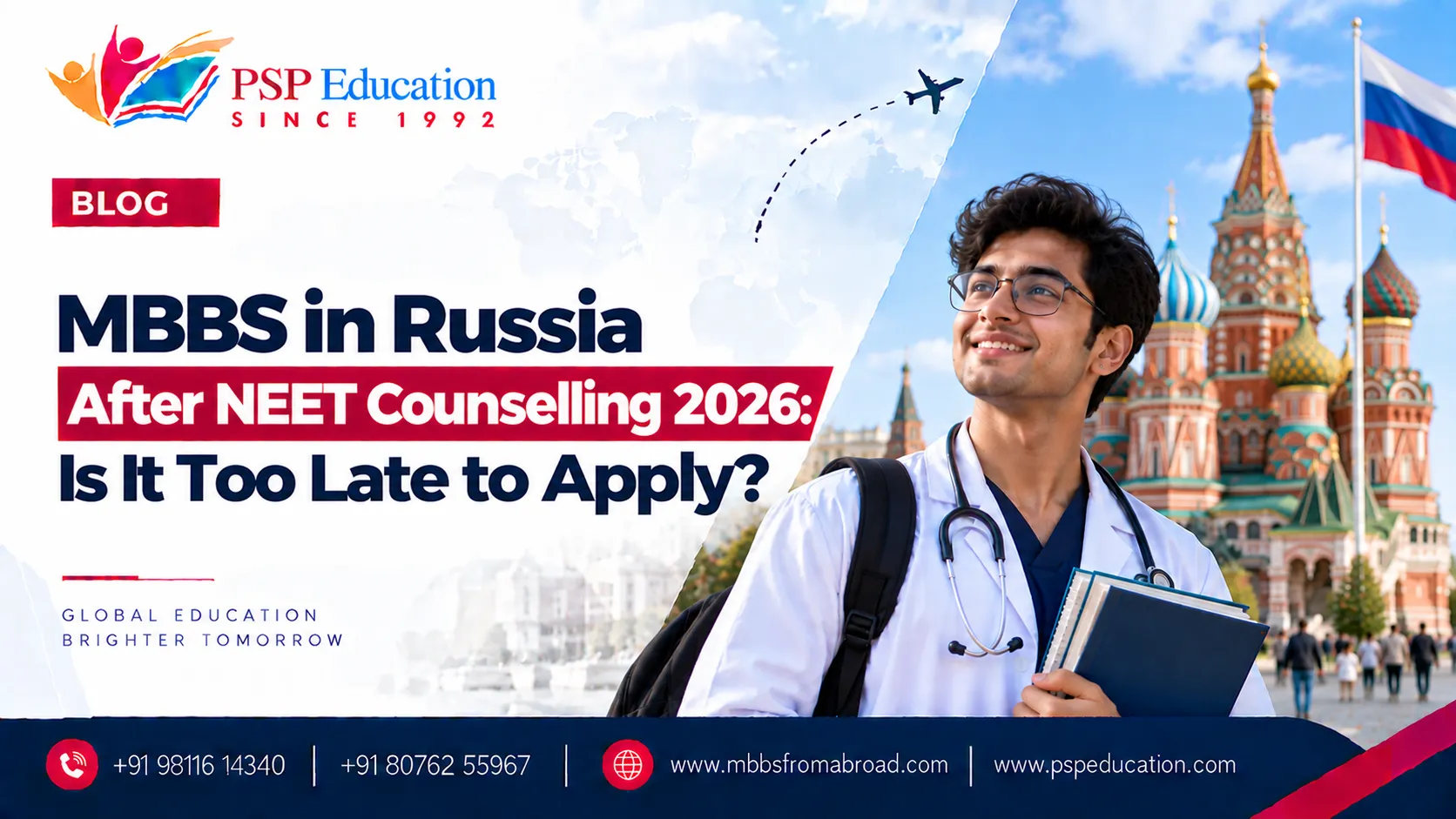
MBBS in Russia After NEET Counselling 2026
If you have just gone through NEET counselling 2026 and you did not get the seat you were hoping for, you are probably asking one question right now: has the window for MBBS in Russia already closed?
It's a fair question. Most families start researching MBBS abroad only after counselling results disappoint them, not before. By then, the academic year already feels like it's slipping away, and every consultant you call seems to say "hurry, seats are filling fast." That kind of pressure makes it hard to think clearly.
This article is written specifically for that moment — after counselling, before you've decided anything. We'll walk through what "too late" actually means in practical terms, what still depends on your own paperwork and timeline, and how to tell the difference between a genuine opportunity and a rushed decision you'll regret. Where you need the full picture on universities, fees, or day-to-day student life, we'll point you to our detailed MBBS in Russia guide rather than repeating it here.
Is It Too Late to Apply for MBBS in Russia After NEET Counselling 2026?
No — for most students, it is not too late, but the comfortable margin you had a month ago is shrinking. Russian medical universities generally keep admitting international students beyond the first rounds of NEET counselling, since their academic calendars and application windows are separate from India's. What changes as weeks pass is not eligibility but convenience: less time to compare universities, tighter windows for visa and invitation processing, and a greater chance of joining after teaching has already started.
The honest answer depends on where you are in the process right now — NEET counselling round, passport status, and how quickly you and your family can move once you decide.
Why Students Consider MBBS in Russia After NEET Counselling
This decision rarely comes out of nowhere. It usually follows one of a few familiar situations.
You didn't secure a government MBBS seat. With roughly 13 lakh-plus candidates qualifying NEET UG against a little over one lakh government MBBS seats across the country, the math simply doesn't work out for most aspirants, however hard they've studied.
The seat you got isn't one you actually want. Maybe it's a private college with fees that would strain the family budget for years, or it's a state quota seat far from home in a stream you're not enthusiastic about. Accepting it "because it's something" is a real temptation, and not always the right one.
Private MBBS fees in India feel out of reach. Many private colleges now charge anywhere from ₹60 lakh to over ₹1 crore for the full course, sometimes with additional donations or capitation-linked costs. For a lot of middle-class families, that number rules out private MBBS entirely.
You've been waiting through round after round. Round 1, Round 2, mop-up, stray vacancy — each round eats weeks, and by the time the picture is clear, the Indian academic session has often already started elsewhere.
Another NEET attempt feels like too much of a gamble. A drop year has a real cost: another year of coaching fees, another year of pressure, and no guarantee of a better outcome next time.
You simply didn't know about Russia earlier. Many students only start researching MBBS abroad once counselling outcomes force the question, which naturally means the research happens later than ideal.
None of these situations are unusual. They're the normal, common reasons families end up looking at MBBS in Russia in August, September, or even October rather than in April.
Is There a Fixed Last Date for MBBS in Russia Admission?
There is no single, universal deadline that applies to every Russian medical university. Each institution sets its own application and intake schedule, and these can differ by several weeks between universities. Rather than assuming a fixed cut-off, treat every university's stated deadline as provisional until it is confirmed directly with the university or through a verified admission partner.
Be cautious of anyone who quotes you an exact, urgent-sounding date without first checking your target university's current intake calendar. Genuine deadlines exist — they're just university-specific, not industry-wide.
How Late Is Actually "Too Late"?
It helps to think of the post-counselling window in stages, because the risk profile changes at each one.
University Applications Are Still Being Accepted
If a university's international admissions office is still processing new applications for the current intake, you're not too late in the strict sense. This is usually the least risky stage — there's still room to compare a few universities properly instead of grabbing the first option offered to you.
Admission Is Possible but Documentation Time Is Tight
As the intake date approaches, universities and agents move faster, and so must you. This is the stage where a missing document — an apostille, a migration certificate, a passport renewal — can genuinely cost you the seat, not because the university is unreasonable, but because there simply isn't slack left in the calendar.
Invitation and Visa Timing Becomes Critical
Once you have admission confirmation, you still need the university's invitation letter and a student visa before you can travel. These steps involve Russian institutional processes and Indian visa processing, both of which take real time and are outside any consultant's direct control. Applying with weeks to spare, rather than days, matters a great deal here.
Academic Session Has Already Progressed
If classes have already begun and continued for some time, joining becomes harder to justify academically, even if a university is technically still willing to enroll you. Missing the opening weeks of a foundation subject is a different problem from missing a single lecture.
The key point to hold onto: admission being technically available does not automatically mean it is a sensible admission decision. A university that will still take you in late October is not necessarily a university you should join in late October. Speed and soundness are two different questions, and it's worth asking both.
What Determines Whether You Can Still Apply?
Several factors decide your real timeline — not one deadline, but a combination of things you can mostly control.
| Factor | Why it matters |
|---|---|
| NEET Eligibility | You must have qualified NEET UG to have your Russian MBBS degree recognised for practice in India later |
| University Seat/Application Availability | Varies by university and changes week to week during peak season |
| Passport | Must be valid well beyond your expected course duration; a fresh application or renewal can take weeks |
| Academic Documents | Mark sheets, certificates, and any required attestations/apostille need lead time to arrange |
| Admission Confirmation | The university's formal offer, which depends on your documents being complete and accurate |
| Invitation Documentation | Russian universities issue an invitation letter after admission is confirmed, needed for the visa |
| Visa | Processing time depends on the Indian visa application system and current volumes |
| Academic Calendar | How much of the term has already elapsed at your target university |
| Travel and Joining Timeline | Flight availability, arrival logistics, and hostel readiness on the ground |
Most delays in "late" applications come from documentation gaps, not from universities refusing students. Getting your paperwork organised early is often the single biggest factor in whether a late application succeeds smoothly.
Step-by-Step Process After NEET Counselling
Once you've decided to explore MBBS in Russia seriously, the sequence generally looks like this:
- NEET counselling result — you know your outcome (or lack of a satisfactory seat) in India
- Eligibility check — confirm your NEET qualifying status, age, and academic percentage meet Russian MBBS requirements
- University shortlist — narrow down 2–3 universities based on your budget, city preference, and timeline
- University verification — check the university's current recognition status directly, not just on an agent's word
- Application — submit your academic documents and passport details to the university
- Admission confirmation — receive the university's formal offer or admission letter
- Invitation/documentation — the university issues the invitation letter needed for your visa application
- Visa — apply for and receive your Russian student visa
- Pre-departure — arrange travel insurance, forex, and pack according to the university's guidance
- Travel — fly to Russia and complete arrival formalities
- University joining — register, complete any orientation, and begin classes
Each of these steps has its own realistic timeline, and skipping ahead on one (say, booking flights before your visa is confirmed) usually creates more stress than it saves. For the complete breakdown of universities, fee structures, and what daily student life looks like at each stage, our main MBBS in Russia guide covers it in detail.
Documents Students Should Prepare
For the application stage, keep these ready early:
- Passport (valid for the full expected course duration, or at least several years)
- 10th and 12th mark sheets and certificates
- NEET UG admit card and scorecard
- Passport-size photographs (per university specifications)
- Birth certificate
For the later, invitation/visa stage, you'll additionally need:
- The university's official invitation letter
- Medical fitness/health certificate as required by Russian authorities
- HIV test report (commonly required for Russian student visas)
- Visa application form and supporting documents as per the current Indian visa process for Russia
- Migration certificate and transfer certificate from your previous institution, where applicable
Document requirements can be updated by universities or by visa authorities, so always confirm the current list directly rather than relying on an old checklist.
Should You Wait for the Final Counselling Round or Apply to Russia?
This is the hardest decision in the whole process, and there is genuinely no single right answer for every student. It depends on your rank, your budget, your family's risk appetite, and how you personally handle uncertainty.
| Consideration | Wait for final India rounds | Apply to Russia now |
|---|---|---|
| Chance of a government seat | Improves slightly in mop-up/stray rounds, but competition remains fierce | Not applicable — separate pathway |
| Certainty of admission | Uncertain until the very last round closes | Reasonably clear once documents are verified and accepted |
| Cost if private MBBS is the only Indian option | Can run ₹60 lakh–₹1 crore+ | Russian MBBS is often positioned as more budget-friendly, but confirm current fees directly with the university |
| Time already lost | Every extra round adds weeks to your decision timeline | Starting now preserves more of the current intake window |
| Risk of rushing | Low — you're not rushing, you're waiting | Moderate if you skip due diligence just to "not miss out" |
| Best for | Students genuinely close to a good seat, or open to another NEET attempt | Students unlikely to get an acceptable Indian seat and ready for a foreign-study commitment |
If you're realistically in contention for a decent seat in the last rounds, it may be worth holding on a little longer. If your rank makes that improbable and another NEET drop isn't something your family wants to consider, moving forward with Russia sooner — carefully, not impulsively — tends to work better than waiting indefinitely.
What If You Get an Indian MBBS Seat After Applying to Russia?
This is a common worry, and a fair one. If you're still in the middle of applying to a Russian university and an acceptable Indian seat comes through later, you are generally not obligated to continue with the Russian application — but the further along you are, the more this decision involves real consequences.
Before you've paid any fees or accepted a formal offer, withdrawing is usually straightforward. Once fees have been paid or an admission letter has been formally accepted, refund and withdrawal terms depend entirely on that specific university's policy, and these vary significantly from one institution to another. We won't guess at refund percentages or timelines here, because they differ by university and by how far into the process you are — always get this in writing from the university (or through your admission partner) before you pay anything, so you know exactly where you'd stand if your India counselling outcome changes.
Is MBBS in Russia Valid in India?
Yes, an MBBS from Russia can be valid for practice in India — but only if the university meets NMC's current requirements at the time you study, and only if you qualified NEET before joining. Recognition is not automatic just because a university is Russian or because it has taught Indian students for years; it depends on the university and your own compliance with the rules in force.
Since 2021, the National Medical Commission has moved away from publishing a fixed "approved list" of foreign universities. Instead, it sets out conditions under the Foreign Medical Graduate Licentiate (FMGL) Regulations, and it becomes the student's responsibility — ideally with proper guidance — to confirm that a chosen university satisfies them before enrolling. This is an important shift to understand: there is no static list you can simply check off. Verification needs to happen university by university, and ideally be reconfirmed close to your admission date, using the National Medical Commission's official website and the WHO's World Directory of Medical Schools.
NMC Rules Students Must Check Before Choosing a Russian University
Before committing to any Russian university, confirm that it satisfies these core NMC conditions:
- Course duration of at least 54 months of academic study, followed by 12 months of compulsory internship, totalling roughly 5.5 years
- Same-institution internship — the internship must generally be completed at the same foreign institution where the degree was pursued, not split across countries
- Medium of instruction should be English for the theoretical portions, as per NMC guidance
- No purely online clinical training — hands-on clinical exposure at a physical, affiliated teaching hospital is required; theory delivered online without matching offline clinical training raises compliance concerns
- NEET UG qualification before joining the foreign MBBS programme, if the goal is to practice in India later
- Listing in the WHO World Directory of Medical Schools, which is separately checkable and a useful cross-reference
None of these checks are optional extras — each one has been the reason a graduate's degree ran into recognition trouble in the past. Confirming them before you pay any fee is far easier than trying to fix a compliance gap after you've already completed the course.
FMGE vs NExT: What Applies to Students in 2026?
This is an area where a lot of outdated or conflicting information circulates online, so it deserves a careful, honest answer rather than a confident-sounding guess.
As of mid-2026, the Foreign Medical Graduate Examination (FMGE) continues to be conducted by the National Board of Examinations in Medical Sciences (NBEMS) as the current licensing screening test for Indian citizens who complete their MBBS abroad — the June 2026 session was held as scheduled. The National Exit Test (NExT) has been notified by the NMC as the intended long-term replacement for both NEET-PG and FMGE, but its rollout timeline specifically for foreign medical graduates has been discussed and revised at different points, and various sources currently disagree on exactly when it takes full effect for FMGs. Because this detail directly affects your licensing pathway, don't rely on any single blog's claim — check the current notification on the NBEMS and NMC websites shortly before you're due to graduate, since the applicable exam could depend on your year of admission or graduation.
What is settled: whichever exam is applicable to you, clearing it is compulsory before you can get a licence to practice in India, and a 12-month internship is part of the pathway either way.
Should You Choose Any Russian University Just Because You're Applying Late?
No. Applying later in the cycle is a reason to move efficiently — it is not a reason to lower your standards. A rushed, poorly-vetted admission can cost you far more time and money in the long run than a few extra days of proper checking would.
Before finalising any university, however tight your timeline feels, verify:
- Course structure and duration — does it meet the 54+12 month NMC requirement?
- Medium of instruction — genuinely English-taught, not English-labelled with Russian-heavy delivery
- Clinical exposure — real hospital access, not simulation-only training
- Internship arrangements — completed at the same institution, as NMC requires
- Local language support — some clinical rotations do involve patient interaction where basic Russian helps
- NMC compliance — checked independently, not taken on faith from a brochure
- Total cost — tuition, hostel, food, and other recurring expenses, not just the headline tuition figure
- Hostel and safety standards — particularly important for first-time travellers and their parents
- University credibility and track record — how long it has taught Indian students, and how transparent it is about its own recognition status
- Student support system — who helps you once you've landed in Russia, not just before you leave India
A university that ticks these boxes is a reasonable choice whether you apply in April or in October. One that doesn't is a risk at any time of year.
Russian Medical Universities Students Can Explore
Several Russian state medical universities remain open to Indian applicants through the later stages of the intake cycle. Here's a brief, factual look — for full fee structures, eligibility details, and admission specifics, use the linked pages for each university.
- Altai State Medical University — a state medical university in Barnaul, established in 1954, with a dedicated faculty for international students offering coursework in English alongside intensive Russian language classes.
- Kirov State Medical University — located in Kirov, known among Indian applicants for its comparatively lower cost of living.
- Ulyanovsk State University — a public research university founded in 1988, offering an English-medium MBBS-equivalent programme.
- Yaroslavl State Medical University — one of Russia's older medical institutions, founded in 1944, located in the historic city of Yaroslavl near Moscow.
- Chita State Medical Academy — established in 1953, a government-run medical academy in eastern Russia.
We're not ranking these against each other here, and we won't quote specific fee figures, seat counts, or FMGE pass percentages in this article, since those numbers change and are best confirmed directly on each university's dedicated page or with current counselling support.
What About Hostel, Food and Student Life in Russia?
This deserves proper attention, but not a rushed summary here. Hostel arrangements, food availability (including Indian food access in most university cities), climate adjustment, and general day-to-day student life in Russia are covered in full detail on our complete MBBS in Russia guide. If this is a major factor in your family's decision — and for many parents, it is — that page is the better place to read it properly rather than getting a partial picture here.
Common Mistakes Students Make When Applying Late
- Choosing a university based purely on speed of admission, without checking NMC compliance or course structure
- Paying fees before receiving anything in writing about refund and withdrawal terms
- Booking flights before the visa is actually approved
- Assuming any "MBBS in Russia" university is automatically the same as any other in terms of recognition or teaching quality
- Not renewing an expiring passport early enough, which then delays the entire visa timeline
- Relying on a single verbal deadline from an agent instead of confirming it with the university directly
- Skipping FMGE/NExT and internship research until after joining, rather than understanding the full path to practising in India from day one
MBBS in Russia After NEET Counselling Checklist
A quick, saveable checklist for students and parents:
- [ ] NEET UG qualifying status confirmed
- [ ] Age and academic percentage eligibility checked
- [ ] Passport valid and not close to expiry (or renewal already in progress)
- [ ] 2–3 universities shortlisted and independently checked for NMC compliance
- [ ] Course duration confirmed as 54 months + 12-month internship at the same institution
- [ ] Medium of instruction confirmed as English
- [ ] Total cost (tuition + hostel + food + incidentals) understood, not just tuition
- [ ] Refund/withdrawal policy obtained in writing before paying any fee
- [ ] Academic documents and certificates organised
- [ ] HIV test and medical fitness certificate arranged, if required
- [ ] Visa application timeline mapped out with realistic processing time
- [ ] FMGE/NExT and internship pathway understood before committing
- [ ] Family aligned on the decision — not rushed by external pressure
Why Expert Guidance Matters When Applying After NEET Counselling
A late application isn't harder because the paperwork itself is difficult — it's harder because several moving parts need to happen in the right order, within a shorter window: the student's documents, the university's admission process, the invitation letter, the visa, travel, and hostel arrangements. Any one of these running late can delay the rest.
This is where coordination matters more than it would earlier in the year. A missed email from the university, a document sent in the wrong format, or a visa appointment booked too late can each cost days you don't have to spare. Having someone track all of these threads at once — rather than the student or a parent trying to manage university communication, documentation, and visa logistics simultaneously — reduces the chance of an avoidable delay turning into a missed intake.
How PSP Education Helps Students Pursue MBBS in Russia
PSP Education works with Indian students navigating exactly this post-counselling decision, across areas including:
- Profile assessment based on your NEET score, academic percentage, and budget
- NEET eligibility and NMC-compliance checks before you shortlist a university
- University selection support, matched to your timeline and preferences
- Application assistance and document preparation
- Direct communication with university admission offices
- Coordination of admission confirmation and invitation-related paperwork
- Visa application guidance
- Pre-departure briefings covering travel, packing, and what to expect
- Travel coordination and arrival support
- Hostel arrangement assistance
- Ongoing guidance for parents throughout the process
- Continued student support after arrival in Russia
PSP Education assists students with admission processes at a number of Russian universities, including Altai State Medical University, Kirov State Medical University, and Ulyanovsk State University, among others. We don't claim guaranteed admission, guaranteed visa approval, or guaranteed FMGE/NExT success for any student — no consultancy can honestly promise those outcomes, and be cautious of anyone who does. What we can offer is careful, document-by-document coordination so that a late application is handled properly rather than rushed.
Final Verdict: Is It Too Late to Apply?
For most students reading this shortly after NEET counselling 2026, it is not too late — but it is also not a moment to relax. The realistic window depends far more on your own documents, your passport status, and how quickly you can make a well-checked decision than on any single fixed deadline.
There's no need for artificial urgency here, and no need for unnecessary panic either. Take the time to verify a university properly, understand the NMC requirements that will matter years from now when you're applying for a licence, and involve your family in the decision. A university you chose carefully in September will serve you far better over the next 5.5 years than one you chose in a hurry.
If you'd like a clear, personalised read on where you stand — your NEET eligibility, your realistic timeline, university options within your budget, and what documentation to prioritise first — PSP Education's counsellors can walk through it with you and your family, without any pressure to decide on the spot.
Frequently Asked Questions
Is it too late to apply for MBBS in Russia after NEET counselling 2026?
For most students, no. Russian universities generally admit students beyond India's counselling rounds, though the comfortable margin for documentation and visa processing shrinks as the academic session progresses.
Do I need to qualify NEET UG to study MBBS in Russia?
Yes. If your goal is to eventually practice medicine in India, NEET UG qualification before joining the foreign MBBS programme is mandatory under current NMC requirements.
Will my Russian MBBS degree be valid in India?
It can be, provided the university meets NMC's Foreign Medical Graduate Licentiate Regulations at the time you study and you qualified NEET before joining. This needs to be verified university by university, since NMC no longer publishes a fixed approved list.
Do I need to clear FMGE or NExT after MBBS in Russia?
You will need to clear whichever licensing screening exam is applicable to your graduation year — FMGE remains active as of 2026, while NExT is intended as its eventual replacement. Confirm the current applicable exam with NMC/NBEMS closer to your graduation.
What if I get a good Indian MBBS seat after I've already started applying to a Russian university?
Before you've paid fees or formally accepted an offer, withdrawing is usually straightforward. After payment or formal acceptance, refund and withdrawal terms depend on that specific university's policy — always get this in writing before paying.
Is a late-cycle Russian MBBS admission lower quality than an early one?
Not inherently. What matters is whether the specific university meets NMC's course-duration, English-medium, and clinical-training requirements — not when in the year you applied.
Considering MBBS in Russia after NEET counselling? Talk to PSP Education for a personalised evaluation of your NEET eligibility, timeline, university options, and documentation checklist.