MBBS Abroad Document Checklist 2026-27
Every year, once NEET results are announced, the questions from students and parents shift almost overnight — from "will I qualify?" to "what do I actually need to prepare?" Documentation is where a lot of families lose weeks they didn't need to lose: a name spelled slightly differently between the passport and the marksheet, a migration certificate applied for too late, a medical report that needs to be redone because it expired before the visa appointment.
None of this needs to be stressful if you know what's coming. This guide lays out a practical, stage-by-stage checklist of the documents Indian students commonly need for MBBS abroad — from the moment you start shortlisting universities to the day you walk into your hostel room. It also explains, honestly, where requirements are common across most destinations and where they genuinely differ by country, university, or visa authority — because pretending every country wants the exact same paperwork does students a disservice.
If you haven't yet confirmed whether you meet the basic starting conditions for MBBS abroad, it's worth reading MBBS abroad eligibility requirements alongside this checklist.
Quick Answer: What Documents Are Required for MBBS Abroad?
Most Indian students need a valid passport, passport-size photographs, Class 10 and Class 12 marksheets and certificates, a NEET-UG scorecard, birth certificate, transfer and migration certificates, character certificate, medical fitness reports, and — once admission is confirmed — financial documents, a university offer/invitation letter, and visa-specific paperwork. Exact requirements vary by country, university, and visa authority, so always confirm the final list with your specific university and consulate.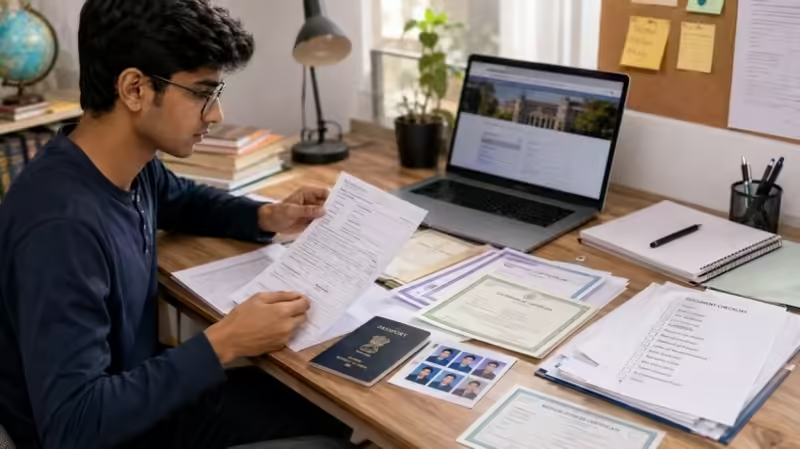
MBBS Abroad Documents: Complete 20-Document Checklist
This is the master list most Indian students preparing for MBBS abroad after NEET need to work through. Not every document applies to every student in exactly the same way — where a requirement is not universal, it's labelled clearly.
1. Passport
Your passport is the single most time-critical document, because it takes weeks to get and everything else — university application, visa, travel — depends on it. Apply or renew early; don't wait for admission confirmation to start this. Most destinations expect the passport to remain valid well beyond your date of travel, and Russia's visa process specifically expects a validity of around 18 months from the date the visa is issued, with at least two blank pages. Requirements differ by country, so always check the destination's current rule rather than assuming one universal number.
2. Passport-Size Photographs
Universities and visa authorities typically ask for recent, specific-format photographs (usually plain white or light background, front-facing, no headgear except for religious reasons). Requirements on photo size, background, and format vary by country and by visa authority — keep at least 8–10 physical copies plus a digital scan, since you'll need them repeatedly for admission, visa, hostel registration, and ID cards.
3. Class 10 Marksheet
Confirms your date of birth and foundational academic record. Universities and visa authorities cross-check the date of birth here against your passport, so any mismatch should be resolved before you apply. May be required depending on university/country in original, attested, or apostilled form for admission or visa processing.
4. Class 10 Certificate (Board Certificate / Pass Certificate)
Separate from the marksheet in most Indian boards, this certifies you passed. Some universities want both the marksheet and the certificate; others accept one. Keep both originals and multiple copies regardless.
5. Class 12 Marksheet
This is one of the most scrutinised academic documents for MBBS abroad, since it verifies your Physics-Chemistry-Biology-English academic background. For visa processing to destinations like Russia, transcripts commonly require notarisation and, in some cases, translation — start this early, as notarisation and translation can each take time.
6. Class 12 Certificate
Confirms successful completion of Class 12. Along with the marksheet, this typically needs to be authenticated (attested/apostilled/notarised, depending on destination) before it's accepted by a foreign university or embassy.
7. NEET Scorecard / Result
NEET-UG qualification is mandatory for Indian students who want their foreign MBBS degree to eventually count toward FMGE/NExT eligibility and Indian medical registration — this is an NMC requirement, independent of what any specific university abroad asks for in its own admission process. Your NEET scorecard functions as your core qualification proof and is generally understood to remain valid for three years for the purpose of abroad admission, though this should be reconfirmed against current NMC guidance before you rely on it for a delayed intake.
8. NEET Qualification Proof Where Applicable
Some universities or visa processes may separately ask for a formal NEET qualification/rank letter or an equivalent document beyond the scorecard itself. This may be required depending on university/country/visa process — check with your specific university's admission office.
9. Birth Certificate
Used to verify date of birth and parentage, and sometimes required for visa applications or university registration. If your birth certificate's spelling of your name or your parents' names doesn't match your passport, resolve this before applying — see the mismatch section further down.
10. Transfer Certificate (TC)
Issued by your Class 12 school, confirming you've formally left that institution. Most universities and some visa processes ask for this as part of the academic document set. Apply for it as soon as you finish school, since schools can take time to issue it, especially during peak admission season.
11. Migration Certificate
Issued by your Class 12 board (not your school) once you're moving to a different education board or system. This one commonly causes delays because boards can take several weeks to process it — apply for this well before your intended departure date, ideally as soon as your board results are declared.
12. School Leaving Certificate
In some states/boards this is separate from the Transfer Certificate; in others the two are combined. Confirm with your school which document(s) they issue, and request both if your school treats them separately.
13. Character Certificate
Usually issued by your last educational institution, confirming good conduct. Some universities and visa authorities ask for this as part of the admission or visa file. May be required depending on university/country.
14. Medical Fitness Certificate
A general certificate from a registered medical practitioner confirming you're fit to undertake academic study. Universities and visa authorities that require this typically specify their own format or a list of approved examination centres closer to the admission/visa stage — do not assume every country or university uses an identical medical fitness format.
15. Medical / HIV Reports Where Required
Some destinations — Russia among them — specifically require a negative HIV test report and other medical clearance as part of the student visa file, generally from a recognised laboratory, and typically valid only for a limited window before the visa appointment. This is not a universal requirement for every MBBS-abroad destination — some countries and universities don't ask for it at all. Always confirm the current requirement with the specific country's visa authority.
16. Vaccination / Immunization Records Where Required
Certain universities or countries may ask for updated immunization records, particularly for hostel registration or campus health clearance. May be required depending on university/country — check with the specific institution rather than assuming a fixed universal list.
17. Financial / Bank Documents Where Required
Depending on the destination and visa authority, you or your sponsoring parent may need to show bank statements, income proof, or solvency certificates demonstrating the ability to fund tuition and living costs. Financial documentation requirements vary significantly by destination and visa authority — some processes are minimal, others are detailed.
18. Sponsorship Affidavit Where Required
If a parent or guardian is financially sponsoring your education, some visa processes ask for a notarised affidavit of support alongside the sponsor's financial documents. May be required depending on the visa process — not every destination asks for this in the same form.
19. Education Loan Documents Where Applicable
If you're funding your MBBS abroad partly or wholly through an education loan, keep the sanction letter, loan agreement, and disbursement schedule ready — universities and, in some cases, visa authorities may want to see these as part of your financial proof.
20. University Admission / Offer / Invitation Letter
This is the document everything downstream depends on. Once a university confirms your admission, it typically issues an offer or admission letter — and for countries like Russia, a separate official visa invitation letter is issued afterward by the relevant government authority at the university's request. Check the exact spelling of your name and passport number on this document the moment you receive it; even a small mismatch can delay your visa.
Master Document Table
| # | Document | Why It May Be Needed | When You Need It | Original / Copy | Attestation / Translation | Notes |
|---|---|---|---|---|---|---|
| 1 | Passport | Core identity document for application, visa, and travel | Before applying | Original + copies | Not applicable | Apply/renew months in advance |
| 2 | Passport photographs | Admission forms, visa, hostel ID | Throughout process | Physical + digital | Not applicable | Keep multiple sets |
| 3 | Class 10 marksheet | Verifies DOB and academic record | Before applying | Original + copies | May need apostille/attestation | Check DOB matches passport |
| 4 | Class 10 certificate | Confirms pass status | Before applying | Original + copies | May need apostille/attestation | Some universities need both marksheet & certificate |
| 5 | Class 12 marksheet | Verifies PCB academic background | Before applying | Original + copies | Often notarised/translated for visa | Start early — translation takes time |
| 6 | Class 12 certificate | Confirms pass status | Before applying | Original + copies | May need apostille/attestation | Pair with marksheet |
| 7 | NEET scorecard | NMC-mandated qualification proof | Before applying | Original + copies | Not typically | Generally valid ~3 years for abroad admission |
| 8 | NEET qualification proof (extra) | Some universities/visas request additional proof | Admission/visa stage | Copies | Case-specific | Confirm with university |
| 9 | Birth certificate | DOB and parentage verification | Admission/visa stage | Original + copies | May need apostille | Check name spelling matches passport |
| 10 | Transfer certificate | Confirms school exit | Before/after admission | Original + copies | Rarely | Apply immediately after Class 12 |
| 11 | Migration certificate | Confirms board exit | Before departure | Original + copies | Rarely | Apply early — boards are slow |
| 12 | School leaving certificate | Some boards treat separately from TC | Before/after admission | Original + copies | Rarely | Confirm with school |
| 13 | Character certificate | Conduct verification | Admission/visa stage | Original + copies | Rarely | May be required by some universities |
| 14 | Medical fitness certificate | Confirms fitness for study | Admission/visa stage | Original | University/visa-specific format | Don't assume one universal format |
| 15 | HIV / medical reports | Visa health screening (destination-specific) | Visa stage | Original | Often needs recent lab report | Not universal across all countries |
| 16 | Vaccination records | Campus/hostel health clearance | Before departure | Copies | Rarely | Country/university-specific |
| 17 | Financial/bank documents | Visa financial proof | Visa stage | Original + copies | Sometimes notarised | Varies by destination |
| 18 | Sponsorship affidavit | Visa financial proof (if sponsored) | Visa stage | Original, notarised | Notarisation typically required | Not needed everywhere |
| 19 | Education loan documents | Financial proof if loan-funded | Admission/visa stage | Copies | Rarely | Keep sanction letter and schedule |
| 20 | University offer/invitation letter | Core admission and visa document | After admission | Original (often digital first) | Not applicable | Verify name/passport number match exactly |
Documents Required Before Applying
Before you even shortlist a university seriously, get these moving: a valid passport application (or renewal check), Class 10 and Class 12 marksheets and certificates in hand, your NEET-UG scorecard, birth certificate, and a stock of passport photographs. This stage is about having your identity and academic paperwork ready so that when a university asks for scanned copies to process your application, you're not scrambling.
Documents Required After Getting University Admission
Once a university confirms your seat, the focus shifts to admission-specific paperwork: signed application/admission forms, medical fitness certificate, character certificate where asked, and the financial documents that support your fee payment. This is also the stage where transfer and migration certificates typically need to be finalised, since universities often want these before issuing a formal offer letter.
Documents Required for Student Visa
Visa documentation is where country-specific requirements matter most. Common elements across many destinations include the university's official invitation/admission letter, a valid passport with the required remaining validity, visa application form, photographs, proof of tuition payment or fee receipt, and — for some countries, including Russia — a negative HIV test report and adequate health insurance coverage. Financial and sponsorship documents may also be required depending on the visa authority. Do not assume visa requirements are identical across countries — always check the specific consulate or embassy's current checklist.
Documents to Carry When Travelling Abroad
Carry your original passport with visa, admission/invitation letter, medical reports, insurance documents, sufficient passport photographs, and attested copies of your academic documents — not just digital scans. Keep a physical folder in your hand luggage (never checked baggage) and a backup digital copy accessible via cloud storage.
Documents Required During University Joining
At physical registration, universities typically ask to see and sometimes retain copies of your passport, visa, admission letter, academic originals for verification, medical certificates, and photographs for your student ID and hostel registration. Some universities also require local registration with immigration authorities within a set number of days of arrival — in Russia, for instance, this is commonly handled with university support but the student is expected to follow up.
Must Prepare Early, During Admission, and After Confirmation
Not every document needs equal urgency. A simple way to think about sequencing:
Must prepare early: Passport, Class 10 documents, Class 12 documents, NEET result, photographs, birth certificate.
Prepare during admission: University application forms, medical fitness certificate, character certificate, transfer/migration certificates, financial documents, sponsorship affidavit if applicable.
Prepare after university confirmation: Visa-specific documents, the university's invitation letter, travel tickets, insurance, and any destination-specific paperwork such as HIV test reports for Russia-bound students.
This isn't a fixed rule for every university — some ask for financial documents earlier, others push medical certificates later — but it reflects the order most Indian students actually experience.
Passport for MBBS Abroad: What Students Should Check
Beyond simply having a passport, check these details carefully before you apply anywhere:
- Validity: Many destinations expect substantial remaining validity at the time of visa issue — for Russia specifically, guidance commonly cited is around 18 months' validity from the visa issue date. Requirements differ by country, so always check the destination's current visa rule.
- Blank pages: Most visa stickers need at least two blank pages.
- Name spelling: Must exactly match your Class 10/12 documents and NEET scorecard.
- Date of birth: Must match your Class 10 marksheet — this is the document most authorities treat as the DOB source of truth in India.
- Parents' names: Some passports list father's and/or mother's name; check this matches other identity documents where required.
Always check the destination country's current visa requirement rather than assuming a single rule applies everywhere.
What If Your Name or Date of Birth Is Different on Your Documents?
This is more common than students expect — a name spelled "Mohammed" on one document and "Muhammad" on another, a middle name present on the passport but missing from the school certificate, or a date of birth recorded slightly differently between the birth certificate and the Class 10 marksheet.
These mismatches matter because visa officers and university admission teams cross-check details across documents, and inconsistencies can cause delays, requests for clarification, or in some cases rejection. If you notice a mismatch:
- Identify which document is likely to be treated as the authoritative source (in India, the Class 10 certificate is generally treated this way for date of birth).
- Consult the relevant issuing authority (school, board, passport office) about correction procedures — these vary and can take time.
- In some cases, a notarised affidavit explaining the discrepancy may be accepted alongside your documents, but this depends on the specific university or visa authority's policy — confirm rather than assume.
- Start this process as early as possible; correcting official records is rarely fast.
This is general guidance, not legal advice — for anything beyond a minor clerical inconsistency, consult a professional or the relevant government office directly.
Do MBBS Abroad Documents Need Attestation or Apostille?
This is one of the most confusing parts of the process, largely because the terms get used loosely.
- Apostille is a single-step certification under the 1961 Hague Apostille Convention. India has been a member since 2005, and it's accepted by all other Hague Convention member countries without further embassy legalisation — for educational and personal documents, this is done by India's Ministry of External Affairs (MEA) through its authorised outsourced agencies, after prior state-level authentication (typically by the state HRD department for educational documents).
- Attestation/legalisation is the older, multi-step process — state authentication, then MEA, then the destination country's embassy in India — required for documents going to countries that are not Hague Convention members.
- Notarisation is a separate local certification (by a notary) that some universities or visa processes require in addition to, not instead of, apostille or attestation.
- Translation may be required into the destination country's official language, particularly for visa purposes — this is distinct from apostille/attestation and is a separate step.
Russia has also been a Hague Apostille Convention member since 1992, which means an MEA apostille is generally the relevant route for Indian documents headed to Russia rather than the older embassy-legalisation chain — but Russian universities and the visa process may still separately require notarised translation of transcripts into Russian. Not every document needs every one of these steps, and the exact combination depends on the destination country, the specific university, and the visa authority's current instructions. Always confirm the precise requirement with your university's admissions office and the relevant consulate before starting the process — the MEA's own apostille portal and outsourced service centres are the authoritative source for the Indian side of this process.
Do You Need Translation of Academic Documents?
For English-medium admission processes, your Class 10 and 12 documents (already in English or with English translations from Indian boards) are often sufficient for the university application itself. However, for the visa stage in some countries, translation into the local official language — for instance, Russian for Russia-bound students — is commonly required for transcripts, particularly where notarisation is also involved. Confirm with the specific consulate whether translation must be done by a certified/sworn translator recognised by that country, since informal translations are often not accepted.
How to Organize Your MBBS Abroad Documents
A simple folder structure — physical and digital — saves real time later:
- Folder 1 — Academic: Class 10 and 12 marksheets/certificates, transfer certificate, migration certificate, school leaving certificate.
- Folder 2 — NEET: Scorecard, admit card, any additional qualification proof.
- Folder 3 — Passport & Identity: Passport, birth certificate, photographs.
- Folder 4 — Admission: University application, offer/admission letter, fee receipts.
- Folder 5 — Visa: Visa application form, invitation letter, visa-specific forms.
- Folder 6 — Medical: Medical fitness certificate, HIV/other reports where required, vaccination records, insurance.
- Folder 7 — Financial: Bank statements, sponsorship affidavit, education loan documents.
- Folder 8 — Travel: Flight tickets, travel insurance, contact details for the university's international office.
Label both the physical folder (a simple labelled envelope system works well) and a matching digital folder structure so nothing gets misplaced between admission, visa, and travel stages.
Digital Backup: What Every Student Should Keep
Keep clear scanned PDFs of every document listed above, backed up in at least two places — for example, a personal cloud storage account and a parent's email — rather than relying on a single phone. A few practical points:
- Scan in PDF, not just photos, for anything you might need to email or upload during admission/visa processing.
- Keep a parent or guardian with independent access to the same backup, in case you can't access your own device while travelling.
- Use password protection or a private, non-shared folder for sensitive documents like passport scans and medical reports — these shouldn't sit in a public or easily shared location.
- Digital copies are a backup for convenience and speed, not a replacement for carrying physical originals abroad — universities and immigration authorities generally want to see and verify originals in person.
Documents Parents May Need
Parents are often directly involved in the financial and sponsorship side of the process, and depending on the destination, university, and visa authority, may need to prepare:
- Identity proof (Aadhaar, PAN, or passport)
- Bank statements and income proof supporting sponsorship
- A notarised sponsorship affidavit, where the visa process requires one
- Education loan sanction letter and repayment schedule, if a loan is involved
- Consent or support documents, in cases involving a minor applicant or specific university requirements
Requirements vary by country, university, and visa process — some destinations ask for detailed financial documentation from parents, others require comparatively little. Confirm the current list directly with the university and the relevant consulate rather than preparing based on a generic list alone.
Documents Required for MBBS in Russia
Because a large share of Indian students choosing MBBS abroad go to Russia, here is a Russia-specific breakdown, based on current publicly available visa and university-process information as of 2026. Requirements can change, and can also differ by specific Russian university, so treat this as a starting checklist to verify — not a final one.
Admission Documents
- Completed university application form
- Class 10 and Class 12 marksheets and certificates (often requiring notarisation, and in some cases Russian translation)
- NEET-UG scorecard
- Passport copy
- Passport-size photographs
- Medical fitness certificate
Visa Documents
- Valid passport (commonly expected to have around 18 months' validity from the visa issue date, with at least two blank pages)
- Official visa invitation letter — typically issued electronically by Russia's Ministry of Internal Affairs (GUVM) at the university's request, once admission is confirmed
- Completed visa application form
- Recent passport-size photograph meeting the specified format
- Negative HIV test certificate from a recognised laboratory
- Health/medical insurance valid in Russia, commonly expected to provide at least around €30,000 in coverage
- Proof of tuition payment or fee confirmation, where required
Travel Documents
- Passport with visa affixed
- University invitation/admission letter (carry the original)
- Travel insurance and medical insurance documents
- Contact details for the university's international student office
University Joining Documents
- Original academic documents for verification at registration
- Passport and visa
- Photographs for student ID and hostel registration
- Medical documents/insurance
- Migration card (issued on arrival in Russia) — students are generally expected to complete local registration with authorities within a set number of days of arrival, usually with university assistance
For the full step-by-step admission journey — from NEET result to university joining — see MBBS in Russia admission process. And because document and visa requirements can shift, always cross-check the current list with your specific university and with the Russian visa authority before finalising your paperwork. The full MBBS in Russia guide covers universities, fees, and eligibility in more depth if you're still shortlisting.
Important: Russia's specific document and visa requirements should not be assumed to apply to other destinations. Kazakhstan, Uzbekistan, Kyrgyzstan, and Georgia each have their own admission and visa processes — always verify the specific country's current requirements with the university and consulate rather than reusing a Russia-specific checklist.
Country-Specific Document Reality Check
The core academic documents — passport, Class 10 and 12 records, NEET scorecard, birth certificate — are broadly similar across most MBBS abroad destinations, because they're fundamentally about proving who you are and what you've studied. But exact admission, visa, attestation, medical, and financial requirements can differ meaningfully by country and by individual university. A document that's optional for one country's visa process may be mandatory for another's.
Before finalising your checklist, verify the current requirements directly with:
- The specific university's admissions office
- The relevant country's embassy or consulate in India
- The official visa authority for that destination
- Where applicable, the National Medical Commission (for anything touching NEET eligibility or future FMGE/NExT recognition)
Treating any single article — including this one — as the final word without that verification step is the most common source of avoidable delays.
10 Common MBBS Abroad Document Mistakes Students Make
- Applying for a passport too late — this is the single biggest avoidable delay, since passport processing and any renewal can take weeks.
- Name mismatch across documents — inconsistent spelling between passport, Class 10/12 records, and NEET scorecard causes real visa and admission delays.
- Incorrect or mismatched date of birth — especially between the birth certificate and Class 10 marksheet.
- Missing NEET result or qualification proof — some students assume a university's own admission test is enough; NMC's NEET requirement is separate and non-negotiable for future India-return eligibility.
- Not keeping originals safe — losing an original migration or transfer certificate can take months to replace.
- Skipping digital backups — relying on a single physical folder with no backup is a genuine risk during travel.
- Assuming every country has identical requirements — Russia's HIV test requirement, for instance, isn't universal across every MBBS abroad destination.
- Missing attestation or translation instructions — submitting documents without checking whether apostille, attestation, or translation applies to the destination.
- Waiting until the last minute for medical documents — HIV tests and medical fitness certificates often have limited validity windows before a visa appointment.
- Not checking the university or visa authority's own current instructions — relying only on generic online checklists instead of confirming with the actual institution and consulate.
If your NEET score is qualifying but on the lower end and you're weighing your realistic options, our related guide on MBBS abroad without NEET requirements explains what is and isn't possible if NEET status is unclear for your situation. And if you're still deciding between staying in India and going abroad, MBBS in Russia vs India walks through what genuinely changes, including the licensing pathway that makes documentation and NEET compliance so important in the first place.
MBBS Abroad Document Checklist: Final Printable Checklist
[ ] Passport [ ] Passport photographs [ ] Class 10 marksheet [ ] Class 10 certificate [ ] Class 12 marksheet [ ] Class 12 certificate [ ] NEET scorecard/result [ ] NEET qualification proof where applicable [ ] Birth certificate [ ] Transfer certificate [ ] Migration certificate [ ] School leaving certificate [ ] Character certificate [ ] Medical fitness certificate [ ] Medical reports where required (e.g., HIV test for Russia) [ ] Vaccination records where required [ ] Financial/bank documents where required [ ] Sponsorship affidavit where required [ ] Education loan documents where applicable [ ] University admission/offer/invitation letter [ ] Passport copies [ ] Scanned digital copies (backed up in two places) [ ] Country-specific visa documents [ ] University-specific documents
Your actual final checklist can vary based on your destination country, chosen university, and current visa authority requirements — use this as a working base, then confirm the specifics for your situation.
How PSP Education Helps With MBBS Abroad Documentation
Getting documentation right is mostly about sequencing and verification — knowing what to prepare early, what can wait, and which requirement is genuinely universal versus destination-specific. This is where an experienced admissions team can save real time.
PSP Education can assist students and parents with:
- Building an initial, personalised document checklist based on your shortlisted country and university
- Reviewing your university application paperwork before submission
- Explaining admission-stage paperwork clearly, including which documents typically need attestation, apostille, or translation
- Guiding you through visa documentation requirements for your specific destination
- Sharing university-specific requirements, since these can differ even within the same country
- Supporting Russia-focused applicants through the admission-to-joining process
- Providing hostel and pre-departure guidance so families know what to expect on arrival
- Keeping parents informed throughout the admission and visa process
PSP Education does not guarantee visa approval, university admission, NMC recognition, or FMGE/NExT outcomes — no consultant is in a position to guarantee results that depend on individual documentation, government processing, and regulatory decisions outside anyone's control. What we can offer is accurate, current guidance and consistent support through a process that's genuinely easier to get right with an experienced team beside you. If you'd like help mapping out your specific document checklist, you can reach out to PSP Education for a direct conversation.
Final Takeaway
Document preparation for MBBS abroad isn't complicated once you break it into stages — but it does reward starting early, especially for anything involving government offices (passport, migration certificate) or medical tests with limited validity windows. Keep your core academic and identity documents in top form months before you apply, confirm destination-specific requirements directly with your university and the relevant consulate, and don't assume one country's checklist — including Russia's — applies everywhere else. Get the sequencing right, and the rest of the admission and visa process becomes far more manageable.
FAQs
What documents are required for MBBS abroad?
Most Indian students need a valid passport, passport photographs, Class 10 and 12 marksheets and certificates, a NEET-UG scorecard, birth certificate, transfer and migration certificates, and — after admission — medical, financial, and visa-specific documents. Exact requirements vary by country and university.
What documents are required for MBBS abroad after NEET?
After qualifying NEET, students typically need the NEET scorecard as core proof, alongside passport, academic records, and identity documents, to begin university applications. NEET qualification is an NMC requirement tied to future Indian registration, separate from what any individual university asks for.
Is NEET scorecard required for MBBS abroad?
Yes. NEET-UG qualification is mandatory under NMC's framework for Indian students who want their foreign MBBS degree to count toward future FMGE/NExT eligibility and Indian medical registration, regardless of whether a specific university abroad requires it for its own admission process.
Is a passport mandatory for MBBS abroad?
Yes, a passport is mandatory for university application, visa processing, and travel. Apply or renew it early, since processing can take weeks and everything downstream depends on it.
Are Class 10 and Class 12 documents required for MBBS abroad?
Yes, in most cases. These verify your date of birth and academic eligibility (particularly your PCB background for Class 12). Some destinations require these documents to be attested, apostilled, or translated — confirm the specific requirement for your destination.
Do I need a birth certificate for MBBS abroad?
It's commonly required for identity and date-of-birth verification, particularly for visa processing. Requirements vary by university and country, so confirm with your specific admissions office.
Do MBBS abroad documents need attestation?
Some do. Attestation (a multi-step legalisation process) is generally required for documents going to countries that are not Hague Apostille Convention members. Not every document needs this — check the specific requirement per document and destination.
Is apostille required for MBBS abroad?
For destinations that are Hague Apostille Convention members — which includes Russia — an MEA apostille is generally the applicable route for Indian educational and personal documents, rather than full embassy attestation. Confirm the current requirement with your university and the relevant consulate.
Do documents need to be translated for MBBS abroad?
For some destinations, particularly for visa purposes, academic transcripts may need translation into the local official language (for example, Russian for Russia-bound students), often alongside notarisation. This isn't universal — confirm with your specific destination.
Do I need a medical certificate for MBBS abroad?
Most universities and several visa authorities require a general medical fitness certificate. Some destinations, including Russia, additionally require a negative HIV test report as part of the visa process. Not every country requires identical medical documentation — verify with your specific destination.
What documents are required for MBBS in Russia?
Commonly required documents include the university invitation letter, passport (with sufficient remaining validity and blank pages), academic transcripts (often notarised/translated), NEET scorecard, medical fitness certificate, HIV test report, and health insurance. Confirm the current list with your specific university and the Russian visa authority, since requirements can change.
What documents do parents need for MBBS abroad?
Depending on the destination and visa process, parents may need to provide identity proof, bank statements or income proof, a sponsorship affidavit, and education loan documents if applicable. Requirements vary by country and visa authority.
Should I carry original documents when travelling abroad?
Yes. Carry originals in your hand luggage along with attested/apostilled copies where relevant. Keep digital backups as a convenience, not a replacement — universities and immigration authorities generally need to see physical originals.
How should I store digital copies of my MBBS abroad documents?
Keep clear PDF scans backed up in at least two secure locations (for example, personal cloud storage and a parent's email), with password protection for sensitive documents like passport and medical reports.
Can document requirements differ by university, even within the same country?
Yes. Even within one country, individual universities can have different document formats, notarisation preferences, or additional requirements. Always confirm the final checklist with the specific university's admissions office.
When should I start preparing MBBS abroad documents?
As early as possible — ideally as soon as you're seriously considering MBBS abroad, and certainly before NEET results are declared for anything that doesn't depend on the result itself (passport, Class 10/12 documents, birth certificate). Documents with government processing timelines, like passports and migration certificates, benefit most from an early start.
This article reflects publicly available information on document, visa, apostille, and NMC-related requirements verified at the time of publishing (2026). Passport, visa, apostille/attestation, medical, and university-specific requirements can change. Students and parents should verify the latest applicable rules directly with the Ministry of External Affairs, the National Medical Commission, the relevant country's embassy or consulate, and the specific university, before finalising any admission, visa, or travel decision.