MBBS in Russia Budget Guide for Indian Student 2026-27
"Kitna paisa lagega, actually?"
That's the question most parents ask after the first counselling call, once the excitement of "affordable MBBS abroad" settles down. A university brochure says ₹25 lakh. A relative who sent their child three years ago says they spent ₹35 lakh. A YouTube video says ₹20 lakh is enough. All three can be true — because they're often describing different things.
This guide doesn't add another university-wise fee table to the internet. It answers a narrower, more useful question: if your family has ₹20 lakh, ₹25 lakh, ₹30 lakh or ₹35 lakh set aside for MBBS in Russia, what does that number actually cover — and what does it leave out?
For the complete university-wise fee structure, eligibility, and admission process, our complete MBBS in Russia fees and university guide covers that in full. This article is about turning any of those fee numbers into a realistic six-year family budget.
Quick Answer: How Much Budget Do You Need for MBBS in Russia?
There isn't one number that fits every student, and any article that gives you a single figure is oversimplifying. Here's the honest version:
- University-paid costs (tuition + hostel, paid directly to the Russian university) for NMC-approved universities commonly range from approximately ₹25 lakh to ₹40 lakh for the full six-year program, depending on the university and city.
- That figure is not the same as your total family expenditure. Food beyond the mess, local travel, visa renewals, insurance, flights home, winter clothing, and an exchange-rate buffer sit on top of it — and are usually paid separately by the family, not to the university.
- ₹20L, ₹25L, ₹30L and ₹35L don't buy the "same thing" at a different price. They buy different combinations of university tier, living comfort, and financial cushion.
- Exchange rates matter more than most brochures admit. Fees are typically set in Russian Rubles (RUB); what that becomes in INR shifts every year you pay it.
The rest of this guide breaks that down tier by tier.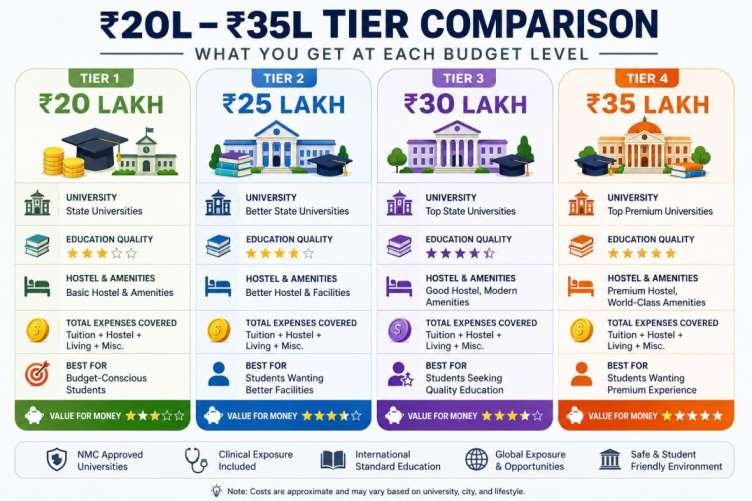
What Should Be Included in Your MBBS in Russia Budget?
Before comparing ₹20L against ₹35L, it helps to separate the pieces that get lumped together under "MBBS fees." Two families can both say they're planning for "₹25 lakh MBBS in Russia" and mean completely different things.
| Cost Component | Paid To | Fixed or Variable |
|---|---|---|
| Tuition Fee | University | Mostly fixed (in RUB), variable in INR |
| Hostel Fee | University | Mostly fixed |
| Food (beyond mess) | Self / local vendors | Variable |
| Visa & Documentation | Consulate / agents | Mostly fixed, recurring for renewals |
| Medical Insurance | Insurer (often university-facilitated) | Fixed annually |
| Flights | Airline | Variable, seasonal |
| Local Transportation | Self | Variable |
| Study/Academic Materials | Self | Variable, mostly one-time |
| Personal Expenses | Self | Variable |
| Emergency / Exchange-Rate Buffer | Self | Should be planned, often skipped |
The tuition + hostel fee is what most quoted "MBBS in Russia fees" figures represent. It is the largest single component, but for a family, it is not the total cost — it's the base on which everything else sits.
The Real Currency Problem: Why "Exact" INR Figures Are Misleading
Russian university tuition is typically billed in Rubles (RUB), not INR. As of early August 2026, the RUB–INR exchange rate has been trading roughly in the ₹1.15–₹1.25 per RUB range depending on the source and the day, and has moved meaningfully over the course of 2026. That's not a rounding error — on a ₹4 lakh annual tuition bill, a 5% currency swing changes your payment by roughly ₹20,000 in a single year, and by ₹1.2 lakh or more across six years.
For this reason, this guide avoids false precision. Where a figure is converted from RUB, treat it as approximate, based on rates available at the time of research (early August 2026) — not a number your bank will guarantee you next year. Build in a currency buffer; don't spend right up to your last rupee of "planned" budget.
MBBS in Russia With a ₹20 Lakh Budget: Is It Realistic?
Direct answer: As a complete, all-inclusive six-year family budget, ₹20 lakh is tight and, for most students, not fully realistic once food, travel, insurance, and currency movement are honestly accounted for. As a tuition-plus-hostel package at the most affordable regional universities, it can be close, but usually still leaves little to no cushion.
Here's why. Even at the lower end of Russia's fee-table (regional universities charging roughly 3.2–3.8 lakh RUB per year in tuition), six years of tuition alone works out to approximately ₹23–28 lakh at current exchange rates — before hostel, food, insurance, travel, or documentation are added. Some university-specific quotes circulating online (including older marketing figures) suggest six-year totals closer to ₹19–22 lakh; where our own research found meaningful gaps between a university's per-year RUB fee (as listed in official fee structures) and the "total package" figure sometimes quoted in promotional material, families should treat this as a flag to verify directly — not as evidence the lower number is correct.
What a genuine ₹20L plan usually requires:
- Choosing among the most affordable NMC-approved regional universities
- Living frugally within hostel-and-mess arrangements, with minimal discretionary spending
- Fewer trips home during the six years
- Accepting little to no exchange-rate cushion, which is financially risky over a six-year horizon
If ₹20 lakh is genuinely your ceiling, the honest move is to ask for an itemized, university-confirmed fee quote (not a rounded consultant estimate) before committing, and to have a realistic conversation about what gets cut if the rupee weakens against the ruble mid-course.
What Can a ₹25 Lakh MBBS in Russia Budget Get You?
Direct answer: ₹25 lakh comfortably covers tuition and hostel at several affordable regional universities, with a modest amount left for living costs — but it still requires disciplined monthly budgeting and offers a thin buffer for currency swings or emergencies.
At this level, families are typically choosing from Russia's more budget-conscious regional universities rather than premium-city institutions. Based on the university's own fee structure (tuition in the roughly 3.2–4 lakh RUB/year range), ₹25 lakh can realistically stretch to cover tuition and hostel for the six-year program at several such universities, with somewhere between ₹0 and ₹5–6 lakh remaining across six years for food beyond mess, visa renewals, insurance, and travel — which is workable but leaves very little room for the unexpected.
What to keep in mind at ₹25L:
- This is very much a "university cost + basic living" budget, not an all-inclusive one
- Extra flights home, elective travel, or a weak rupee year can push actual spend above plan
- It's worth asking your shortlisted university for a documented, current fee circular rather than relying on an older quoted range
What Can a ₹30 Lakh MBBS in Russia Budget Get You?
Direct answer: ₹30 lakh opens up a wider set of NMC-approved universities, including some mid-tier options beyond the cheapest regional colleges, and gives most families a genuine buffer for living costs, insurance, and moderate currency movement across the six years.
At this level, the budget conversation changes. Instead of asking "can we afford tuition," families can start asking "which university and city fit us best," because tuition-plus-hostel across a meaningfully wider range of universities fits inside ₹30 lakh, leaving roughly ₹5–8 lakh for the rest — living costs, visa renewals, insurance, one or two flights home per year, and a real (not theoretical) currency buffer.
Cost ≠ quality here. A ₹30 lakh budget doesn't automatically mean a "better" university than a ₹25 lakh one — it means more choice and more breathing room, including the option to pick a university based on FMGE/NExT track record, city, and student support rather than purely on what's cheapest.
What Can a ₹35 Lakh MBBS in Russia Budget Get You?
Direct answer: ₹35 lakh provides genuine financial flexibility — access to a broader range of universities including some higher-fee institutions, a comfortable living-cost allowance, and a meaningful cushion against currency swings and unplanned expenses — but it does not mean the "best" MBBS outcome. That still depends on the university's academic quality, NMC compliance, and FMGE/NExT track record, not the size of the family's budget.
At this level, families typically have room to prioritise factors beyond raw affordability: city safety, hostel quality, an established Indian student community, or a university's historical licensing-exam performance. It's also enough to comfortably absorb a difficult currency year without derailing the six-year plan.
Important distinction: a ₹35L university is not inherently "better" than a ₹25L one. Some of the most expensive Russian universities for international students (for instance, premier Moscow-based institutions) sit well above this range entirely and are a different conversation altogether — this guide focuses on the realistic affordable-to-mid-range band most Indian NEET-qualified students actually compare.
₹20L vs ₹25L vs ₹30L vs ₹35L: Quick Comparison
| Budget | Tuition/University Cost Flexibility | Living Cost Coverage | Buffer for Currency/Emergencies | What Parents Should Know |
|---|---|---|---|---|
| ₹20L | Limited to the most affordable regional universities; may require careful verification of quoted totals | Minimal — largely mess-dependent, few extras | Little to none | Realistic mainly as a bare tuition+hostel plan; verify every figure before committing |
| ₹25L | Several affordable NMC-approved universities fit | Basic — covers essentials with limited extras | Thin | Workable with disciplined monthly budgeting; ask for documented fee circulars |
| ₹30L | Wider mid-range university choice | Comfortable for standard living | Reasonable | Enough room to choose university on factors beyond price alone |
| ₹35L | Broadest choice within the affordable-to-mid-range band | Comfortable, with room for extras | Strong | Financial flexibility, not automatically "better" education |
Figures depend heavily on the specific university, city, and prevailing RUB–INR exchange rate. Treat this table as a planning aid, not a guarantee.
Which Russian Medical Universities Fit Different Budgets?
Rather than repeating the complete university-wise fee table — which you'll find in full on our complete MBBS in Russia fees and university guide — here's how a few commonly asked-about universities tend to fit into the budget conversation, based on their currently listed annual tuition.
- Altai State Medical University — Among the more affordable options in the fee structure, with annual tuition in the low-RUB-lakh range. Tends to fit within the ₹25L–₹30L band once hostel and basic living are factored in, though we noted a gap between the per-year fee-table figure and some promotional "total cost" figures — confirm directly before finalizing.
- Kirov State Medical University — Similarly positioned among the affordable-to-mid-range universities; fits comfortably within a ₹25L–₹30L planning band for tuition and hostel.
- Ulyanovsk State University — One of the lower-tuition options in the fee structure; often discussed in the ₹20L–₹25L conversation, though — as above — the exact six-year total should be confirmed against a current, official fee circular rather than an older quoted range.
- Yaroslavl State Medical University — Sits slightly higher in the fee structure; typically a ₹25L–₹30L consideration once hostel and living costs are included.
- Chita State Medical Academy — One of the more budget-friendly universities in the fee structure; among the closer options to a ₹20L–₹25L tuition-plus-hostel plan, though still worth verifying against current official figures.
None of this replaces a university-issued, dated fee confirmation. Consultant-quoted "total cost" ranges can lag behind actual current fee circulars, and currency conversions age quickly — always ask for the latest official number before you commit funds.
10 Costs Students Often Forget When Planning MBBS in Russia
These aren't hidden fees in the sense of anything being concealed — they're simply costs that live outside the university's fee receipt, so they're easy to leave out of a mental budget.
- Currency fluctuation across six years of RUB payments
- Annual flights home (or lack of them, if budget doesn't allow)
- Visa renewal fees, which recur yearly, not just at admission
- Medical insurance, mandatory and paid annually
- Food beyond the university mess, especially in later years if living independently
- Local transport within the city
- Winter clothing and setup costs, particularly in colder regions
- SIM card, internet, and communication costs
- Study materials and, in some cases, optional exam-prep support
- A genuine emergency fund — medical, travel, or otherwise — that isn't quietly assumed to come from "somewhere"
None of these individually breaks a budget. Together, unplanned, they can add up to a meaningful percentage of what a family originally set aside.
Pre-Departure vs Annual vs Variable Costs
| Expense | Before Departure | Recurring/Annual | Variable |
|---|---|---|---|
| Tuition (Year 1) | ✔ | — | — |
| Tuition (Years 2–6) | — | ✔ | Currency-dependent |
| Hostel Fee | Often with Year 1 tuition | ✔ | — |
| Visa (Initial) | ✔ | — | — |
| Visa Renewal | — | ✔ | — |
| Medical Insurance | Sometimes Year 1 | ✔ | — |
| Flights | ✔ (arrival) | Optional, if visiting home | Seasonal pricing |
| Winter Clothing | ✔ | Occasional top-up | — |
| Documentation/Apostille/Translation | ✔ | — | — |
| Food & Personal Expenses | — | Ongoing monthly | ✔ |
This timing view matters as much as the total number — a family that has ₹30 lakh "eventually available" but needs a large lump sum before departure (first-year tuition, hostel, visa, documentation, flights, winter setup) may need to plan cash flow, not just total savings.
How Currency Changes Can Affect Your Russia MBBS Budget
This isn't about predicting where the rupee or the ruble will go — no one can responsibly do that. It's about planning for the fact that it will move.
If your six-year tuition commitment is fixed in RUB, a stronger ruble (or weaker rupee) means each year's INR payment can be higher than the year before, even though the RUB amount hasn't changed. Over six years, this is one of the most common reasons families end up spending more than their original plan — not because of any hidden fee, but because they budgeted using one year's exchange rate and paid across six.
A reasonable approach: build a currency buffer of at least 8–10% on top of your calculated total, and revisit your remaining-years' budget in INR terms at least once a year rather than assuming the number you calculated at admission will hold for six years.
Should You Choose the Cheapest Medical University in Russia?
Not necessarily.
It's tempting to treat budget as the only variable, especially once a family has a number in mind. But university selection should weigh several factors together:
- Academic program structure and clinical exposure
- Course duration and NMC compliance
- Medium of instruction and quality of English-medium delivery
- Hostel standards and safety
- FMGE/NExT track record (available on our main Russia guide)
- Location, climate, and student support
- Total cost — as one factor among these, not the only one
A university that's ₹3–5 lakh cheaper over six years isn't automatically the better financial decision if it comes with weaker clinical exposure or a lower FMGE/NExT pass rate, since that can translate into additional coaching or repeat-attempt costs after graduation.
Parent Checklist Before Finalizing an MBBS in Russia Budget
☐ Complete tuition schedule obtained (all 6 years, not just Year 1) ☐ Hostel cost checked separately from tuition ☐ Fee currency (RUB/USD) and conversion basis understood ☐ Current INR conversion confirmed, not an old estimate ☐ Monthly food and personal expenses estimated realistically ☐ Annual travel budget included ☐ Medical insurance cost factored in ☐ Visa and documentation costs (including renewals) considered ☐ Emergency/currency buffer maintained (8–10% minimum) ☐ Refund/cancellation policy read before paying any advance ☐ Whether annual fee revisions are possible checked with the university ☐ NMC eligibility and course-duration compliance verified
Save this list — it's more useful at the admission-offer stage than any single "total cost" figure.
MBBS in Russia vs Private MBBS in India: How Should Families Compare Cost?
The comparison that actually matters is total-to-total, not "Russia's tuition vs India's total fee."
Private medical colleges in India can run into the ₹80 lakh to over ₹1 crore range for the complete course, depending on the institution and state, often before accounting for hostel, coaching, or donation-linked costs in some cases. Against that backdrop, even a fully loaded Russia budget — tuition, hostel, living, travel, insurance, and buffer — tends to land meaningfully lower for most affordable-to-mid-range universities.
That said, this comparison should be made using your own complete, verified numbers on both sides — not a rounded "Russia is cheap" headline against a rounded "India is expensive" headline. Request full-course cost breakdowns from any Indian private college under consideration, the same way you would from a Russian university.
Budget Shouldn't Be the Only Factor: Check NMC Requirements Too
A university fitting your budget doesn't automatically mean it fits National Medical Commission requirements for foreign medical graduates — course duration, internship structure, and medium of instruction all matter for your eligibility to sit for the FMGE/NExT licensing exam in India.
A cheaper university that doesn't clearly meet current NMC guidelines isn't a good financial decision, regardless of the number on the fee receipt — it risks the entire investment. Always cross-check a shortlisted university's NMC status independently, not just through a consultant's assurance.
How PSP Education Helps Families Plan an MBBS in Russia Budget
Once you have a realistic sense of what your budget tier actually covers, the next step is usually turning that into a specific university shortlist and a documented, itemized cost plan.
PSP Education works with families through this planning process — helping map your available budget against current university tuition and hostel costs, expected living expenses, admission-related charges, and full six-year financial planning, along with documentation, visa guidance, and travel and hostel arrangements once a university is finalized.
We don't promise a fixed "guaranteed" total, because food, flights, exchange rates, and personal spending genuinely vary by student and family. What we do commit to is transparency — a clear breakdown of what's paid to the university versus what the family manages separately, so there are no surprises three years into the course.
If you'd like help turning your specific NEET score, preferred university type, and available budget into a realistic six-year plan, our counsellors are happy to walk through it with you.
Get a Free Budget Assessment — based on your NEET status, budget, and preferred university.
Frequently Asked Questions
What is the total budget for MBBS in Russia?
University-paid tuition and hostel for NMC-approved universities commonly range from approximately ₹25 lakh to ₹40 lakh for the full six-year program. A complete family budget — including food, travel, insurance, and a currency buffer — is typically higher than the tuition-only figure quoted in brochures.
Can I complete MBBS in Russia under ₹20 lakh?
It's difficult as a fully inclusive six-year budget once food, insurance, travel, and currency movement are honestly included. It may be closer to realistic as a bare tuition-plus-hostel figure at the most affordable universities, but with little to no financial cushion.
Is ₹25 lakh enough for MBBS in Russia?
₹25 lakh can cover tuition and hostel at several affordable regional universities, with a modest amount for living costs — but it requires disciplined monthly budgeting and leaves a thin buffer for currency changes or emergencies.
Is ₹30 lakh a realistic budget for MBBS in Russia?
Yes, for most affordable-to-mid-range NMC-approved universities. ₹30 lakh typically covers tuition, hostel, and living costs with a reasonable buffer, and opens up more university choice than ₹20–25 lakh.
What does MBBS in Russia fee typically include?
University-charged fees usually cover tuition and hostel accommodation. Food beyond the mess, insurance, visa costs, travel, and personal expenses are typically arranged and paid separately by the student or family.
Are hostel fees included in Russia MBBS fees?
In most published fee structures, hostel is either bundled into the "total fee" figure or billed as a clearly separate, predictable annual charge — always confirm which applies for your shortlisted university.
What are the additional expenses for MBBS in Russia?
Food beyond mess, local transport, visa renewals, medical insurance, flights, winter clothing, communication costs, and an emergency/currency buffer are the most commonly overlooked additional expenses.
Does the Russia MBBS fee change because of exchange rates?
Yes. Tuition is typically fixed in Rubles, so the INR amount you pay can vary year to year based on the prevailing RUB–INR exchange rate, even though the Ruble figure itself hasn't changed.
Which Russian medical university is affordable for Indian students?
Several regional universities — including Chita State Medical Academy, Ulyanovsk State University, Altai State Medical University, and Kirov State Medical University — are positioned toward the more affordable end of the fee structure. Exact fit depends on current, official fee confirmation.
How much money should parents keep as an extra buffer?
A minimum of 8–10% above your calculated total, specifically to absorb currency movement and unplanned costs across the six-year program, is a reasonable planning benchmark.
This guide is based on publicly available university fee structures, NMC guidelines, and currency data researched in early August 2026. Fees, exchange rates, and regulations can change — always confirm current figures directly with the university or with PSP Education before making any payment.